


Digital Fleet Analytics Market size
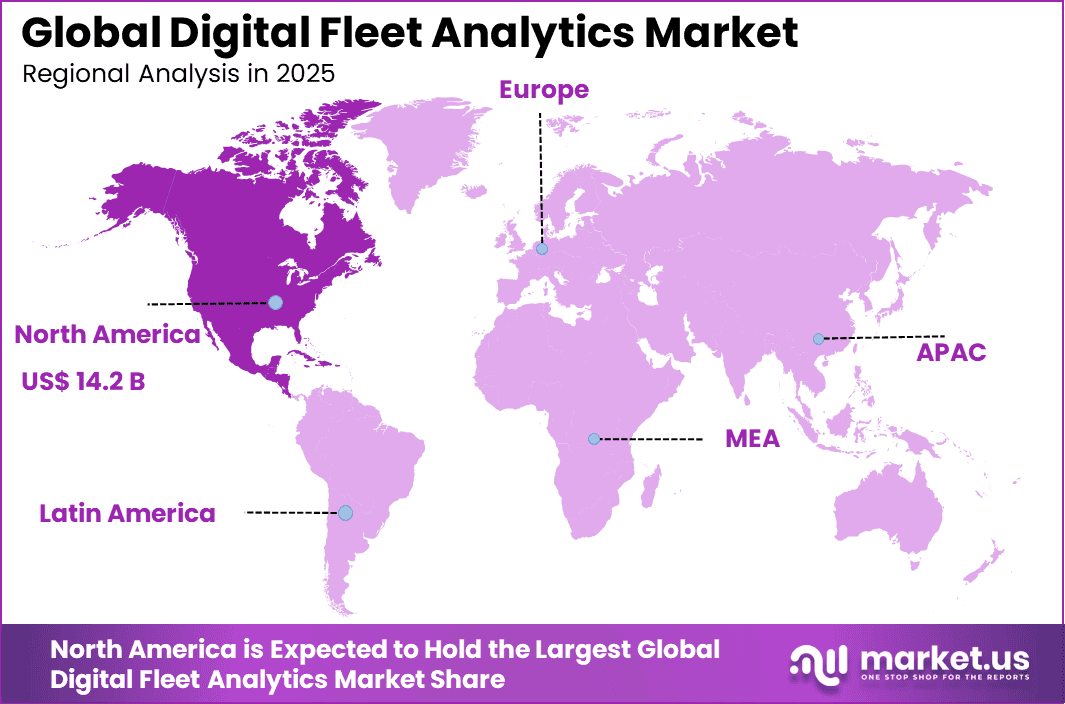
The Global Digital Fleet Analytics Market size is expected to be worth around USD 201 Billion By 2035, from USD 35.6 billion in 2025, growing at a CAGR of 18.9% during the forecast period from 2026 to 2035. North America held a dominant Market position, capturing more than a 40% share, holding USD 14.2 Billion revenue.
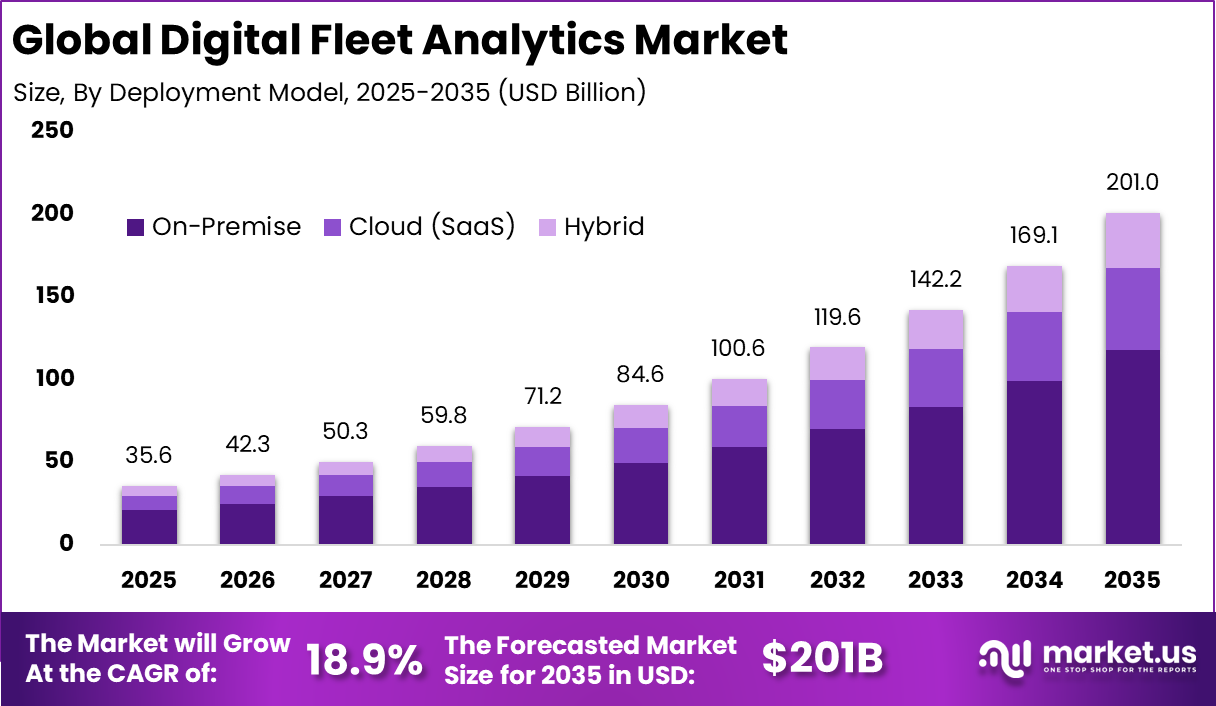
Top Market Takeaways
- On premise deployment accounts for 58.6% reflecting preference for internal data control
- Asset and vehicle tracking leads with 35.6% as core analytics functionality
- Light commercial vehicles under 3.5 tons represent 38.5% of adoption
- Fleets with 50 to 199 vehicles contribute 39.4% due to structured operational needs
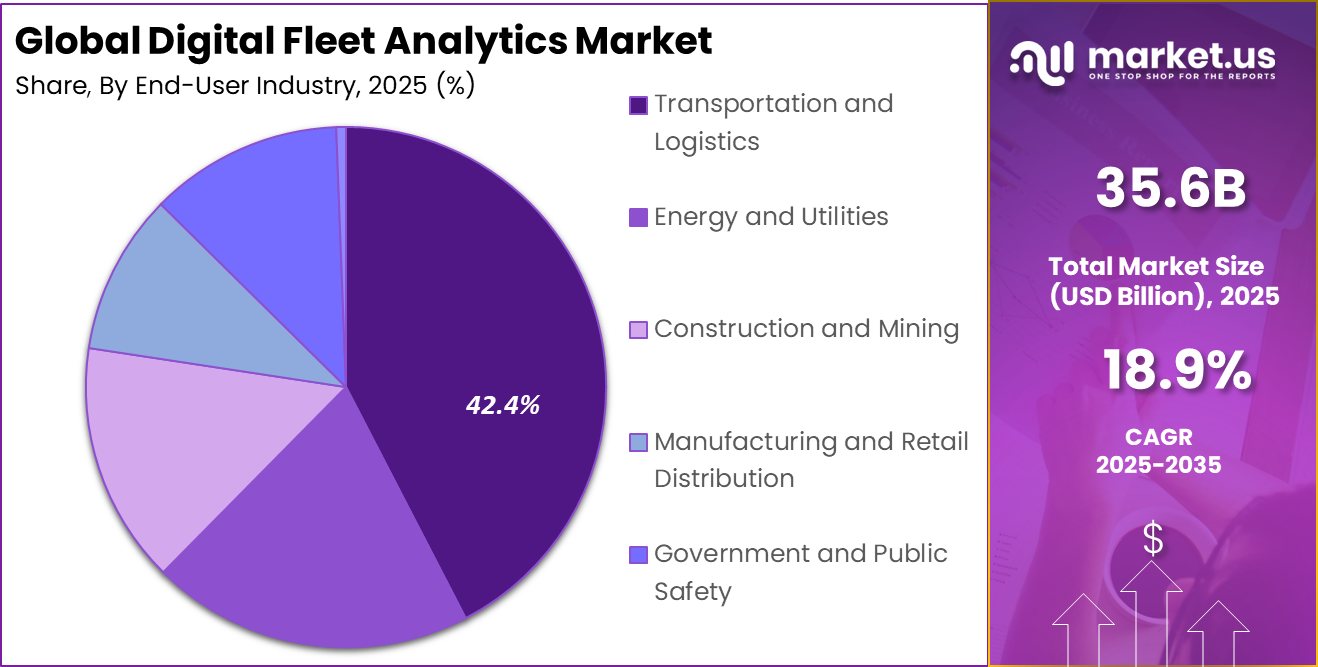
- Transportation and logistics dominates with 42.4% as digital optimization becomes essential
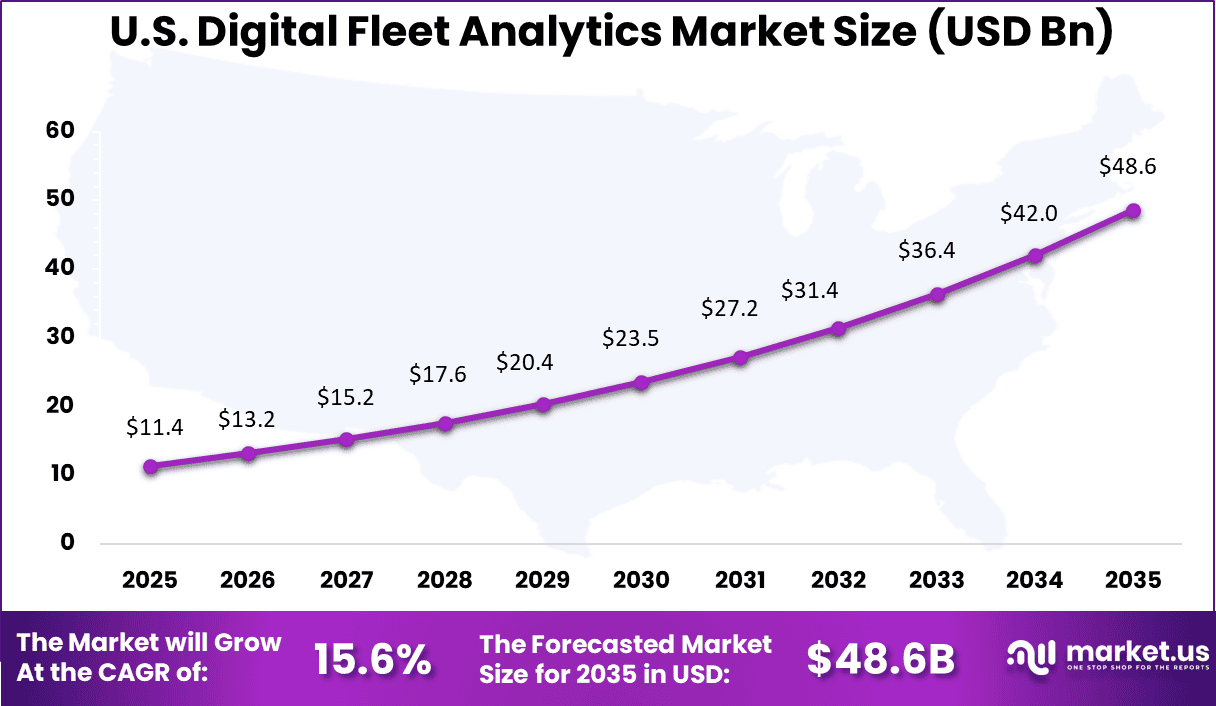
- North America holds 40.0% with the United States driving expansion at a CAGR of 15.6%
Key Statistics and Benchmarks
- Around 74% of fleet operators monitor vehicle location, while 66% track Hours of Service (HOS) using telematics systems. However, only 23% leverage big data analytics for long-term strategic planning and performance optimization.
- Telematics adoption has strengthened safety management, with 32% of companies actively monitoring driver behavior, 26% implementing speed prevention controls, and 30% reporting measurable reductions in driver fatigue incidents.
- Inefficient routing and prolonged idling contribute to 5% to 10% excess fuel consumption, directly increasing operational costs and reducing overall fleet productivity.
- Digital fleet management tools support predictive maintenance and performance monitoring, helping reduce maintenance-related breakdowns and mitigate the 13% of road accidents linked to driver fatigue.
Report Overview
The Digital Fleet Analytics Market refers to software and analytical solutions that collect, process, and interpret data from vehicles and fleet operations to support decision making and performance improvement. These solutions integrate telematics, location data, sensor information, and historical records to present insights on vehicle utilization, driver behaviour, fuel consumption, route efficiency, and maintenance needs.
Digital fleet analytics helps organizations manage fleets with greater visibility, efficiency, and accountability. As commercial fleets grow and operational complexity increases, analytics capabilities have become central to optimized fleet management strategies. The market has expanded in response to growing demand for operational efficiency and cost control in transportation, logistics, delivery services, and public sector mobility.
Traditional fleet management methods rely heavily on manual data collection, which is time consuming and prone to inaccuracies. Digital analytics platforms automate data aggregation and provide real time dashboards, predictive reports, and actionable alerts that support proactive decision making. This shift toward data driven fleet management reflects broader trends in digital transformation and performance optimization across industries.
By Deployment Model
On premise deployment holds 58.6% as fleet operators prioritize control over telematics data and operational analytics. Many transport companies manage sensitive route information, fuel consumption records, and driver behavior data that they prefer to store internally. This approach allows direct oversight of infrastructure, security protocols, and system configuration.
Operational continuity is another factor behind on premise preference. Fleet systems often integrate with dispatch platforms, maintenance software, and enterprise accounting systems. Maintaining these integrations within an internal environment reduces external dependency and supports predictable performance.
Compliance requirements also influence deployment decisions. In regulated transportation sectors, companies must retain historical tracking data and maintain strict access logs. On premise infrastructure provides confidence in meeting audit and reporting obligations.
By Solution Type
Asset and vehicle tracking leads with 35.6% because location visibility forms the foundation of fleet analytics. Real time GPS tracking enables route optimization, theft prevention, and fuel efficiency management. Without accurate tracking data, advanced analytics models cannot function effectively.
Fleet managers use tracking systems to monitor idle time, driving patterns, and route deviations. These insights directly impact operating cost reduction and service reliability. Over time, tracking platforms evolve into predictive analytics tools that support maintenance planning and risk mitigation.
The growth of telematics devices has strengthened this segment. Sensors installed in vehicles capture engine performance, braking behavior, and mileage patterns. Analytics platforms convert this information into actionable performance indicators.
By Vehicle Type
Light commercial vehicles under 3.5 tons account for 38.5% of adoption because they dominate last mile and urban delivery operations. The rapid expansion of e commerce has increased the use of vans and small delivery trucks in metropolitan areas. These vehicles generate high frequency operational data that benefits from continuous analytics.
Smaller vehicles typically operate in dense traffic conditions where route efficiency significantly impacts cost and delivery time. Digital fleet analytics helps reduce fuel consumption and improve schedule adherence. As urban logistics networks expand, monitoring these vehicles becomes critical.
Fleet safety is another consideration. Light commercial vehicles often travel long hours across varied routes. Monitoring driver behavior and vehicle health improves compliance and reduces accident risk.
By Fleet Size
Fleets operating between 50 and 199 vehicles represent 39.4% because they reach a scale where manual oversight becomes inefficient. At this size, operators require structured reporting, centralized dashboards, and automated maintenance alerts. Digital analytics solutions provide visibility that supports strategic decision making.
Mid sized fleets often compete with larger enterprises while managing tighter margins. Analytics tools help optimize fuel usage, reduce downtime, and control repair expenses. These cost improvements directly influence profitability.
Technology adoption in this segment is driven by the need to professionalize operations. As fleets grow, compliance requirements and insurance conditions become more stringent. Digital systems help document operational discipline and improve transparency.
By End User Industry
Transportation and logistics leads with 42.4% due to the central role of fleet operations in supply chain efficiency. Delivery timelines, cargo safety, and cost control depend heavily on vehicle performance and route planning. Digital analytics platforms strengthen coordination between dispatch centers and drivers.
In logistics environments, predictive maintenance reduces unexpected breakdowns that disrupt shipments. Fleet managers rely on data driven alerts to schedule servicing and avoid delays. This improves customer satisfaction and operational reliability.
The sector also faces pressure to reduce fuel consumption and emissions. Analytics systems provide measurable indicators of performance improvements. Environmental monitoring has become part of broader sustainability reporting in transport operations.
Regional Analysis
North America accounts for 40.0% of the digital fleet analytics market due to advanced telematics infrastructure and strong adoption of connected vehicle technologies. Enterprises in the region have invested in real time monitoring and automated reporting systems. This technological maturity supports continuous innovation in fleet optimization.
The United States represents the largest contributor within the region, driven by expansive logistics networks and high commercial vehicle density. The projected CAGR of 15.6% reflects sustained investment in route efficiency, safety compliance, and predictive analytics capabilities. Fleet modernization initiatives continue to expand across public and private sectors.
Regulatory frameworks related to electronic logging devices and driver safety standards have further encouraged analytics deployment. Companies require accurate data collection and storage to meet compliance obligations. Digital fleet analytics platforms simplify documentation and reporting processes.
Emerging Trends Analysis
A major trend in the digital fleet analytics market is the integration of artificial intelligence for predictive insights. Machine learning models analyze driving patterns, traffic conditions, and maintenance histories to forecast operational risks. This shift from reactive monitoring to predictive planning improves asset utilization.
Another trend is the expansion of connected vehicle ecosystems. IoT devices, onboard diagnostics systems, and cloud platforms are being combined to create unified analytics environments. Real time communication between vehicles and central systems strengthens decision speed and operational control.
Key Market Segments
By Deployment Model
- On-Premise
- Cloud (SaaS)
- Hybrid
By Solution Type
- Asset / Vehicle Tracking
- Driver Management and Safety
- Operations and Dispatch
- Fuel and Route Optimization
- Compliance and Risk
- Analytics and Reporting
- Others
By Vehicle Type
- Light Commercial Vehicles (less than 3.5 t)
- Heavy Trucks (above 3.5 t)
- Buses and Coaches
- Trailers / Semi-trailers
- Off-highway and Construction Equipment
By Fleet Size
- less than 50 Vehicles
- 50-199 Vehicles
- 200-999 Vehicles
- above or equal to 1,000 Vehicles
By End-User Industry
- Transportation and Logistics
- Energy and Utilities
- Construction and Mining
- Manufacturing and Retail Distribution
- Government and Public Safety
- Other End-User Industry’s (Rental, Waste Mgmt, etc.)
Regional Analysis and Coverage
- North America
- US
- Canada
- Europe
- Germany
- France
- The UK
- Spain
- Italy
- Russia
- Netherlands
- Rest of Europe
- Asia Pacific
- China
- Japan
- South Korea
- India
- Australia
- Singapore
- Thailand
- Vietnam
- Rest of Latin America
- Latin America
- Brazil
- Mexico
- Rest of Latin America
- Middle East & Africa
- South Africa
- Saudi Arabia
- UAE
- Rest of MEA
Driver Analysis
The primary driver of market growth is the need to reduce operational costs. Fuel expenses, maintenance charges, and downtime significantly affect fleet profitability. Analytics solutions provide measurable improvements in efficiency and resource allocation.
Another driver is regulatory compliance. Transportation companies must document driver hours, vehicle condition, and route history. Digital analytics platforms simplify compliance management and reduce administrative burden.
Restraint Analysis
High initial implementation costs remain a restraint, particularly for smaller operators. Hardware installation, software licensing, and system integration require upfront investment. Some fleet managers delay adoption due to budget constraints.
Data privacy and cybersecurity concerns also create hesitation. Fleet systems collect sensitive operational and driver information. Protecting this data against unauthorized access requires strong security frameworks.
Opportunity Analysis
A significant opportunity exists in the electrification of fleets. Electric vehicles generate detailed performance data that can be analyzed for battery health and charging optimization. Digital analytics platforms are well positioned to support this transition.
Another opportunity lies in emerging markets where logistics infrastructure is modernizing rapidly. As fleet operators in developing regions adopt digital tools, demand for scalable analytics platforms is expected to expand.
Key Player Analysis
The competitive landscape includes major telecommunications and telematics providers such as AT&T Inc., Cisco Systems Inc., Geotab Inc., and Verizon Communications Inc. through its Verizon Connect division. These companies leverage connectivity infrastructure and cloud integration to deliver large scale fleet analytics platforms.
Specialized fleet technology providers including Trimble Inc., Omnitracs LLC, Samsara Inc., and MiX Telematics focus on advanced telematics and driver performance monitoring. Their strength lies in hardware integration combined with analytics software.
Additional participants such as TomTom N.V., Ctrack, Motive, Fleet Complete, Donlen, Azuga Inc., Chevin Fleet Solutions, Octo Telematics, Tenna LLC, Odoo SA, Fleetio, One Step GPS, Advance Tracking Technologies, and Astrata Group expand the competitive intensity through niche offerings and regional specialization. Collectively, the market is characterized by technology integration, analytics depth, and service scalability.
Top Key Players in the Market
- AT&T Inc.
- Cisco Systems Inc.
- Geotab Inc.
- Verizon Communications Inc. (Verizon Connect)
- Trimble Inc.
- Omnitracs LLC
- Samsara Inc.
- MiX Telematics
- TomTom N.V.
- Ctrack (Inseego)
- KeepTruckin (Motive)
- Fleet Complete
- Donlen (Hertz)
- Azuga Inc.
- Chevin Fleet Solutions
- Octo Telematics
- Tenna LLC
- Odoo SA
- Rarestep Inc. (Fleetio)
- One Step GPS
- Advance Tracking Technologies
- Astrata Group
- Others
Recent Developments
- In 2025, Motive (KeepTruckin) enhanced its dashboard with AI safety, ELD compliance and 5/5 integration ratings for Fleetio, focusing on accident prevention and spend management across trucking/logistics.
- In December 2025, Samsara ranked No. 1 in Fleet Management on G2 for all of 2025 and the first report of 2026, with top scores in 21 Grid Reports for AI dash cams, safety coaching, real-time insights and 99.99% uptime.









