


Report Overview
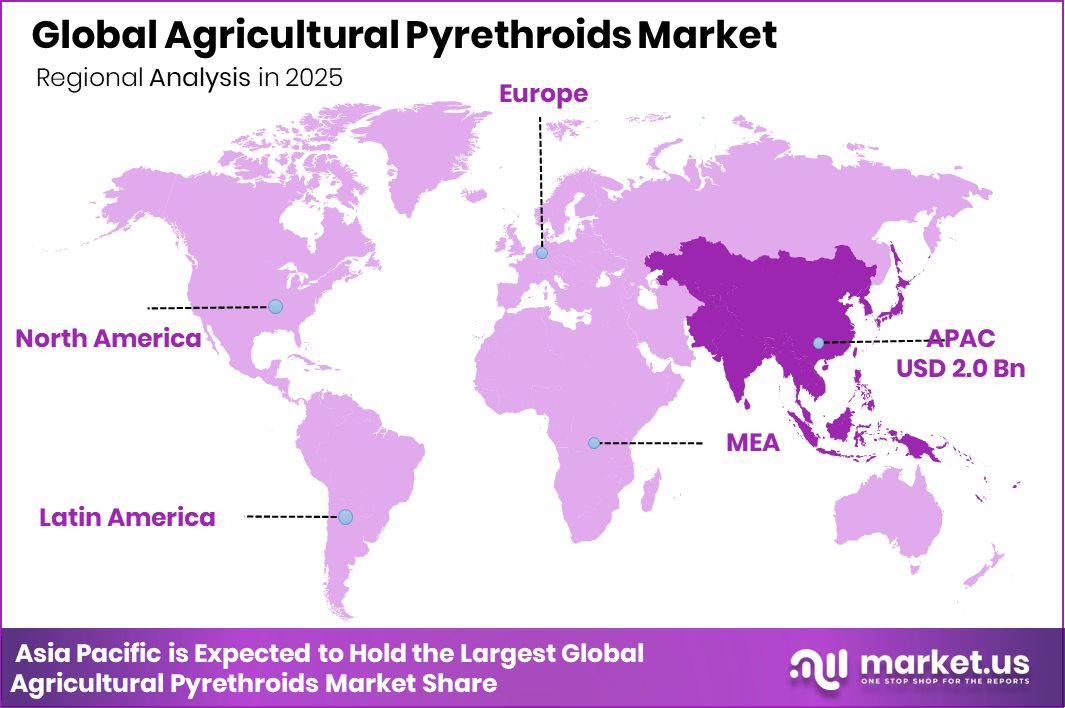
The Global Agricultural Pyrethroids Market is expected to be worth around USD 8.3 billion by 2035, up from USD 4.5 billion in 2025, and is projected to grow at a CAGR of 6.3% from 2026 to 2035. Asia Pacific maintains a 46.1% share and a USD 2.0 Bn value in pyrethroids.
Agricultural pyrethroids are synthetic insecticides designed to act quickly and provide strong protection against a wide range of crop-damaging pests. They are modeled from natural pyrethrins and are widely used because they work fast, require low doses, and fit easily into regular farm spraying practices. The Agricultural Pyrethroids Market represents the commercial landscape where these products are formulated, distributed, and adopted across different crop groups such as cereals, grains, fruits, vegetables, fiber crops, and oilseeds. The market also includes various formulations like emulsifiable concentrates, suspension concentrates, wettable powders, granules, and microencapsulated options that farmers select based on crop needs and field conditions.
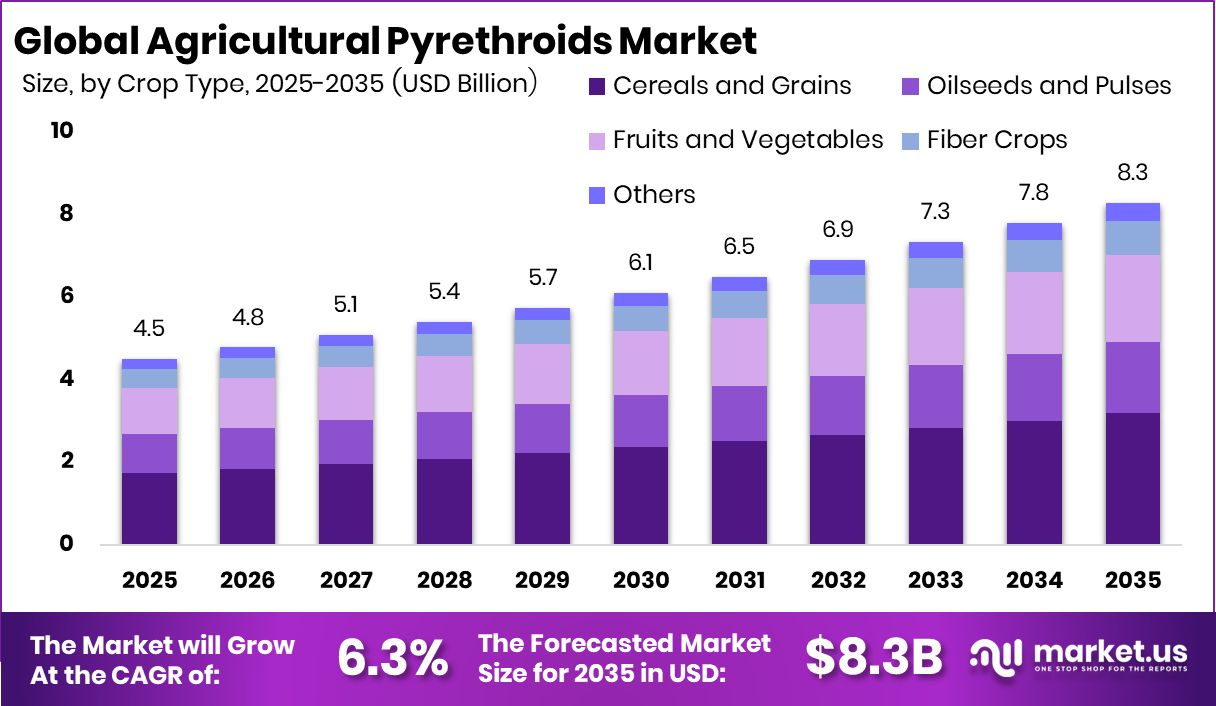
One key growth factor for this market is the rising pressure on global food systems. With a foodgrain production target of 341.55 MT for 2024–25, farmers rely on pyrethroids to avoid yield losses from fast-spreading insects. Strong demand also comes from the issue of post-harvest waste, where countries like India lose up to 16% of fresh produce, prompting growers to protect crops more aggressively at the farm level.
Opportunities are emerging as governments and agricultural bodies increase support for crop protection and productivity. The Manitoba Government’s $13-million investment in a downtown agriculture exchange and the USDA’s support for the $143B specialty crop export sector, along with $72.9M in Specialty Crop Block Grant funding, create a favorable environment for better crop management tools. These initiatives encourage farmers and agribusinesses to adopt reliable insect control solutions, positioning agricultural pyrethroids as an essential part of improving quality, reducing losses, and strengthening overall market competitiveness.
Key Takeaways
- The Global Agricultural Pyrethroids Market is expected to be worth around USD 8.3 billion by 2035, up from USD 4.5 billion in 2025, and is projected to grow at a CAGR of 6.3% from 2026 to 2035.
- The Agricultural Pyrethroids Market sees strong demand, with pyrethroids capturing 47.8% product share.
- Growing pesticide usage in cereals and grains drives 38.6% demand within the Agricultural Pyrethroids Market.
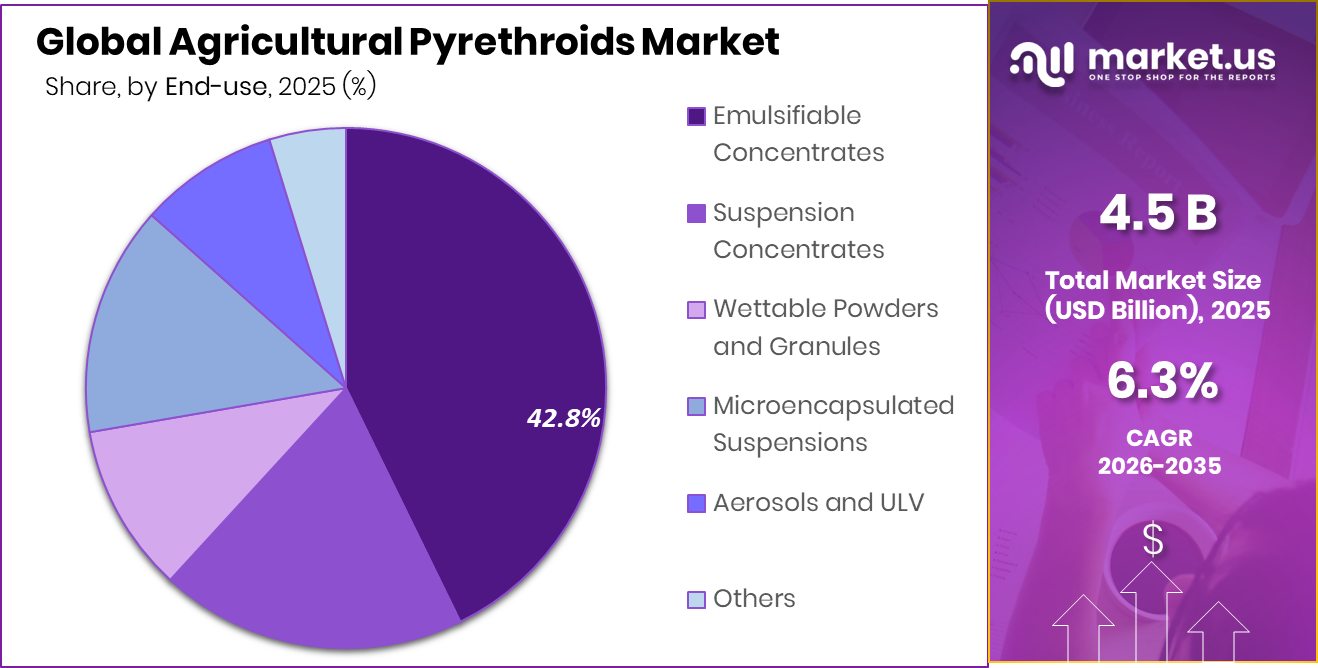
- Emulsifiable concentrates dominate formulations, holding 44.9% share across the expanding Agricultural Pyrethroids Market.
- The Asia Pacific Agricultural Pyrethroids Market value stands at USD 2.0 Bn, driven by crop protection needs.
By Product Type Analysis
The agricultural pyrethroids market sees strong dominance, with pyrethroids capturing 47.8% demand share.
In 2025, the Agricultural Pyrethroids Market is expected to strengthen its position as farmers continue choosing fast-acting synthetic insecticides to protect high-value crops. Within product categories, pyrethroids account for 47.8%, reflecting their reliability against a broad spectrum of pests and their compatibility with modern farm practices. Demand remains strong across developing agricultural economies, where crop losses from insects continue to impact farm income.
Farmers prefer pyrethroids because they deliver quick knockdown effects, require lower application volumes, and work well with mechanised spraying systems. As climate variability increases pest pressure, growers lean toward proven and cost-effective chemical solutions, keeping pyrethroids central to integrated pest management programs across global farmlands.
By Crop Type Analysis
Cereals and grains remain primary users, holding 38.6% market share globally.
In 2025, cereals and grains remain the leading crop group using agricultural pyrethroids, holding 38.6% market share. These crops, including rice, wheat, maize, and barley, face intense pest infestation risks, prompting growers to choose pyrethroids for dependable field protection. Rising global food demand pushes farmers to minimise yield losses and secure consistent harvest quality.
Because cereals and grains are cultivated on large acreages, the industry favours insecticides that can cover wide areas efficiently while maintaining residue compliance. Pyrethroids meet these needs with strong field performance, quick action, and affordability, making them indispensable in large-scale cereal crop protection strategies.
By Formulation Analysis
Emulsifiable concentrates lead formulations in the agricultural pyrethroids market with a 44.9% adoption rate.
In 2025, emulsifiable concentrates (EC) dominate the formulation segment of the Agricultural Pyrethroids Market with 44.9% share, mainly due to their ease of mixing, uniform spray coverage, and compatibility with widely used spraying equipment. Farmers prefer EC formulations because they disperse well in water, ensuring better adhesion on crop surfaces and improved pest control efficiency. Their convenience reduces operational time during peak seasons, especially in regions where rapid application is necessary to control sudden pest outbreaks.
As farming operations move toward more structured pesticide schedules, EC formulations continue to serve as a practical choice for both smallholders and commercial farms, supporting consistent application results across diverse climatic and soil conditions without altering existing field practices.
Key Market Segments
By Product Type
- Type | Pyrethroids
- Type II Pyrethroids
- Dual-Action Formulations
- Others
By Crop Type
- Cereals and Grains
- Oilseeds and Pulses
- Fruits and Vegetables
- Fiber Crops
- Others
By Formulation
- Emulsifiable Concentrates
- Suspension Concentrates
- Wettable Powders and Granules
- Microencapsulated Suspensions
- Aerosols and ULV
- Others
Driving Factors
Rising pest attacks increase pyrethroid demand
The Agricultural Pyrethroids Market continues to grow as rising pest attacks push farmers to rely on fast-acting insecticides that can prevent sudden yield losses across cereals, grains, and vegetable crops. This demand becomes more visible when food supply pressures increase, especially as support systems such as food banks respond to uncertainties like the USDA’s $1B funding cut, which has raised concerns about future food availability and affordability.
Farmers respond by protecting crops more aggressively, ensuring stable supply volumes reach markets. Pyrethroids, known for their quick action and broad pest coverage, fit well into this situation, helping growers sustain production while dealing with unpredictable pest cycles and changing climatic patterns.
Restraining Factors
Regulatory limits reduce product adoption
Despite strong demand, regulatory limits continue to reduce the adoption pace of agricultural pyrethroids, especially in regions with stricter crop protection norms. Restrictions on active ingredients, residue limits, and approval delays create hesitation among growers who must follow compliance rules.
At the same time, broader challenges in food assistance programs, such as Nevada’s consideration to spend $7.3M to keep women and infant food assistance active during shutdowns, highlight how sensitive food supply chains are. These pressures increase scrutiny on chemical inputs, pushing regulators to tighten oversight, which in turn slows market penetration of traditional pyrethroid products.
Growth Opportunity
Government farm investments expand applications
Opportunities emerge as governments and food-focused organizations invest in programs that strengthen crop availability and access. Increased support for farm development and community food systems drives interest in reliable pest-control solutions. For instance, the Partnership for a Healthier America is awarding $50,000 to Brighter Bites to boost fresh food access in Washington, D.C. schools demonstrates how stakeholders are seeking better supply consistency.
As fresh produce programs expand, growers have greater motivation to protect fruits and vegetables from pest damage, creating openings for pyrethroid use in diversified crop segments where loss prevention directly supports nutrition-focused initiatives.
Latest Trends
Shift toward advanced dual-action formulations
A major trend shaping the Agricultural Pyrethroids Market is the shift toward advanced dual-action formulations that offer improved efficacy with better field stability. These solutions support farmers who need dependable pest management while facing increasingly frequent pest surges.
At the same time, efforts to strengthen fresh produce consumption—such as Idaho elementary schools being eligible for $3 million in fruit and vegetable grants—reflect a growing focus on healthy food supply chains. As institutions encourage more fruit and vegetable intake, producers supplying these crops prioritize strong pest-control practices, reinforcing interest in innovative pyrethroid formulations suited for high-value horticulture.
Regional Analysis
Asia Pacific leads the agricultural pyrethroids market with 46.1%, reflecting strong regional demand.
The Agricultural Pyrethroids Market shows varied regional dynamics across North America, Europe, Asia Pacific, the Middle East & Africa, and Latin America, each influenced by crop patterns and pest management needs. North America demonstrates steady adoption as growers focus on maintaining yields in large-scale cereal and vegetable farming. Europe maintains a measured usage pattern due to stricter regulatory norms but continues relying on pyrethroids for essential field protection.
Asia Pacific remains the dominant regional market with a strong 46.1% share valued at USD 2.0 Bn, supported by extensive cultivation of cereals, grains, and high-intensity cropping cycles.
Latin America reflects a healthy uptake driven by vast soybean and maize acreage requiring consistent insect control. Meanwhile, the Middle East & Africa show rising demand as farmers work to protect crops in climate-sensitive regions.
Overall, Asia Pacific leads the global landscape, with its sizeable agricultural base and higher pest pressure reinforcing its position as the primary revenue-generating region for agricultural pyrethroid solutions.
Key Regions and Countries
- North America
- US
- Canada
- Europe
- Germany
- France
- The UK
- Spain
- Italy
- Rest of Europe
- Asia Pacific
- China
- Japan
- South Korea
- India
- Australia
- Rest of APAC
- Latin America
- Brazil
- Mexico
- Rest of Latin America
- Middle East & Africa
- GCC
- South Africa
- Rest of MEA
Key Players Analysis
BASF SE is expected to maintain a solid position in the global Agricultural Pyrethroids Market in 2025 due to its strong crop protection portfolio and long-standing expertise in synthetic chemistry. The company’s continued emphasis on formulating stable, high-performance pyrethroid products helps it serve large farming economies where pest pressure remains high. BASF’s integrated agricultural solutions, including pest control and crop enhancement technologies, enable it to provide consistent value to growers seeking dependable yield protection.
For Bayer AG, 2025 is shaping up to be a year of reinforced market presence supported by its strong global distribution network and its well-established insecticide platforms. Bayer’s commitment to offering effective field-ready solutions allows it to serve diverse crop segments, especially cereals and grains, where pyrethroids remain essential for managing widespread pest infestations. The company’s brand recognition and farmer trust further strengthen its position in competitive agricultural markets.
The Syngenta Group continues to act as a major contributor to the pyrethroids landscape through its focus on safeguarding crop productivity in high-intensity farming regions. In 2025, its portfolio alignment toward reliable and fast-acting insect control supports farmers dealing with increasingly unpredictable pest cycles. Syngenta’s technical guidance, field programs, and strong engagement with growers help ensure practical adoption of pyrethroid products, positioning the company as a key strategic player in sustaining global crop performance.
Top Key Players in the Market
- BASF SE
- Bayer AG
- Syngenta Group
- FMC Corporation
- UPL Ltd.
- Meghmani Organics Ltd (Meghmani Group)
- Mitsui Chemicals India Pvt. Ltd
- Pl Industries Limited
- Sumitomo Chemical Co., Ltd.
- Corteva Agriscience
Recent Developments
- In June 2025, Bayer introduced BICOTA, a new insecticide to help rice farmers control stem borer pests in the major rice-growing states of India. The product works quickly, provides long-lasting protection, and helps improve crop health and yields.
- In February 2025, BASF initiated regulatory filings and plans to launch Prexio Active, a new insecticide aimed at protecting rice crops from hopper pests in Asia-Pacific, with launch targeted during the 2025 kharif season. This supports farmers with durable pest control in rice farming.









