


Report Overview
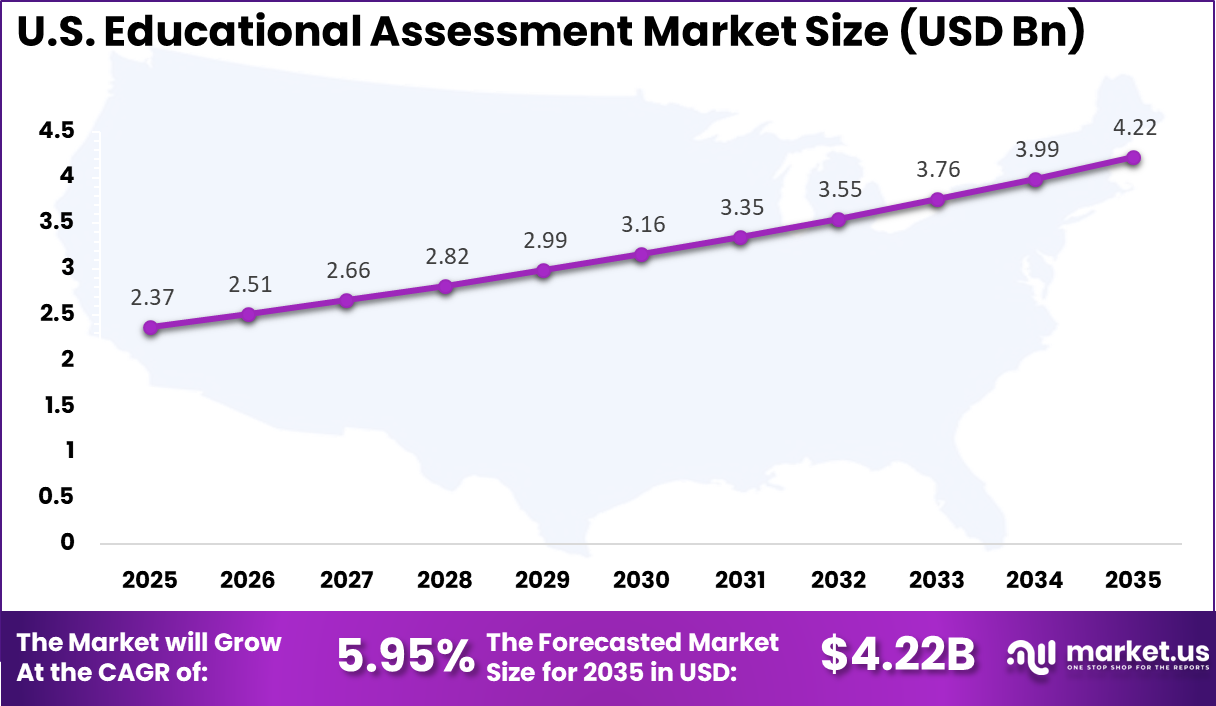
The Global Educational Assessment Market size is expected to be worth around USD 15.24 billion by 2035, from USD 7.26 billion in 2025, growing at a CAGR of 7.7% during the forecast period from 2025 to 2035. North America held a dominant market position, capturing more than a36.1% share, holding USD 2.62 billion in revenue.
The Educational Assessment Market refers to tools and solutions used to measure, evaluate, and report on learner performance, skills acquisition, and instructional outcomes across educational contexts. These solutions include standardized tests, digital assessment platforms, formative and summative evaluation tools, and analytics systems that support data driven insights. Assessments are used by schools, higher education institutions, training providers, and certification bodies to monitor progress and inform instructional strategy.
The market encompasses both paper based assessments and technology enabled platforms that deliver adaptive, interactive, and real time evaluation capabilities. Growth in this market has been driven by the increasing emphasis on measurable learning outcomes and accountability across education systems. Policymakers and educators are prioritising assessment as a way to identify achievement gaps, support personalised learning, and evaluate programme effectiveness.
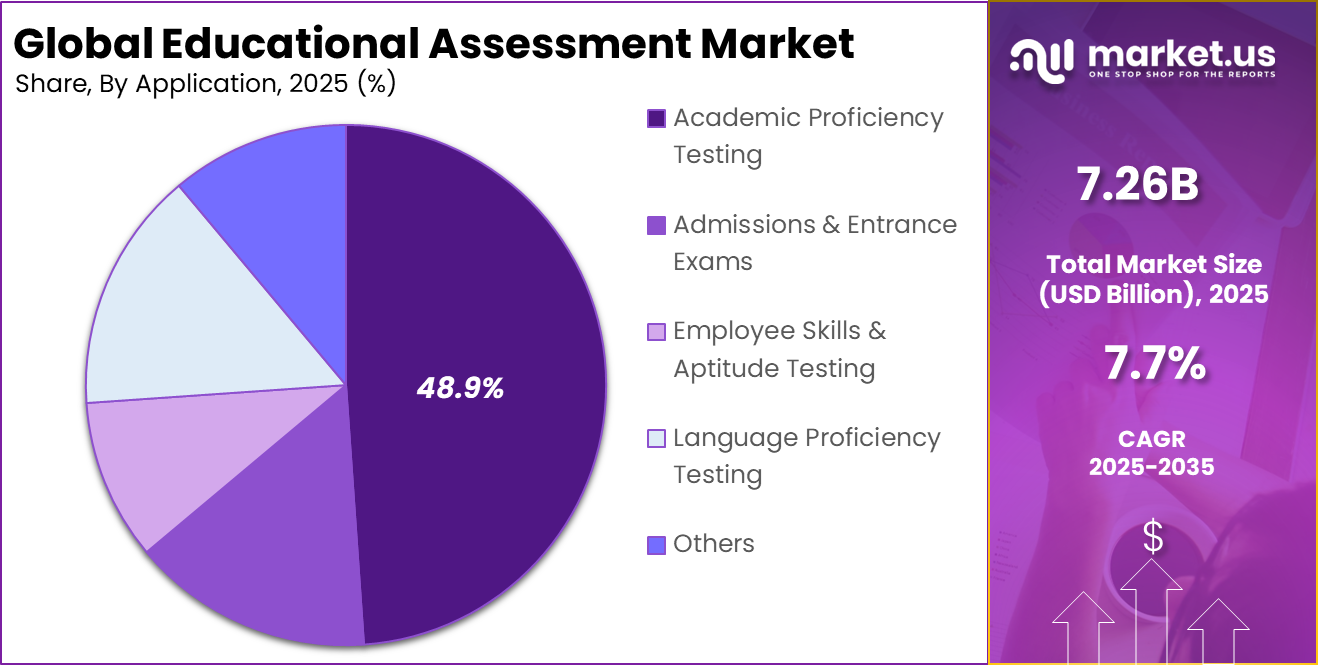
Advanced assessment software integrates analytics tools that provide real-time feedback on student outcomes. Educators can monitor learning gaps and adjust instruction strategies accordingly. Integration with learning management systems further enhances operational efficiency. As digital classrooms expand, software-based assessment tools continue to gain structural importance. For Instance, in June 2025, McGraw-Hill partners with Pearson to integrate advanced assessment software into its platforms. Teachers access state-aligned tests in 30 minutes via familiar online tools, cutting admin time. This boosts predictive insights for personalized learning, showing software’s role in streamlining K-12 workflows. Summative assessments represent 52.4% of the market, highlighting their role in measuring academic achievement at the end of instructional periods. Standardized examinations, final term tests, and certification evaluations fall within this category. Educational institutions rely on summative tools to evaluate overall competency and curriculum effectiveness. These assessments are often linked to academic progression and institutional benchmarking. Regulatory bodies and education boards frequently require structured summative testing frameworks. The emphasis on accountability and performance measurement sustains demand in this segment. Digital scoring systems enhance transparency and consistency in grading practices. As outcome-based education models expand, summative assessments remain central to formal evaluation processes. For instance, in May 2025, ETS overhauls TOEFL iBT with AI-driven adaptive summative testing and faster 72-hour scores. New CEFR-aligned bands simplify results for institutions. Home edition improvements and global prep resources ensure fairer end-of-test evaluations for millions of learners. Online and computer-based delivery holds 71.6% share, demonstrating the rapid transition from paper-based to digital examination systems. Schools and universities are increasingly implementing remote and in-class digital testing environments. This shift is supported by broader access to internet-connected devices. Digital delivery also enables adaptive testing and faster result processing. Computer-based assessments improve scalability for large student populations. Automated scoring reduces turnaround time and administrative burden. Enhanced security features such as remote proctoring further support digital examination integrity. As institutions continue investing in digital infrastructure, online delivery remains the preferred mode. For Instance, in April 2025, ACT rolls out enhanced online testing nationwide with bring-your-own-device options. The shorter format gives more time per question, starting with the national Saturday tests. This flexible computer-based shift preserves standards while increasing accessibility for students. Academic proficiency testing accounts for 48.9% of applications, reflecting the need to measure subject-level competency. These assessments evaluate student understanding in mathematics, language, science, and other core disciplines. Educational authorities use proficiency metrics to benchmark performance across districts and regions. The segment plays a critical role in maintaining curriculum standards. Proficiency assessments also guide targeted intervention programs for underperforming students. Data collected through testing supports personalized learning initiatives. Schools rely on structured evaluation frameworks to track academic progress over time. As learning outcomes remain a priority, proficiency testing continues to drive demand. For Instance, in July 2025, Renaissance Learning updates Star Assessments for back-to-school with new math proficiency field tests like Numeral Recognition 0-20. State-specific learning progressions align to standards, helping educators gauge core skills accurately in K-8. The Educational Assessment market is increasingly shaped by the transition from paper based examinations to digital and computer based testing platforms. Schools and higher education institutions are adopting online assessment systems that enable remote participation and automated grading. These platforms support real time performance tracking and reduce administrative burden. Another notable trend is the integration of adaptive assessment technologies powered by data analytics. Assessment tools are being designed to adjust question difficulty based on student responses. This approach enhances measurement accuracy and provides personalized evaluation pathways. Institutions are leveraging detailed performance analytics to inform curriculum planning and targeted intervention strategies. A primary driver of the Educational Assessment market is the increasing emphasis on measurable learning outcomes and accountability. Educational institutions are required to demonstrate academic performance through standardized testing frameworks. Digital assessment tools provide reliable data collection and reporting capabilities. This focus on performance benchmarking is accelerating adoption across K 12 and higher education segments. Another key driver is the expansion of online and hybrid learning models. Remote education environments require secure and scalable assessment solutions that ensure academic integrity. Institutions are investing in proctoring technologies and secure testing platforms to maintain evaluation standards. Growing digital infrastructure further supports this transition. One significant restraint in the Educational Assessment market is concerns related to data privacy and cybersecurity. Digital testing platforms process sensitive student information and performance data. Security breaches or unauthorized access can undermine institutional trust. Compliance with data protection regulations increases operational complexity. Another restraint involves disparities in digital infrastructure and device access. Not all educational institutions possess adequate connectivity or hardware to support large scale online testing. Uneven access may create inequities in assessment delivery. Infrastructure limitations can therefore slow full scale digital adoption. A major opportunity lies in the expansion of formative and competency based assessments. Institutions are increasingly focusing on continuous evaluation rather than single high stakes examinations. Digital platforms enable ongoing assessment and personalized feedback. This approach aligns with modern pedagogical models that emphasize skill development. Another opportunity exists in corporate training and professional certification programs. As workforce skill requirements evolve, organizations require structured assessment tools to validate competencies. Educational assessment providers can extend services beyond academic institutions into corporate learning environments. This diversification broadens long term growth potential. A primary challenge in the Educational Assessment market is ensuring academic integrity in digital testing environments. Preventing cheating and unauthorized collaboration requires advanced proctoring technologies and secure authentication systems. Balancing security with user convenience remains complex. Continuous system upgrades are necessary to address emerging threats. Another challenge involves maintaining fairness and inclusivity in assessment design. Standardized tests must accommodate diverse learning needs and cultural contexts. Bias in question formulation or algorithmic scoring can impact outcomes. Ensuring equitable evaluation frameworks is essential for sustained credibility and adoption. North America Europe Asia Pacific Latin America Middle East & Africa The educational assessment market is shaped by established global providers with broad portfolios and strong institutional relationships. Pearson plc, Educational Testing Service (ETS), and McGraw Hill, LLC maintain leadership through standardized testing, digital assessment platforms, and curriculum aligned tools. Their scale supports large scale deployments across K-12 and higher education segments. College Board and ACT, Inc. hold strong positions in college readiness and entrance examinations. Technology focused players are strengthening competition through adaptive and data driven solutions. Renaissance Learning, Inc., NWEA, and Cambium Assessment, Inc. emphasize formative assessment, benchmarking, and progress monitoring tools. Their platforms are widely used in K-12 schools to track student performance in real time. ExamSoft Worldwide, LLC and Questionmark Corporation provide secure online testing and remote proctoring solutions. Quality assurance and institutional accreditation providers also contribute to market depth. Cognia, Inc. and ETS Global B.V. expand international assessment and evaluation services. Illuminate Education, Inc. and TK20, Inc. focus on educator effectiveness, program evaluation, and data management systems. These companies support compliance, reporting, and performance improvement initiatives.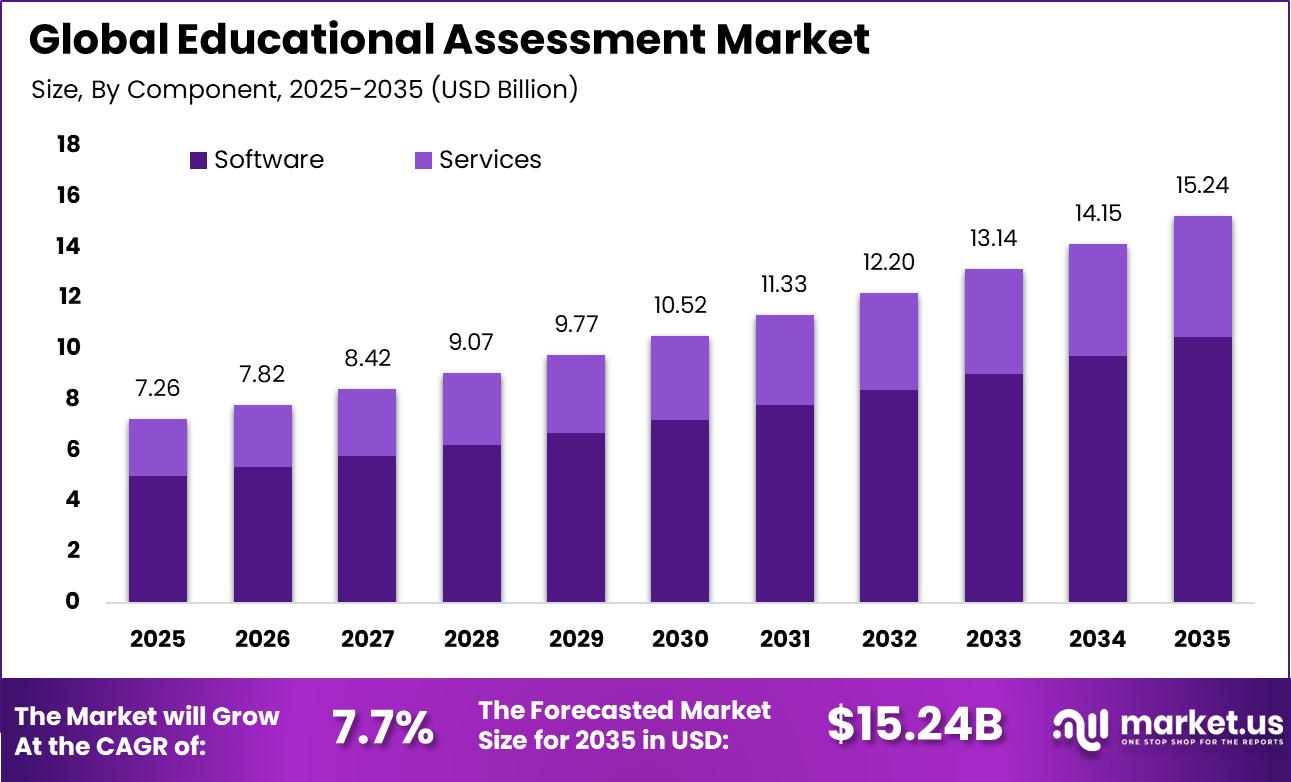
By Assessment Type
By Delivery Mode
By Application
Emerging Trends Analysis
Driver Analysis
Restraint Analysis
Opportunity Analysis
Challenge Analysis
Key Market Segments
By Component
By Assessment Type
By Delivery Mode
By Application
By End-User
Key Regions and Countries
Key Players Analysis
Top Key Players in the Market
Recent Developments









