


Report Overview
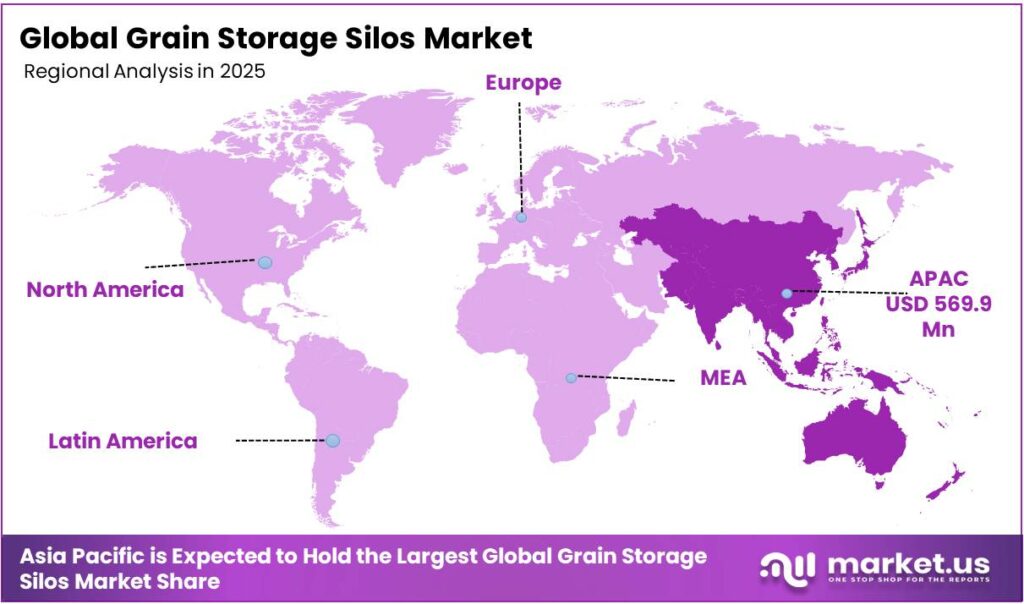
The Global Grain Storage Silos Market is expected to be worth around USD 2.5 Billion by 2035, up from USD 1.6 Billion in 2025, at a CAGR of 4.7% from 2026 to 2035. The Asia Pacific segment maintained 36.3%, supporting a Grain Storage Silos value of USD 569.9 Mn.
Grain storage silos are specialized, high-capacity structures designed to store bulk quantities of agricultural products, primarily grains like wheat, corn, rice, and barley. While they primarily serve as massive containers, modern silos are sophisticated engineering systems that actively protect and maintain the quality of the stored goods.
- According to the Food and Agriculture Organization (FAO) 2024 data, global agricultural production in 2024 saw significant expansion in land use, with crop areas reaching 1.5 billion hectares. The increase in agricultural production leads to the need for high-quality silos to store the produced yield.
The multi-point temperature, moisture, CO₂, and humidity sensors are deployed within silos to detect early signs of spoilage, insect activity, or unsafe conditions. Sensor systems can automatically control aeration fans and ventilation based on environmental data, reducing reliance on manual intervention. Monitoring technologies often integrate level measurement and inventory tracking alongside environmental sensors to support continuous oversight of stored grain, with alerts and automation enhancing management. These practices underscore a trend toward sensor-driven automation in silo environments, where empirical data collection and automated interventions are explicitly used to optimize storage conditions, reduce losses, and improve operational responsiveness. Geopolitical Tensions Have Led to Disrupted Grain Storage Supply Chains. The geopolitical tensions, primarily the Russia-Ukraine conflict, have fundamentally shifted the grain storage market from a “just-in-time” to a “just-in-case” strategic model. According to the European Parliament, as of late 2023, the Ukrainian agricultural sector sustained an estimated US$80 billion in damages and losses, with targeted strikes on storage and transport infrastructure serving as a primary driver of global supply volatility. Before the conflict, Ukraine and Russia together accounted for roughly 30% of global wheat exports and a significant share of maize and barley trade, which created systemic vulnerability as export routes and infrastructure were compromised. These geopolitical pressures influence grain silo utilization patterns, compel adjustments in on-farm and commercial storage strategies, and underline the strategic importance of resilient storage infrastructure that can respond to export network volatility. Consequently, governments in Sweden, Norway, India, and Indonesia are actively expanding national reserves to mitigate instability. Asia Pacific Held the Largest Share of the Global Grain Storage Silos Market. In 2025, the Asia Pacific dominated the global grain storage silos market, holding about 36.3% of the total global consumption, driven by the very high volumes of grain production and corresponding storage infrastructure expansion in major producers such as China and India. According to an official from the National Food and Strategic Reserves Administration, China’s consistent construction of grain warehouses, including eco-friendly facilities, raised the country’s total grain storage capacity to over 700 million tons by the end of 2023, a 36% increase since 2014, with modernized facilities largely replacing outdated stack and open-air storage methods. China and India together produce more than half of the world’s rice, with Asia accounting for about 90% of global rice output, underscoring the magnitude of cereals in regional agriculture that necessitates extensive storage systems. India’s largest public storage agency, the Food Corporation of India, manages nearly 917 lakh tons of installed capacity across silos, godowns, and other structures, reflecting government-level storage commitments. These illustrate the scale of Asia Pacific’s grain storage infrastructure and its centrality in accommodating the region’s substantial cereal production and food security imperatives. Manufacturers of grain storage silos increasingly concentrate on product innovation, digital tool deployment, and strategic collaborations to differentiate their offerings and enhance competitive positioning. Additionally, these players engage with agricultural cooperatives and industry groups to promote safety and the adoption of modern storage practices. The technology enhancement, education platforms, and partnerships are documented manufacturer strategies aimed at reinforcing product relevance and securing broader application across diverse farming and grain-handling contexts.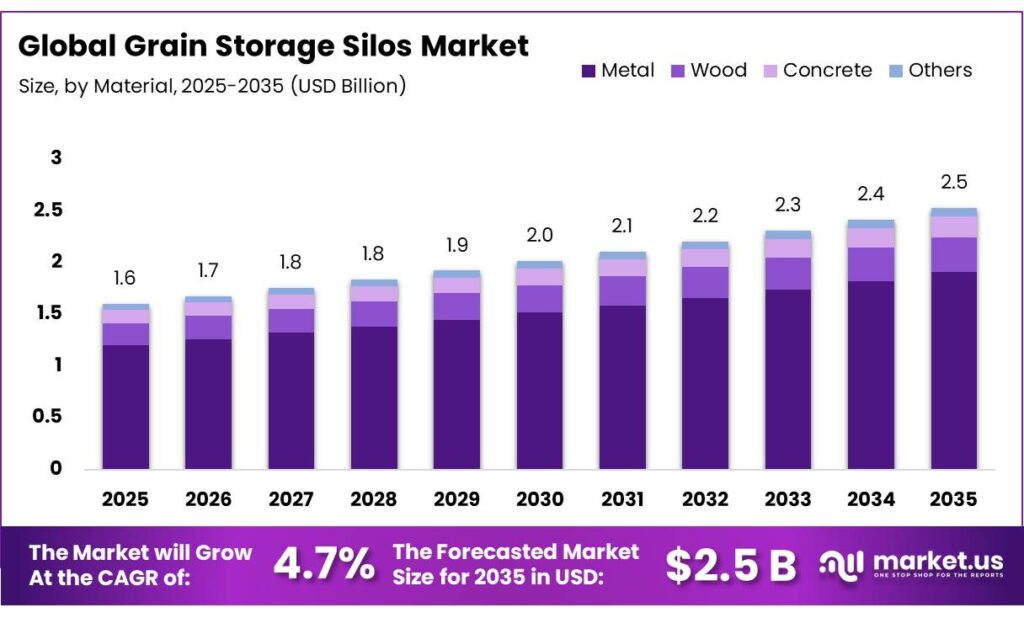
Geopolitical Impact Analysis
Regional Analysis
Key Regions and Countries
Key Players Analysis:
The major players in the industry
Key Development:









