Report Overview
The Global Connected Mining Market size is expected to be worth around USD 49.1 Billion by 2035 from USD 15.53 Billion in 2025, growing at a CAGR of 12.20% during the forecast period 2026 to 2035.
Connected mining integrates industrial IoT sensors, autonomous systems, edge computing, and real-time data analytics into mine operations. This convergence enables operators to monitor equipment health, manage fleets, track workers, and optimize ore processing from centralized platforms — replacing reactive maintenance cycles with data-driven decision-making.
The structural shift in mining is not just technological — it is economic. Operators face mounting pressure to reduce downtime, control labor costs, and meet stricter environmental regulations. Connected platforms answer all three simultaneously, making digital infrastructure a capital priority rather than an optional upgrade for mine operators worldwide.
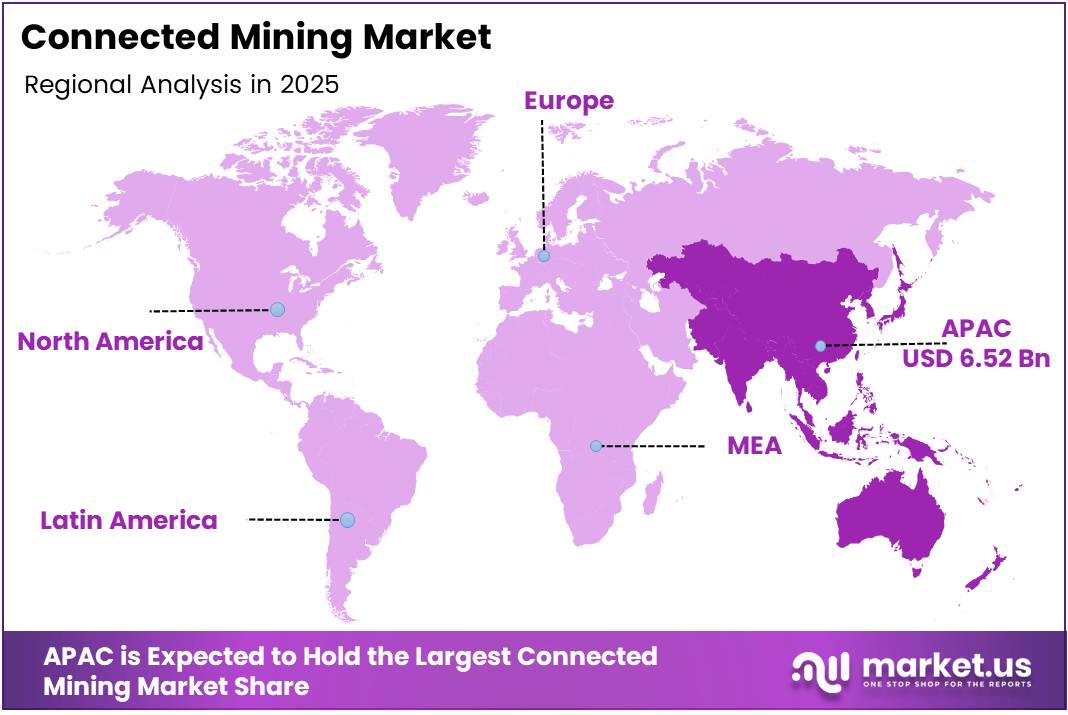
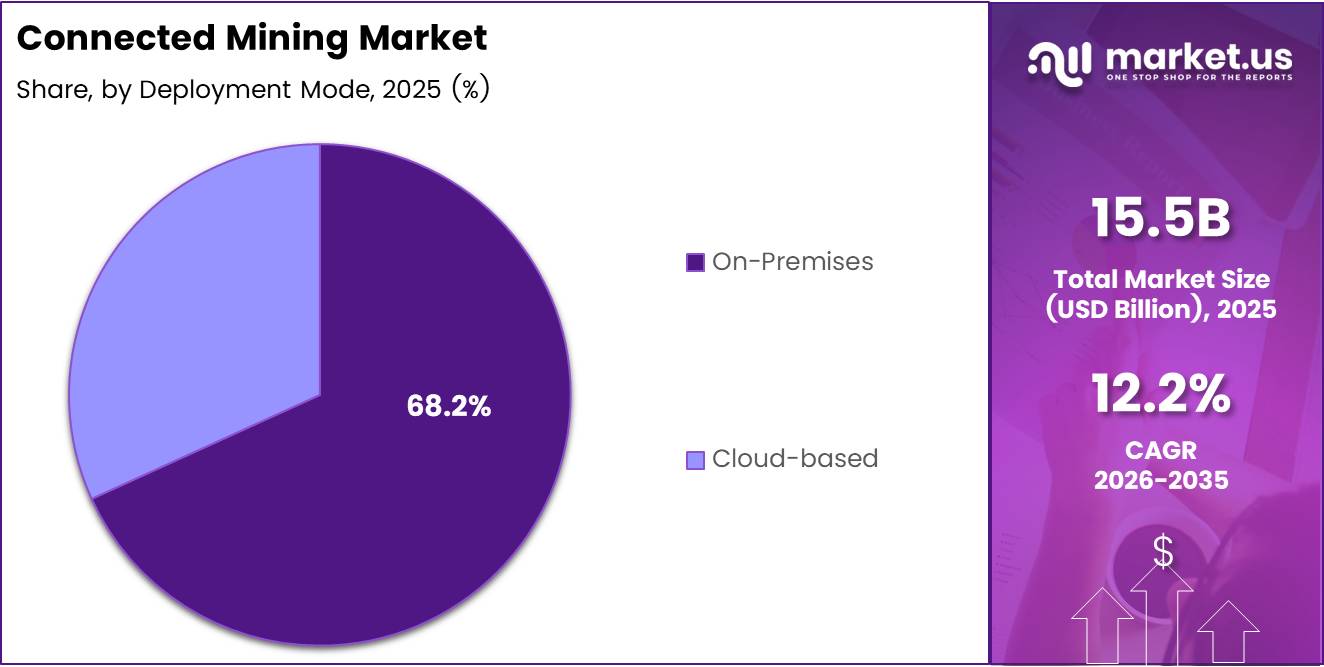
Solution providers targeting on-premises deployment hold a structural advantage today, as mine operators in remote locations prioritize network reliability over cloud flexibility. However, the cost economics of cloud-based centralized command centers are narrowing this gap, particularly for multi-site operators managing assets across multiple geographies simultaneously. According to the International Institute for Sustainable Development (IISD), advanced mining economies such as Australia and South Africa report a 75% adoption rate for connected technologies including IoT sensors, autonomous fleets, and AI software as of 2025. This concentration of adoption in mature markets means vendors currently derive most of their revenue from a narrow geographic base — and the next growth wave depends on replicating that infrastructure in emerging mineral-rich economies. According to laccei.org, predictive monitoring enabled by machine learning and digital twin integration delivers up to a 50% reduction in maintenance costs for critical mining equipment. For a capital-intensive industry where unplanned equipment failures can halt production for days, this figure translates directly into enterprise-level ROI justification — and explains why asset optimization software commands premium pricing in procurement cycles. Solution dominates with 78.43% due to integrated platform demand across mine operations. In 2025, Solution held a dominant market position in the By Offering segment of the Connected Mining Market, with a 78.43% share. Mine operators prefer integrated software platforms over standalone services because they reduce vendor fragmentation, enable unified data flows, and deliver faster time-to-value across asset tracking, safety, and process control functions. Asset Tracking and Optimization serves as the highest-priority entry point for connected mining deployments. Operators adopt asset tracking first because it delivers measurable ROI within months — reducing idle time and improving equipment utilization rates without requiring full mine-wide infrastructure overhaul. This makes it the most common starting point for digital transformation programs. Fleet Management carries strong commercial weight because haulage accounts for the largest share of operational costs in surface mining. Connected fleet systems enable real-time route optimization, fuel consumption tracking, and shift coordination. For operators running large fleets, even marginal efficiency gains translate into tens of millions in annual cost savings. Industrial Safety and Security differentiates through its direct alignment with regulatory compliance requirements. As governments mandate digital worker monitoring and incident reporting, safety solutions move from discretionary to required spend. This creates a procurement floor that insulates safety platform vendors from budget cuts during commodity price downturns. Workforce Management addresses the labor productivity challenge that underground operations face most acutely. Real-time location tracking, task assignment, and fatigue monitoring tools reduce supervisory overhead and improve shift efficiency. Adoption accelerates in operations with high worker density and complex multi-level underground environments. Analytics and Reporting functions as the intelligence layer that converts raw sensor data into operational decisions. Its value compounds over time as datasets grow, making early adopters increasingly difficult for competitors to displace — a lock-in dynamic that drives longer contract cycles and higher customer retention for analytics platform vendors. Process Control targets the highest-value stage of the mining value chain — ore processing and refining. Connected process control systems optimize mill throughput, reagent dosing, and energy consumption in real time. In April 2025, Hitachi Construction Machinery launched LANDCROS Connect Insight, which collects near-real-time operational data to provide predictive analytics and fuel consumption dashboards, illustrating the commercial direction of this sub-segment. Services — including Professional Services and Managed Services — represent the recurring revenue layer of connected mining ecosystems. While they account for a smaller share than solutions, their margin profile is typically higher and their churn rates lower, making them strategically valuable for vendors building long-term platform relationships with major mining operators. Professional Services captures implementation, integration, and consulting revenue tied to initial deployment complexity. Large-scale mine network buildouts require significant professional services engagement, particularly where legacy systems and multi-vendor environments create integration challenges that off-the-shelf solutions cannot resolve alone. Managed Services represents the transition toward subscription-based operational models in mining technology. Operators outsource network management, system monitoring, and software updates to reduce internal IT burden. This model works best for mid-tier miners that lack in-house digital expertise but still require enterprise-grade connectivity performance. On-Premises dominates with 68.21% due to connectivity constraints in remote mine environments. In 2025, On-Premises held a dominant market position in the By Deployment Mode segment of the Connected Mining Market, with a 68.21% share. Remote mine locations with limited and unreliable wide-area network coverage make local infrastructure the only viable option for real-time operations. Operators cannot risk production-critical systems depending on unstable external connectivity. Cloud-based deployment gains traction among multi-site operators that need centralized visibility across geographically dispersed assets. While latency and connectivity constraints limit its penetration in underground operations today, the buildout of private 5G and LTE networks is systematically removing those barriers — making cloud-based command centers a credible option for surface and processing operations in well-connected jurisdictions. Transportation applications anchor the value proposition of autonomous haulage systems and connected fleet management. Haulage represents the highest share of operational cost in most surface mines, making transportation the application category with the clearest and most immediate ROI. The ongoing deployment of autonomous trucks across major mining regions confirms operator confidence in connected transportation solutions. IoT sensor networks across surface and underground operations give mine managers continuous visibility into equipment health, environmental conditions, and worker location. This real-time data layer eliminates the operational blind spots that historically caused unplanned shutdowns. Operators that deploy connected sensor infrastructure reduce reactive maintenance cycles and shift to data-led operational decisions. Fleet management and predictive maintenance represent the most commercially compelling use case for connected mining investment. According to laccei.org, ML-based predictive models achieve 95% accuracy in fault detection and real-time decision-making for mining plant equipment. This level of precision means operators can schedule maintenance before failures occur — directly cutting the downtime that erodes production targets and profitability. Autonomous haulage systems and remote-controlled drilling add a second performance layer on top of connectivity. In July 2025, Nevada Gold Mines and Komatsu launched the first U.S. deployment of Komatsu’s FrontRunner Autonomous Haulage System, introducing connected autonomous trucks that enhance safety and real-time operational control. This deployment signals that autonomous connected systems have crossed from pilot programs into mainstream operational use. Building a mine-wide connected network requires substantial upfront capital — fiber or wireless backbone infrastructure, ruggedized edge hardware, integration with legacy equipment, and specialized IT deployment teams. For mid-tier and junior miners operating in cost-constrained commodity cycles, this capital threshold delays or prevents full deployment, concentrating connected mining adoption among large-scale operators. Cybersecurity risk compounds the capital challenge. Cloud-connected mining ecosystems expose operational technology to external threat vectors that were previously air-gapped from the internet. A successful cyberattack on a connected mine can halt production, corrupt process data, or compromise worker safety systems — consequences that carry regulatory, financial, and reputational consequences simultaneously. ERG’s digital transformation, which delivered an economic impact exceeding USD 111 million in 2025, required multi-year investment in proprietary AI, computer vision, digital twins, and strengthened IT infrastructure. This scale of investment is feasible for tier-one producers but represents a structural barrier for smaller operators — widening the competitive gap between digitally mature miners and those still operating legacy systems. Private 5G and LTE network deployments resolve the connectivity bottleneck that limits connected mining adoption in underground and remote surface operations. High-bandwidth, low-latency underground communication enables real-time autonomous vehicle coordination, continuous sensor streaming, and video-based safety monitoring — unlocking use cases that were technically impossible on legacy wireless infrastructure. AI-driven digital twin platforms represent the most significant value multiplier in connected mining. According to laccei.org, machine learning and digital twin integration delivers a 7.62% reduction in SAG mill energy consumption and a 19.80% reduction in flotation process energy use. For energy-intensive processing operations, these figures translate into tens of millions in annual savings — making digital twin deployment one of the highest-ROI investments available to mine operators. In September 2025, Komatsu announced a multi-year strategic partnership with Applied Intuition to accelerate next-generation intelligent and autonomous vehicles for connected mining haulage using AI and Vehicle OS technology. This partnership signals that connected mining platforms will increasingly depend on advanced AI software stacks — creating a new layer of the value chain where software-specialized vendors can build competitive positions independent of equipment manufacturing. Real-time geospatial analytics and drone-based surveying solutions compress data collection timelines and improve spatial accuracy across both exploration and active mine operations. Exyn’s autonomous drone mapping at Northern Star’s Pogo mine collected survey data in roughly half the time of traditional methods — illustrating how connected aerial platforms shift surveying from a periodic activity to a continuous operational data feed. Cloud-based centralized command and control centers allow multi-site operators to unify operational visibility across geographically dispersed mine assets. As private 5G networks extend connectivity into previously unreachable areas, the economics of cloud command centers improve — enabling smaller operations to access enterprise-grade monitoring capabilities without building dedicated on-site control infrastructure for each mine. According to laccei.org, ML and digital twin systems deliver a 13.10% increase in Overall Equipment Effectiveness for belt conveyors. This OEE improvement, combined with wearable smart devices for workforce health and location tracking, indicates that the next competitive frontier in connected mining is not just machine optimization — it is the integrated management of both equipment and human performance in real time. Asia Pacific holds a 41.96% share of the connected mining market, valued at USD 6.52 Billion in 2025. The region’s dominance reflects the scale of mineral extraction activity in Australia, China, and Indonesia — combined with Australia’s mature digital mining ecosystem, where connected technology adoption rates among advanced economies reach 75% according to IISD. This concentration of mining output and digital readiness makes APAC the primary commercial battleground for connected mining vendors.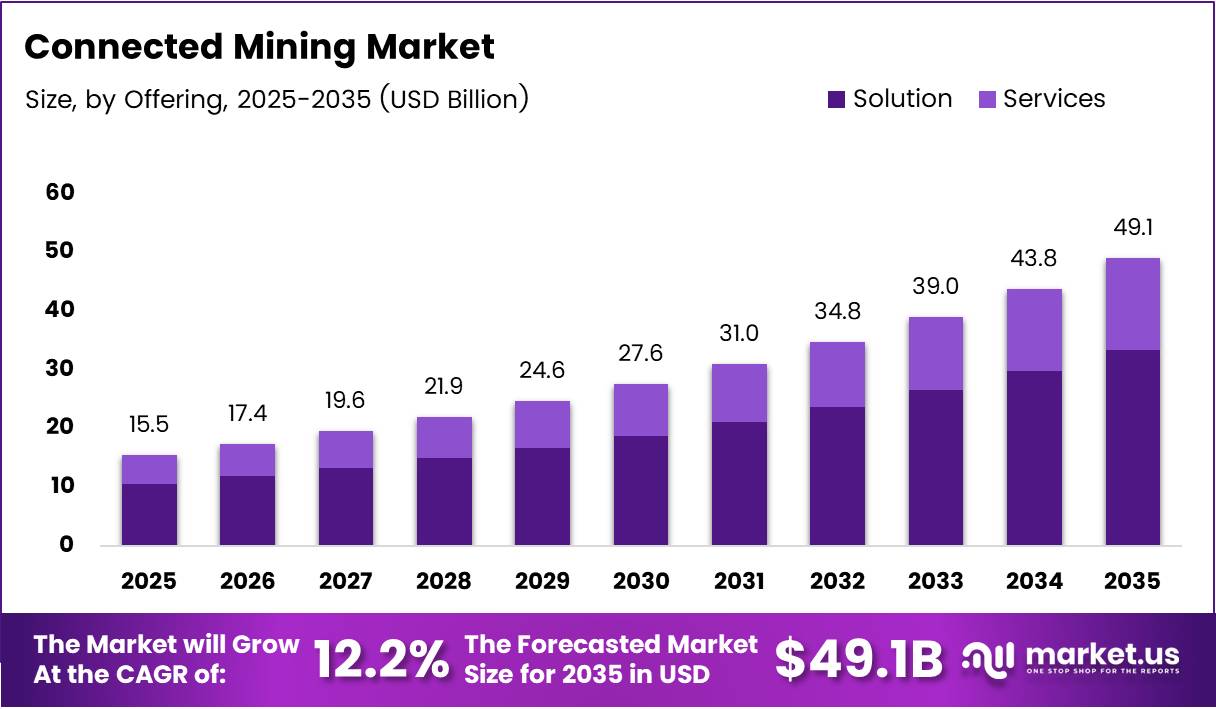
Key Takeaways
Offering Analysis
Deployment Mode Analysis
Key Market Segments
By Offering
By Deployment Mode
By Mining Type
By Application
Drivers
Industrial IoT Adoption and Autonomous Systems Drive Real-Time Operational Control Across Mining Environments
Restraints
High Infrastructure Costs and Cybersecurity Exposure Constrain Mine-Wide Connected Deployment
Growth Factors
Private 5G Networks, AI-Driven Digital Twins, and Emerging Economy Investment Open New Revenue Horizons
Emerging Trends
Geospatial Analytics, Cloud Command Centers, and Wearable Devices Redefine Connected Mine Management
Regional Analysis
Asia Pacific Dominates the Connected Mining Market with a Market Share of 41.96%, Valued at USD 6.52 Billion