


Report Overviews
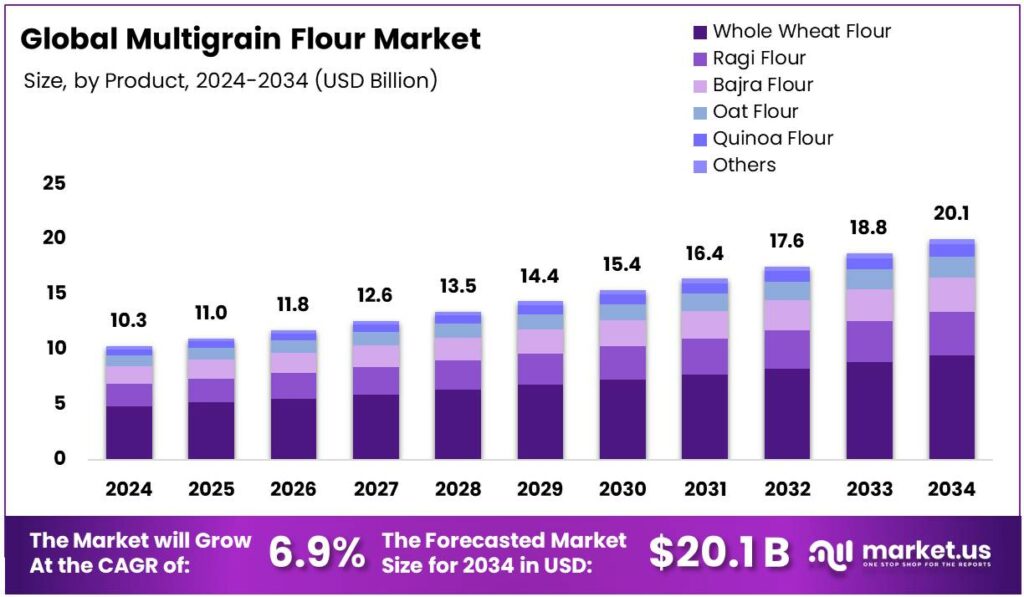
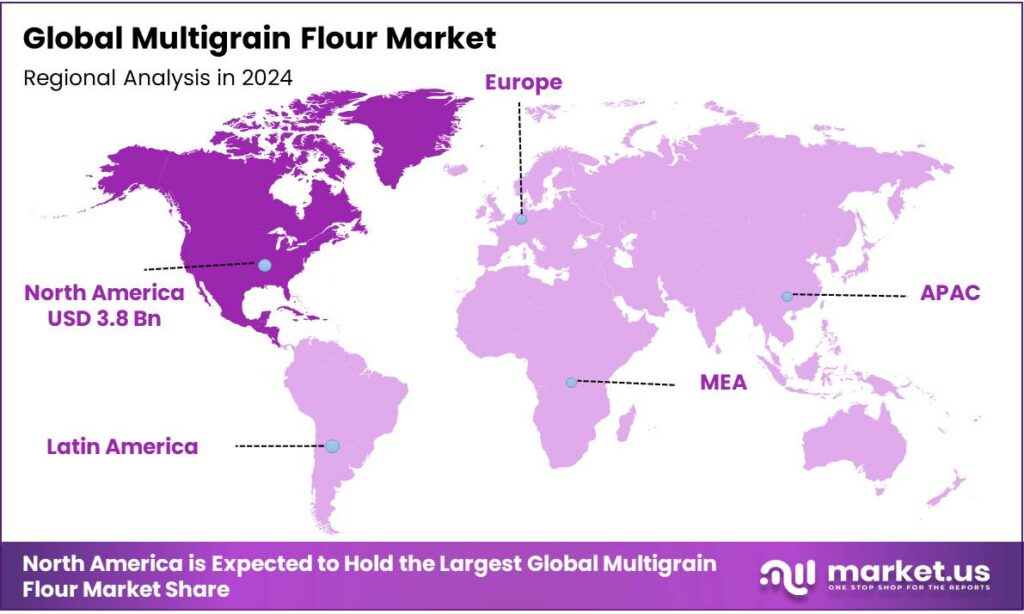
The Global Multigrain Flour Market is expected to be worth around USD 20.1 Billion by 2034, up from USD 10.3 Billion in 2024, at a CAGR of 6.9% from 2025 and 2034. The North America segment maintained 36.6%, supporting a Magnetorheological Fluids value of USD 3.8 Bn.
Multigrain flour is a type of flour made by blending two or more different types of grains. It offers a broader range of nutrients, flavors, and textures compared to a single-grain flour. Its market is shaped by the intersection of nutrition-led demand shifts and structural constraints within grain-based food systems. Public dietary guidance in major economies increasingly emphasizes whole-grain intake, supporting consumer interest in flour blends containing multiple cereals and pulses.
- A 2023 USDA Economic Research Service (ERS) report highlighted that U.S. consumers’ consumption density for whole grains was more than 70% below the recommended amount, while refined grains were over 85% above the recommended level.
Furthermore, multigrain flour aligns with preferences for higher fiber, plant-based, and reduced-refined-grain diets, including vegan and select gluten-free use cases when non-wheat grains are emphasized. However, adoption is moderated by the continued dominance of staple grains such as wheat and rice, reinforced by large-scale agricultural production, public food distribution systems, and entrenched culinary habits.
- For the 2025/26 cycle, the UN Food and Agriculture Organization (FAO) forecasts global cereal production to exceed 3 billion tons for the first time, with wheat output estimated at a record 819 million tons.
The multigrain flour is most widely used in baked goods, where processing tolerances allow heterogeneous grain blends, while applications in pasta, noodles, and infant foods remain more technically constrained. Moreover, North America exhibits strong institutional support for whole-grain consumption, underpinning comparatively higher utilization of multigrain flour in everyday food products.
- According to the studies by the FDA and NIH, roughly 25% of the U.S. population consumes gluten-free products, significantly exceeding the diagnosed medical need.
Key Takeaways:
- The global multigrain flour market was valued at USD 10.3 billion in 2024.
- The global multigrain flour market is projected to grow at a CAGR of 6.9% and is estimated to reach USD 20.1 billion by 2034.
- Based on types of multigrain flour, whole wheat flour dominated the market in 2024, comprising about 47.2% share of the total global market.
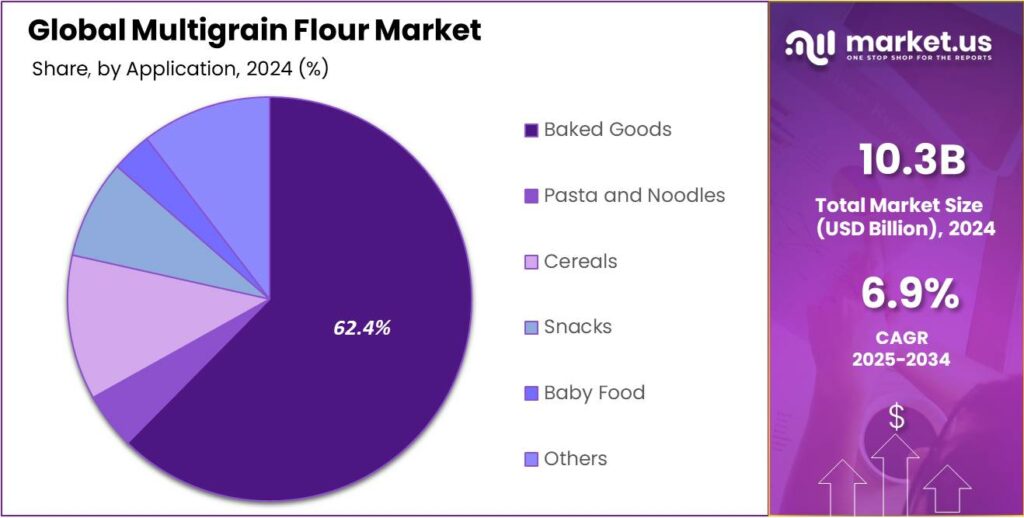
- Among the applications of multigrain flour in commercial settings, the baked goods industry dominated the market in 2024, accounting for around 62.4% of the market share.
- North America was the largest market for multigrain flour in 2024 due to its rapidly expanding food and beverage industry.
Product Type Analysis
Whole Wheat Flour Dominated the Market Due to Its Mass Consumption.
Based on product type, the multigrain flour market is segmented into whole wheat flour, ragi flour, bajra flour, oat flour, quinoa flour, and others. The whole wheat flour dominated the market in 2024 with a market share of 47.2%, primarily due to agricultural scale, functional performance, and dietary familiarity. Wheat is cultivated at large scale across multiple geographies and benefits from established storage, milling, and distribution infrastructure, ensuring consistent availability and uniform quality.
Additionally, wheat contains gluten-forming proteins, which provide elasticity, structure, and gas retention, properties that are critical for bread, chapati, and baked goods, making it technologically versatile compared with most alternative flours. Similarly, whole wheat flour has long been embedded in staple diets, recipes, and food systems, particularly in Europe, North America, and parts of Asia. In contrast, flours such as ragi or bajra are regionally concentrated, while oat and quinoa flours often require blending or formulation adjustments to achieve comparable texture and taste. These combined factors sustain whole wheat flour’s dominant everyday use.
Application Analysis
In 2024, the Baked Goods Industry Dominated the Multigrain Flour Market.
In 2024, the baked goods industry emerged as the largest end-use sector for multigrain flour, accounting for nearly 62.4% of the product’s global consumption, outperforming applications such as pasta and noodles, cereals, snacks, and baby food. Most multigrain flour is used for baked goods, as baking applications are technologically more tolerant of grain diversity than pasta, noodles, cereals, or infant foods. Baked products can accommodate variations in particle size, fiber content, and grain composition without severely compromising structure or sensory quality.
In contrast, pasta and noodles require precise protein strength and starch behavior to ensure firmness, elasticity, and low cooking loss, which are harder to achieve with heterogeneous multigrain blends. Similarly, cereals, snacks, and baby foods face stricter process and safety constraints, including extrusion stability, shelf-life control, digestibility, and regulatory requirements for infant nutrition. Additionally, consumer expectations for baked goods, such as bread, flatbreads, and biscuits, more readily accept denser textures and darker colors associated with multigrain formulations.
Key Market Segments
By Product Type
- Whole Wheat Flour
- Ragi Flour
- Bajra Flour
- Oat Flour
- Quinoa Flour
- Other Flours
By Application
- Baked Goods
- Pasta and Noodles
- Cereals
- Snacks
- Baby Food
- Others
Drivers
Rising Consumer Demand for Healthier Alternatives to Refined Flour Drives the Market.
Rising consumer demand for healthier alternatives to refined flour is increasingly observed in consumption patterns and is a key driver in the multigrain flour market. Government nutrition authorities such as the U.S. Dietary Guidelines recommend that at least 50% of total grain intake be whole grains, implicitly advocating reduced reliance on refined-grain products as part of a healthy diet.
The National Health and Nutrition Examination Survey (NHANES) for 2013-2016 showed that whole grains accounted for only 15.8% of total grain intake among U.S. adults, indicating consumer diets lag behind official recommendations. Refined grains lack the bran and germ inherent in whole grains, leading to marked reductions in fiber and micronutrients. National dietary guidelines across multiple countries uniformly advise limiting refined grains and increasing whole-grain consumption to improve diet quality and obtain benefits such as enhanced intake of dietary fiber and other nutrients.
Additionally, large-scale national surveys have documented high consumption of low-quality carbohydrates dominated by refined cereals, linked to rising lifestyle diseases, underscoring public health interest in dietary shifts toward nutrient-dense grain alternatives. Multigrain flours, which blend whole and diverse grains, align with these nutritional priorities, reflecting consumer demand for products perceived as healthier than refined flour.
Restraints
Competition from Established Staples Might Hamper the Growth of the Multigrain Flour Market.
Staple cereals such as rice and wheat continue to dominate global diets, posing a structural challenge for multigrain flour adoption. According to the OECD-FAO Agricultural Outlook, rice and wheat together account for a majority of cereal food consumption worldwide, with per capita rice consumption in Asia alone averaging about 71.9 kg/year and projected to rise further, while wheat remains a central staple across multiple regions.
These cereals form the core of caloric intake and food security strategies, particularly in Asia, Africa, and Latin America, where dietary patterns remain heavily dependent on rice and wheat as household staples. Furthermore, in India, the Public Distribution System (PDS) institutionalizes the dominance of subsidized rice and wheat distributed in fixed monthly rations in the country, up to 35 kg per priority household under the National Food Security Act, effectively anchoring consumer purchasing towards these staples.
Such entrenched supply mechanisms reinforce consumer reliance on rice and wheat for basic nutrition, limiting dietary displacement by alternative grain products such as multigrain flour. Consequently, shifts toward multigrain flour remain constrained by the prevailing scale and accessibility of rice and wheat in staple food systems.
Opportunity
Shift Towards Vegan and Gluten-Free Diets Creates Opportunities in the Multigrain Flour Market.
Emerging dietary patterns emphasizing plant-based and gluten-limited eating present opportunities for multigrain flour consumption, given its compatibility with these diets. Global participation in the Veganuary initiative, a month-long vegan challenge, expanded markedly, reaching approximately 25.8 million participants in 2025, reflecting intensifying interest in veganism as a lifestyle choice. In addition, population surveys show that vegetarian and vegan diets constitute a measurable minority in some countries.
For instance, according to the National Diet and Nutrition Survey, national data indicate that about 4.5% of the UK population adheres to vegetarian or vegan diets. Concurrently, adherence to gluten-free diets has increased beyond clinically diagnosed celiac disease. A longitudinal study in Mexico found adherence to gluten-free diets rose from 3.63% in 2015 to 7.16% in 2022, with many individuals citing weight control and perceived health benefits as motivations.
These shifts indicate a non-negligible and growing cohort of consumers seeking foods compatible with vegan and gluten-free diets, categories where multigrain flours, especially those incorporating naturally gluten-free grains like millet and buckwheat, can align with evolving dietary preferences.
Trends
Adoption of Multigrain Flours in Expanded Applications.
There are diversified uses of multigrain flours in products beyond traditional bread, illustrating an applied trend toward snacks, pasta, noodles, and ready-to-eat (RTE) foods. The multigrain flour blends, combining cereals and legumes such as sorghum, finger millet, and lentil flours, can be successfully incorporated into pasta products with quantified improvements. For instance, multigrain pastas can achieve a glycemic index (GI) as low as 41, compared to 70 for white bread.
Similarly, multigrain soy-enriched noodles with 62.2% refined wheat, 24.6% sorghum, and 13.2% soy exhibited significantly higher protein, about 19.1%, and dietary fiber, approximately 5.5%, than refined wheat noodles, supporting nutritional attributes for mid-day meal programs. The development of multigrain extruded RTE snacks using blends of refined wheat, sorghum, and pearl millet, achieving acceptable sensory profiles alongside enhanced dietary fiber and protein.
These indicate that multigrain flour’s functional versatility supports its application in a range of processed foods, such as snacks, noodles, pasta, and RTE products, beyond bakery staples, underpinned by nutritional enhancements. For instance, Nestlé introduced the Vital Pursuit brand in 2024, featuring frozen pasta bowls and pizzas made with whole grains and plant proteins.
Geopolitical Impact Analysis
Geopolitical Tensions Leading to Supply Chain Disruptions in the Multigrain Flour Market.
The geopolitical tensions, most notably the Russia-Ukraine conflict, have materially influenced global grain supply chains, with implications for markets that depend on cereals such as wheat and input flours integral to multigrain products. Russia and Ukraine together accounted for around 25% of global wheat and barley exports and 15% of maize exports, creating concentrated exposure to conflict-induced disruption. The war has severely restricted Ukraine’s ability to produce and export grains.
The production in the 2023/24 marketing year in Ukraine yielded 22.5 million tons of wheat, considerably below pre-war levels, while export corridors such as the Black Sea Grain Initiative had been interrupted. This volatility affects commodity availability and pricing benchmarks that feed into downstream products, including multigrain flour blends, which often incorporate wheat and maize.
Disruptions in staple grain supply and logistic bottlenecks can heighten input cost volatility and pressure supply planning for multigrain formulations. Furthermore, conflict-related food security concerns persist. The geopolitical effects through primary food systems data underscore ongoing structural exposure of grain-based markets, including multigrain flour, to external political stressors.
Regional Analysis
North America is at the Forefront of the Global Multigrain Flour Market.
North America held the major share of the global multigrain flour market, led by the United States, commanding an estimated 36.6% of total revenue share. The 2025-2030 U.S. Dietary Guidelines for Americans explicitly focus on whole grains, recommending 2-4 servings of whole grains per day across typical caloric levels, reflecting a sustained policy emphasis on grain products with higher whole-grain content. This underscores North America’s comparatively high engagement with whole-grain and multigrain food consumption patterns, a foundational element for the multigrain flour market.
- According to the USDA 2025/26 report, the U.S. wheat ending stocks are at their highest level since 2019/20, further suppressing prices to a forecast US$5.10 per bushel.
Under definitions aligned with the Dietary Guidelines for Americans, mean daily whole-grain intake rose from approximately 0.50 oz to 0.81 oz (per 2, 000 kcal) over the period 2003 to 2018. These consumption trends point to comparatively strong consumer engagement with grain products, emphasizing whole-grain content in North America, consistent with the region’s prominent role in multigrain flour utilization.
Key Regions and Countries
- North America
- The US
- Canada
- Europe
- Germany
- France
- The UK
- Spain
- Italy
- Russia & CIS
- Rest of Europe
- APAC
- China
- Japan
- South Korea
- India
- ASEAN
- Rest of APAC
- Latin America
- Brazil
- Mexico
- Rest of Latin America
- Middle East & Africa
- GCC
- South Africa
- Rest of MEA
Key Players Analysis
Manufacturers of multigrain flour pursue strategic activities centered on product differentiation and consumer engagement to gain a competitive advantage. They invest in product innovation, developing specialized blends that incorporate diverse grains, ancient grains, and dietary-specific formulations, such as gluten-free, to meet evolving nutritional preferences.
Additionally, there is an emphasis on health attributes and clean-label positioning, such as certified organic or non-GMO sourcing and transparent ingredient lists, to align with consumer wellness trends and enhance product appeal. Furthermore, the companies focus on distribution strategies such as expansion of e-commerce and digital channels, broadening reach beyond traditional retail, and facilitating direct engagement with health-focused demographics.
The Major Players in The Industry
- Shenyang Xiangxue Flour
- Bob’s Red Mill
- Heilongjiang Agriculture
- COFCO Fulinmen
- Yihai Kerry Arawana Holdings
- Archer Daniels Midland
- King Arthur Flor
- Arrowhead Mills
- Xiangnian Food
- Other Key Players
Key Developments
- In November 2025, Bob’s Red Mill, a leader in the homemade food movement with over 40 years of experience, introduced three specialty baking flours: Super-Fine Cake Flour, Self-Rising Flour, and High Fiber Flour.
- In May 2025, COFCO International began importing bulk shipments of Canadian durum wheat to meet the growing demand for high-quality wheat products in the Chinese market.









