


Market Overview
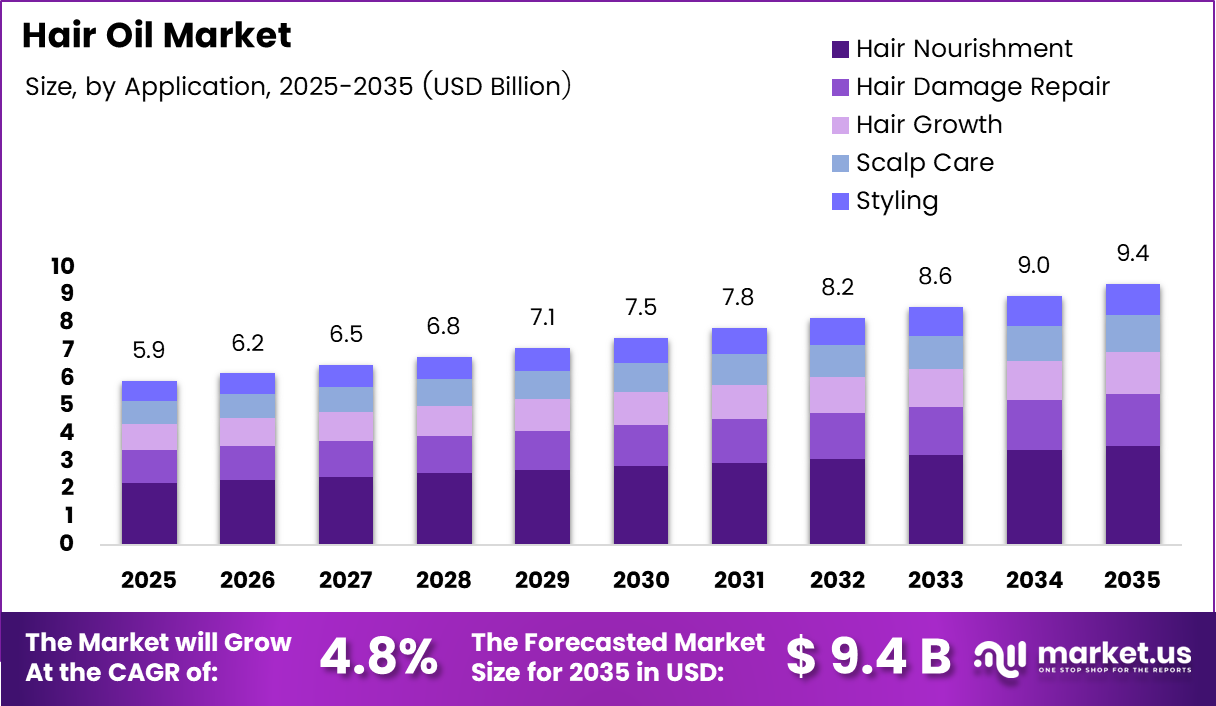
Global Hair Oil Market size is expected to be worth around USD9.4 Billion by 2035 from USD5.9 Billion in 2025, growing at a CAGR of 4.8% during the forecast period 2026 to 2035.
The hair oil market refers to the global industry focused on the production, distribution, and sale of oil-based Natural hair care products. These products are used for nourishing the scalp, reducing hair fall, promoting growth, and improving overall hair texture. The market spans a wide range of formulations, including herbal, organic, and synthetic variants.
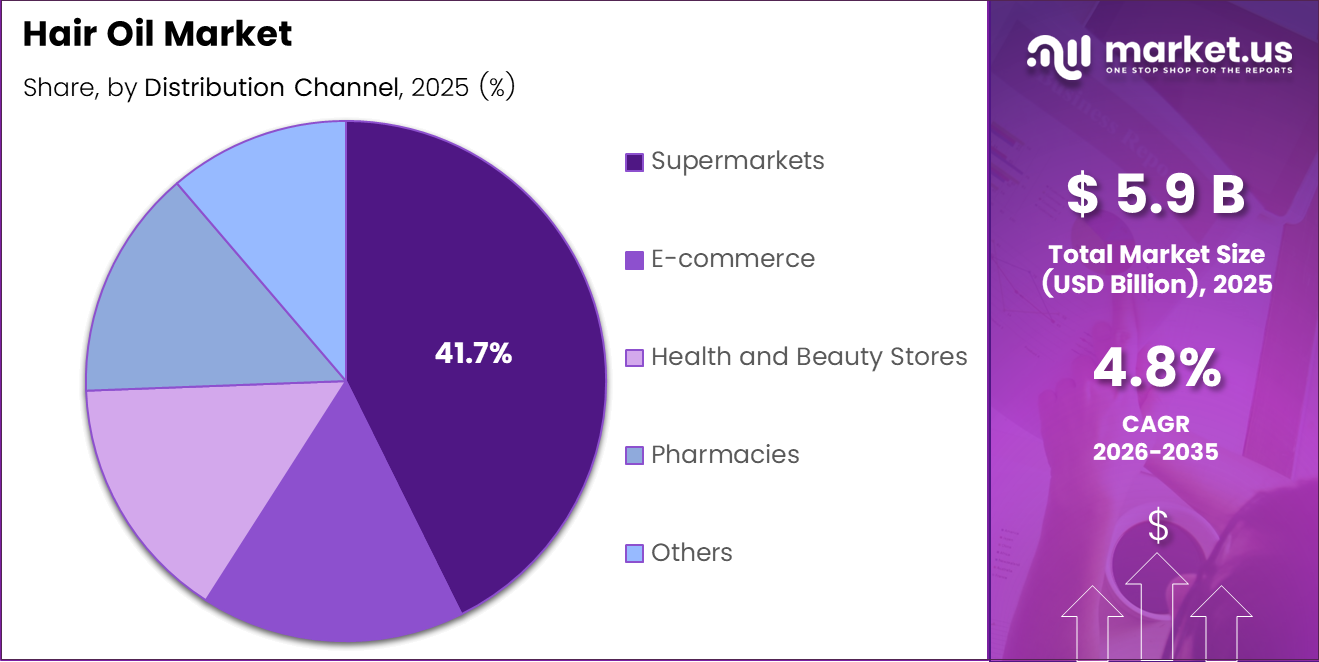
 Health and beauty stores cater to consumers seeking specialized and premium hair care products. These outlets offer expert guidance and curated assortments focused on hair health and wellness. As a result, they play an important role in influencing informed purchase decisions.
Pharmacies
Pharmacies are growing in importance as hair oil brands increasingly position therapeutic and dermatologist-recommended products in clinical retail environments. Consumers associate pharmacies with credibility and safety. Consequently, this channel strengthens product trust and supports adoption among health-conscious buyers.
Others
Other distribution channels include salons, local specialty stores, and direct sales platforms. These outlets often serve niche or regional consumer segments with targeted offerings. Therefore, they contribute to broader market reach while supporting personalized and professional hair care solutions.
Key Market Segments
By Type
- Coconut Oil
- Almond Oil
- Argan Oil
- Olive Oil
- Castor Oil
- Others
By Formulation
- Organic
- Synthetic
- Herbal
By Application
- Hair Nourishment
- Hair Damage Repair
- Hair Growth
- Scalp Care
- Styling
By Distribution Channel
- Supermarkets
- E-commerce
- Health and Beauty Stores
- Pharmacies
- Others
Drivers
Rising Consumer Preference for Herbal and Natural Hair Oil Formulations Drives Market Growth
The growing preference for herbal, Ayurvedic, and plant-based hair oils is a primary market driver. Consumers are actively shifting away from chemical-heavy products toward clean-label formulations. Moreover, increasing awareness of scalp health, hair fall control, and damage repair solutions is encouraging regular hair oiling habits across diverse consumer segments.
Hair oiling as a regular grooming practice has a high penetration rate across age groups, particularly in Asia Pacific. This cultural habit, combined with growing scientific validation of oil-based treatments, is sustaining consistent product demand. Additionally, social media and wellness influencers are reinforcing hair oiling routines among younger demographics globally.
The expansion of premium and therapeutic hair oils targeting specific hair concerns is also accelerating market growth. Consumers are willing to pay higher prices for oils addressing hair thinning, scalp inflammation, or chemical damage. Consequently, brands investing in research-backed, dermatologist-recommended formulations are capturing a growing share of the premium hair care market.
Restraints
Shift Toward Non-Oiling Alternatives and Concerns Over Greasy Texture Limit Market Adoption
A significant restraint facing the hair oil market is the growing consumer shift toward lightweight, non-oiling hair care alternatives. Products such as serums, leave-in conditioners, and dry oils are gaining popularity, particularly among younger urban consumers. Therefore, traditional hair oil brands face increasing competition from formats perceived as more convenient and modern.
Concerns over greasy texture, strong odor, and the time-intensive nature of hair oil application continue to deter adoption among certain consumer groups. Many consumers, especially working professionals, find traditional oiling routines impractical for daily use. Additionally, these concerns are particularly pronounced in Western markets where hair oiling has not historically been a mainstream grooming practice.
These restraints are compelling brands to reformulate their products with faster-absorbing, lighter textures to retain existing users and attract new ones. However, reformulation involves significant research and development investment. Consequently, smaller brands may struggle to compete with larger players who have greater resources to innovate and adapt their product portfolios effectively.
Growth Factors
Customization, Organic Demand, and E-Commerce Expansion Accelerate Hair Oil Market Growth
The development of customized hair oils based on specific hair types and scalp conditions represents a major growth opportunity. Personalization is becoming a key differentiator in the hair care space. Moreover, advances in ingredient science and diagnostic tools are enabling brands to offer tailored formulations that address individual consumer needs more precisely.
Rising demand for organic, cold-pressed, and chemical-free hair oils is creating substantial growth potential across global markets. Health-conscious consumers are prioritizing products with transparent ingredient lists and certifications. Additionally, increasing availability of pure and handmade natural oils demonstrates strong consumer appetite for authentic, minimally processed hair care products.
Increasing adoption of hair oils in male grooming and anti-hair fall segments is opening new market avenues. Men are now a growing consumer base for targeted hair health products. Furthermore, the rapid expansion of e-commerce and direct-to-consumer brands is reducing market entry barriers and enabling niche players to reach global audiences efficiently and cost-effectively.
Emerging Trends
Innovative Formulations, Influencer Marketing, and Sustainable Packaging Reshape the Hair Oil Market
A significant emerging trend is the surge in demand for onion, castor, and essential oil-infused hair oil variants. These ingredients are backed by growing consumer and clinical interest in natural hair growth stimulants. Moreover, brands are actively marketing these variants through digital platforms to capitalize on high search volume and social media engagement.
The popularity of celebrity-endorsed and influencer-led hair oil brands is reshaping how consumers discover and choose products. Social proof has become a powerful purchase driver, particularly among younger demographics. Additionally, collaborations between wellness influencers and emerging hair oil brands are enabling rapid market penetration without traditional advertising expenditure.
The introduction of fast-absorbing, non-sticky hair oil textures is directly addressing longstanding consumer concerns about traditional oil formulations. Consequently, these innovations are expanding the consumer base for hair oils in markets previously resistant to oiling routines. Furthermore, growing use of sustainable packaging and eco-friendly ingredients is aligning brand values with the preferences of environmentally conscious consumers globally.
Regional Analysis
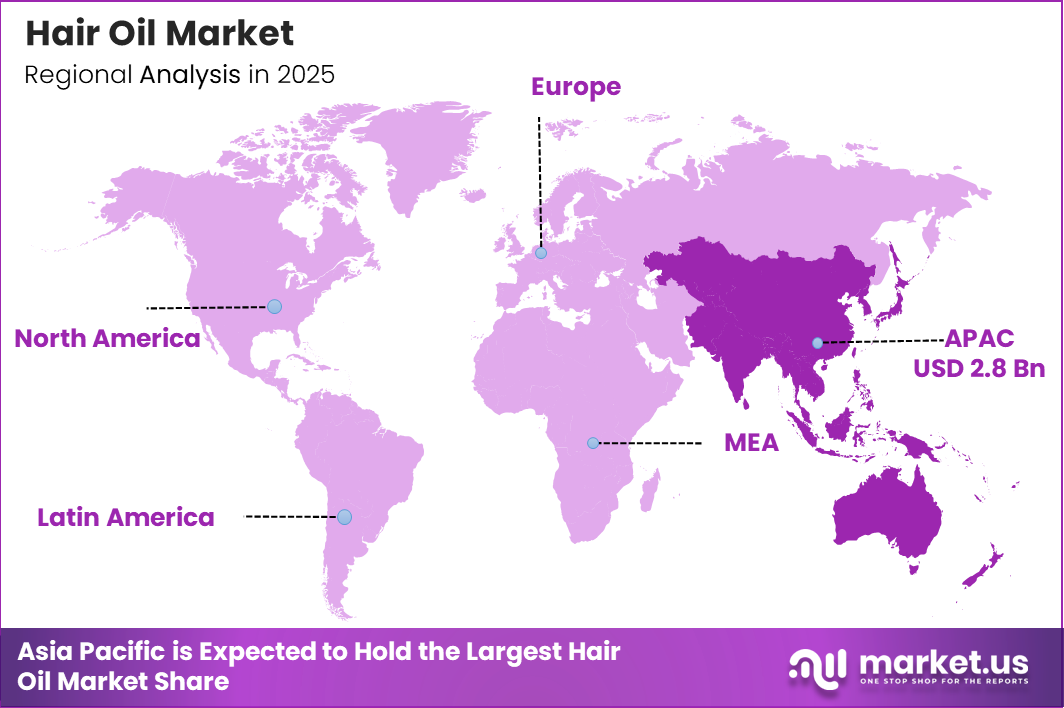
Asia Pacific Dominates the Hair Oil Market with a Market Share of 48.30%, Valued at USD 2.8 Billion
Asia Pacific leads the global Hair Oil Market, accounting for 48.30% of total market share and valued at USD 2.8 Billion in 2025. This dominance is driven by deeply rooted hair oiling traditions across India, Southeast Asia, and East Asia. Moreover, a large and growing middle-class population, rising disposable incomes, and strong demand for Ayurvedic and herbal hair care products further reinforce the region’s leading position.
North America Hair Oil Market Trends
North America represents a growing market for hair oils, driven by increasing multicultural consumer influence and the rising popularity of natural hair care routines. The United States is the primary revenue contributor, with growing interest in premium, organic, and therapeutic hair oils. Additionally, strong e-commerce infrastructure is enabling both domestic and international brands to expand their market presence effectively.
Europe Hair Oil Market Trends
Europe is a mature but steadily growing market for hair oils, particularly in the premium and clean beauty segments. Germany, France, and the UK are key markets, with consumers showing strong preference for certified organic and sustainably produced hair care products. Furthermore, the influence of South Asian diaspora communities across Europe is increasing mainstream adoption of hair oiling practices.
Latin America Hair Oil Market Trends
Latin America presents promising growth potential for the hair oil market, supported by rising beauty consciousness and increasing urbanization. Brazil and Mexico are the leading markets in the region, driven by demand for affordable yet effective hair care solutions. Moreover, the expansion of retail networks and e-commerce platforms is improving product accessibility across the region.
Middle East and Africa Hair Oil Market Trends
The Middle East and Africa region shows consistent demand for hair oils, particularly argan and natural oil variants popular in North African markets. GCC countries are witnessing growing demand for premium hair oil products driven by high consumer spending power. Additionally, increasing awareness of hair care and grooming in Sub-Saharan Africa is creating new market expansion opportunities for established and emerging brands alike.
Key Regions and Countries
North America
- US
- Canada
Europe
- Germany
- France
- The UK
- Spain
- Italy
- Rest of Europe
Asia Pacific
- China
- Japan
- South Korea
- India
- Australia
- Rest of APAC
Latin America
- Brazil
- Mexico
- Rest of Latin America
Middle East & Africa
- GCC
- South Africa
- Rest of MEA
Key Company Insights
Dabur India Ltd is one of the most recognized names in the global hair oil market, with a particularly dominant presence in India and emerging markets. The company’s Vatika and Almond Drops product lines have built strong consumer loyalty over decades. Moreover, Dabur continues to invest in Ayurvedic research and product innovation, positioning itself as a leader in the natural and herbal hair oil segment.
Emami Group holds a strong position in the hair oil market with its flagship hair care products focused on herbal and therapeutic formulations. The group has a well-established distribution network across South Asia and Africa. Additionally, its consistent focus on affordable yet effective hair care solutions makes it a preferred brand among mass-market consumers seeking value-driven options for hair nourishment and scalp care.
L’Oreal S.A. brings significant global scale and innovation capability to the hair oil market. The company leverages advanced cosmetic science to develop premium hair oil products that combine efficacy with sensory appeal. Consequently, L’Oreal’s hair care portfolio is well-positioned to meet growing consumer demand for fast-absorbing, non-greasy formulations that align with modern grooming preferences in Western and premium global markets.
Hindustan Unilever Limited operates one of the most extensive hair care portfolios in the hair oil market, particularly across South and Southeast Asia. The company’s brands address a wide spectrum of hair concerns from nourishment to damage repair. Furthermore, Hindustan Unilever’s distribution strength, combined with ongoing product innovation in the natural and organic segment, keeps it highly competitive across both urban and rural consumer markets.
Key Players
- Dabur India Ltd
- Emami Group
- L’Oreal S.A.
- Hindustan Unilever Limited
- Henkel AG
- Patanjali Ayurved
- Coty Inc.
- Procter & Gamble
- Johnson & Johnson Private Limited
- Himalaya Drug Company
Recent Developments
- January 2024 – Unilever announced the acquisition of K18 and simultaneously launched 15 new bond repair hair care products. This move signals a strong strategic commitment to the bond repair and hair restoration category, positioning Unilever to capture growing consumer demand for scientifically advanced hair damage solutions.
- February 2026– Zion Health Inc. launched the Deep Cleansing Scalp and Hair Scrub Pheromone Infused Dark Orchid, a 4 oz exfoliating treatment designed to purify the scalp and nourish hair from root to tip. This product reflects the growing consumer interest in scalp health and multi-functional hair care treatments combining cleansing with nourishment.









