


Report Overview
The Global Liquid Synthetic Rubber Market size is expected to be worth around USD 17.4 billion by 2035 from USD 11.4 billion in 2025, growing at a CAGR of 4.3% during the forecast period 2026 to 2035.
Liquid synthetic rubber refers to low-molecular-weight elastomeric polymers that remain in a fluid or semi-fluid state at room temperature. Manufacturers use these materials as reactive intermediates, binders, and processing aids across tires, adhesives, sealants, and specialty coatings. Their functional versatility drives consistent adoption across automotive, construction, and industrial sectors.
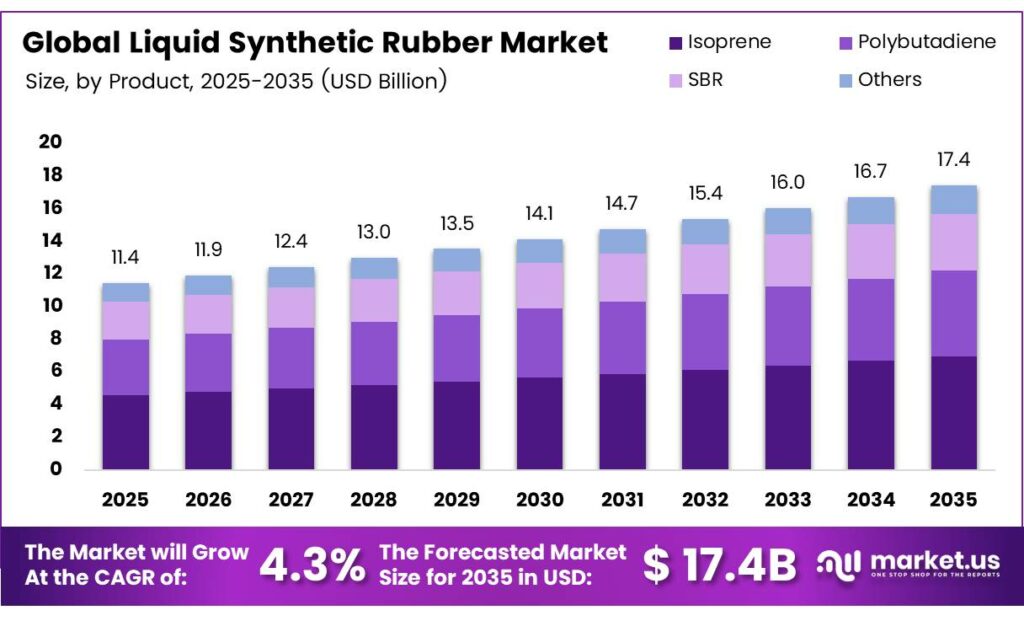
Key product types include liquid styrene-butadiene rubber (SBR), liquid isoprene rubber, liquid polybutadiene, and specialty grades. Each variant delivers distinct performance properties such as thermal stability, chemical resistance, and elongation characteristics. Consequently, end-users select specific grades based on application requirements and processing conditions.
- World synthetic rubber production reached 16.327 million tonnes in 2024, up from 15.431 million tonnes in 2023, while consumption rose from 15.319 million tonnes to 16.291 million tonnes over the same period. This tightening supply-demand balance across all synthetic rubber grades, including liquid variants, signals favorable pricing conditions and sustained market expansion through 2035.
The market benefits from strong downstream demand in the global tire industry, where liquid rubber grades enhance compound performance and processing flow. Additionally, adhesive manufacturers and construction chemical producers increasingly incorporate these elastomers for waterproofing membranes, joint sealants, and surface coatings. This broad applicability supports multi-sector revenue growth.
- The Rubber Board of India, synthetic rubber accounted for 52% of total world rubber consumption in 2024, compared to 48% for natural rubber, maintaining the same 52:48 ratio recorded in 2023. This structural reliance on synthetic rubber systems, including liquid SBR and liquid isoprene rubber, confirms steady global demand momentum.
Governments across the Asia Pacific, Europe, and North America actively support infrastructure expansion, electric vehicle adoption, and sustainable manufacturing. Regulatory frameworks promoting low-VOC and eco-friendly polymer formulations accelerate product innovation. Therefore, manufacturers invest in advanced synthesis technologies to meet both performance and compliance requirements simultaneously.
Key Takeaways
- The Global Liquid Synthetic Rubber Market is valued at USD 11.4 billion in 2025 and is projected to reach USD 17.4 billion by 2035, at a CAGR of 4.3% during the forecast period from 2026 to 2035.
- SBR holds the dominant segment share at 38.4% in 2025.
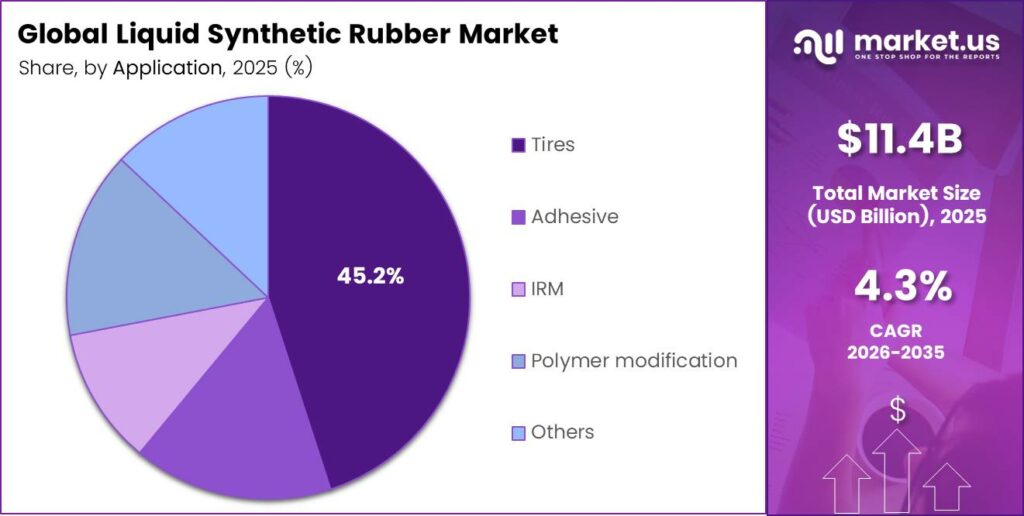
- The Tires segment leads the market with a share of 45.2% in 2025.
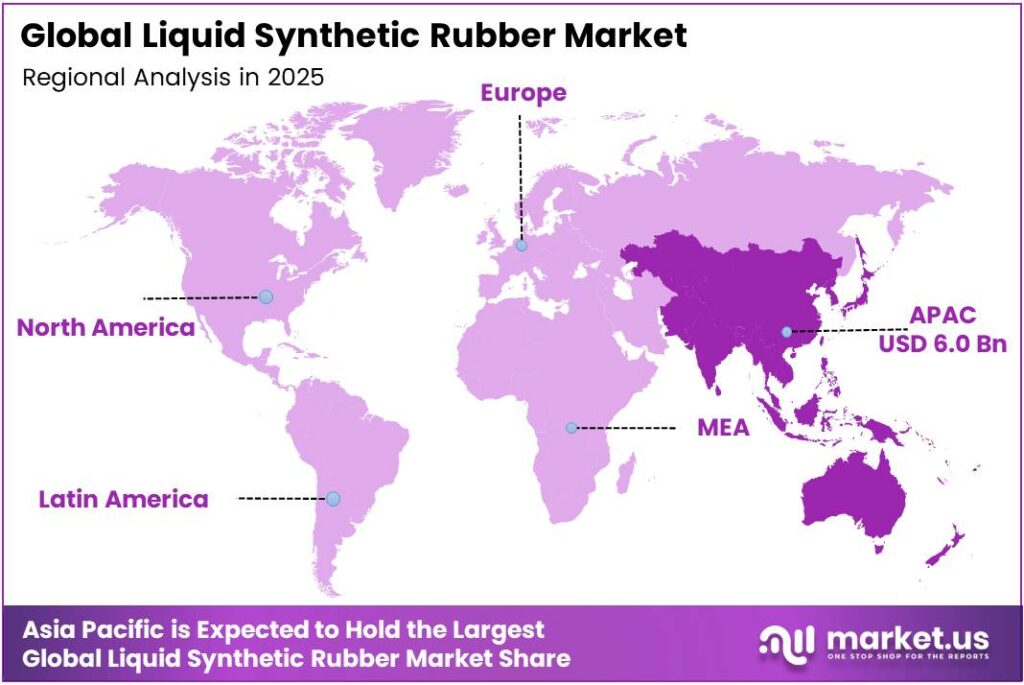
- Asia Pacific dominates the regional landscape with a market share of 52.7%, valued at USD 6.0 billion in 2025.
By Product Analysis
SBR dominates with 38.4% due to its extensive use in tire compounding and adhesive formulations.
In 2025, SBR (Styrene-Butadiene Rubber) held a dominant market position in the By Product segment of the Liquid Synthetic Rubber Market, with a 38.4% share. Liquid SBR delivers excellent abrasion resistance and wet-grip performance, making it the preferred elastomer for high-performance tire compounds. Moreover, its compatibility with multiple processing systems drives adoption across adhesive and sealant manufacturers globally.
Isoprene-based liquid rubber serves as a key functional material in medical-grade components, pressure-sensitive adhesives, and specialty sealants. Its natural rubber-like properties, including high elasticity and biocompatibility, make it suitable for healthcare and pharmaceutical applications. Additionally, isoprene rubber supports advanced polymer modification processes that require precise molecular weight control.
Polybutadiene liquid grades offer superior low-temperature flexibility and fatigue resistance, making them essential in tire sidewalls, golf ball cores, and impact modifiers. Manufacturers use polybutadiene extensively in polymer blending applications to improve the mechanical properties of final compounds. Consequently, this segment maintains steady demand across the automotive and sporting goods industries.
Others in the product segment include specialty liquid rubbers such as liquid EPDM, liquid chloroprene, and functionalized elastomers for niche industrial uses. These materials address specific application needs in electronics encapsulation, aerospace sealing, and custom industrial coatings. Therefore, the other segment contributes incremental growth driven by high-value specialty formulation demand.
By Application Analysis
Tires dominate with 45.2% due to critical demand for high-performance elastomers in automotive manufacturing.
In 2025, Tires held a dominant market position in the By Application segment of the Liquid Synthetic Rubber Market, with a 45.2% share. Tire manufacturers integrate liquid synthetic rubber grades into tread compounds, sidewalls, and bead fillers to enhance performance and durability. Moreover, rising global vehicle production and premium tire demand continue to drive sustained consumption of liquid elastomers.
The Adhesive segment represents a significant application area where liquid synthetic rubber provides strong bonding performance, flexibility, and weather resistance. Construction, packaging, and automotive assembly industries rely on these formulations for structural and non-structural bonding solutions. Additionally, the shift toward solvent-free and waterborne adhesive systems increases demand for functional liquid rubber grades.
IRM (Industrial Rubber Molding) applications utilize liquid synthetic rubber for gaskets, seals, vibration dampers, and custom-molded parts used in heavy equipment and industrial machinery. The growing manufacturing sector across the Asia Pacific and Europe drives consistent demand for molded rubber components. Consequently, IRM remains a stable and volume-driven application segment within the market.
Polymer modification and Others collectively represent growing application areas where liquid rubber improves impact strength, flexibility, and processability of thermoplastic and thermoset systems. Electronics, construction chemicals, and specialty coatings drive adoption across these categories. Therefore, diversified end-use penetration supports broader market expansion beyond traditional tire and adhesive applications.
Key Market Segments
By Product
- SBR
- Isoprene
- Polybutadiene
- Others
By Application
- Tires
- Adhesive
- IRM
- Polymer Modification
- Others
Emerging Trends
Customization, Sustainability, and Smart Manufacturing Shape Liquid Synthetic Rubber Market Trends
Automotive manufacturers increasingly demand customized high-performance compounds tailored for electric vehicle components and lightweight structural parts. Liquid synthetic rubber producers respond by developing application-specific grades that meet precise viscosity, thermal, and mechanical requirements. Moreover, the integration of liquid rubber into EV battery housings and vibration-damping systems creates new formulation opportunities.
Precision molding technologies and multi-component injection systems drive demand for liquid rubber grades with tighter processing tolerances and consistent flow behavior. Specialty manufacturers focus on developing materials compatible with automated and robotics-integrated production lines. Additionally, these advancements reduce material waste and improve cycle times, making liquid rubber more competitive in high-volume applications.
Strategic industry collaborations between polymer producers, compounders, and end-users accelerate the development of next-generation elastomers with enhanced durability and chemical resistance. Furthermore, manufacturers increasingly shift toward low-emission, high-thermal-stability formulations aligned with global sustainability regulations. This shift positions advanced liquid rubber grades as compliance-ready materials for regulated markets worldwide.
Drivers
Rising Tire Demand, EV Growth, and Infrastructure Expansion Drive Liquid Synthetic Rubber Market
Global tire manufacturers demand liquid synthetic rubber grades that deliver superior grip, low rolling resistance, and extended service life. The growing automotive fleet, particularly across emerging economies, drives consistent volume requirements for high-performance elastomers. India’s synthetic rubber consumption climbed to 836,050 tonnes in 2024-25 from 807,806 tonnes in 2023-24, illustrating rising downstream demand that supports liquid rubber imports.
Rapid electric vehicle production growth requires lightweight and resilient elastomers capable of withstanding high-cycle thermal and mechanical stress. Liquid synthetic rubber provides critical performance in EV battery sealing, thermal management components, and chassis vibration systems. Consequently, tier-one automotive suppliers actively qualify new liquid rubber grades to meet EV platform specifications across global manufacturing programs.
Booming construction and infrastructure development across Asia Pacific, the Middle East, and Latin America drives strong demand for adhesives, sealants, and waterproofing membranes based on liquid synthetic rubber. Additionally, advancements in low-VOC and high-purity formulations improve processing efficiency and regulatory compliance across multiple industries. Therefore, these converging demand forces sustain robust market growth throughout the forecast period.
Restraints
Feedstock Price Volatility and Regulatory Compliance Burden Restrain Market Expansion
Persistent volatility in petrochemical feedstock prices, including butadiene, styrene, and isoprene, significantly elevates production costs for liquid synthetic rubber manufacturers. Price fluctuations reduce profit margins and complicate long-term supply contracts, forcing producers to absorb or pass on cost increases. Moreover, Synthomer plc’s 2024 group revenue declined to £1,986.8 million from £2,380.9 million in 2023, partly reflecting weaker volumes linked to softer demand and cost pressures across latex and specialty polymer segments.
Stringent environmental regulations across the European Union, North America, and Asia limit the use of certain chemical intermediates and processing aids in liquid rubber manufacturing. Compliance with REACH, EPA standards, and regional chemical safety frameworks increases operational complexity and capital expenditure for producers. Consequently, smaller manufacturers face disproportionate compliance burdens that constrain capacity expansion and product development agility.
Market entrants and mid-scale producers struggle to match the technical capabilities and distribution networks of established global players. High capital requirements for specialty polymerization facilities limit new investment. Additionally, the long qualification cycles in automotive and aerospace applications create extended revenue lag periods that reduce return on investment timelines for new capacity entrants.
Growth Factors
Asia-Pacific Boom, Sustainable Formulations, and Healthcare Adoption Accelerate Market Growth
Asia-Pacific emerging economies present the largest untapped growth opportunity for liquid synthetic rubber producers. Rapid automotive industry expansion, industrial output growth, and infrastructure investment across India, Vietnam, Indonesia, and Thailand drive rising demand. China produced 5.16 million tons of synthetic rubber from January to July 2024, representing an 8.38% year-on-year increase, confirming the region’s dominant consumption trajectory.
- Development of bio-based and sustainable liquid synthetic rubber variants addresses growing demand from eco-conscious end-users in automotive, packaging, and consumer goods sectors. Evonik Industries AG, with €15.2 billion in 2024 sales, continues to invest financial capacity in specialty elastomers and liquid rubber additive businesses that support low-emission formulation development.
Rising adoption of liquid synthetic rubber in medical devices and biocompatible components opens a high-value growth channel beyond traditional industrial uses. Electronics manufacturers additionally drive demand through encapsulation, insulation, and smart device assembly applications. Therefore, market diversification into healthcare and electronics segments reduces cyclical dependence on automotive demand and strengthens overall market resilience.
Regional Analysis
Asia Pacific Dominates the Liquid Synthetic Rubber Market with a Market Share of 52.7%, Valued at USD 6.0 Billion
Asia Pacific leads the global liquid synthetic rubber market, holding a dominant share of 52.7% and valued at USD 6.0 billion in 2025. China, Japan, South Korea, and India anchor regional demand through large-scale tire manufacturing, automotive OEM production, and expanding industrial output. Furthermore, growing infrastructure investments and domestic polymer processing capacity continue to reinforce the Asia Pacific’s market leadership through the forecast period.
North America represents a mature yet strategically important market driven by high-performance tire demand, automotive manufacturing, and specialty industrial applications. The United States leads regional consumption, supported by strong adhesive and sealant industries. Additionally, increasing EV platform production across North American automotive facilities creates new demand for specialty liquid rubber grades in lightweight and thermal management components.
Europe maintains a steady demand for liquid synthetic rubber through its well-established automotive OEM supply chain, specialty chemical sector, and construction industry. Germany, France, and Italy represent the largest consuming nations within the region. Moreover, stringent EU regulations on VOC emissions and chemical safety standards accelerate the shift toward advanced low-emission liquid rubber formulations among European manufacturers.
The Middle East and Africa region shows growing potential driven by infrastructure construction, industrial diversification, and rising automotive assembly activity. GCC nations lead regional demand through large-scale construction projects requiring high-performance sealants and waterproofing systems. Consequently, increasing regional manufacturing capacity and foreign investment in polymer processing support gradual market expansion across the MEA region.
Key Regions and Countries
North America
- US
- Canada
Europe
- Germany
- France
- The UK
- Spain
- Italy
- Rest of Europe
Asia Pacific
- China
- Japan
- South Korea
- India
- Australia
- Rest of APAC
Latin America
- Brazil
- Mexico
- Rest of Latin America
Middle East & Africa
- GCC
- South Africa
- Rest of MEA
Key Players Analysis
Synthomer plc operates as a leading global supplier of aqueous polymers and specialty elastomers, serving adhesive, construction, and industrial markets across Europe, Asia, and the Americas. The company focuses on innovation in functional latex and specialty polymer formulations that serve as critical inputs for liquid synthetic rubber applications. Its broad product portfolio and established customer relationships reinforce its competitive position in performance elastomers.
H.B. Fuller Company holds a strong market position as a global adhesives manufacturer that extensively integrates liquid synthetic rubber in its bonding, sealing, and coating solutions. The company serves diverse end markets, including packaging, hygiene, electronics, and construction, through a wide distribution network. Moreover, H.B. Fuller’s focus on sustainable adhesive chemistry and formulation innovation drives the continued development of advanced liquid rubber-based product lines.
TER Chemicals GmbH & Co. KG operates as a specialty chemicals distributor and development partner that provides liquid synthetic rubber grades to industrial compounders, adhesive producers, and surface coating manufacturers across European and global markets. The company differentiates through technical application support, tailored supply chain solutions, and access to a broad supplier network. Consequently, TER Chemicals serves as a critical intermediary connecting rubber producers with specialty end-users.
Kuraray Co., Ltd. develops and markets high-value specialty polymers, including liquid isoprene rubber, hydrogenated liquid rubber, and functional elastomers for automotive, medical, and industrial applications. The company invests consistently in R&D to expand the application range of its liquid rubber products, particularly in the healthcare and electronics sectors. Additionally, Kuraray’s global manufacturing presence and technical expertise support premium positioning in high-performance elastomer markets.
Top Key Players in the Market
- Synthomer plc
- H.B. Fuller Company
- TER Chemicals GmbH & Co. KG
- Kuraray Co., Ltd.
- Evonik Industries AG
- NIPPON SODA CO., LTD.
- Asahi Kasei Corporation
- ENEOS Corporation
- JSR Corporation
- China Petrochemical Corporation
Recent Developments
- In 2025, Synthomer plc (UK-based producer of speciality polymers, including synthetic latexes used in adhesives, coatings, and related applications; synthetic latex dispersions are closely related to liquid synthetic rubber formulations). Divested its latex compounding operations, synthetic latex mixing for end-use in adhesives, sealants, and other applications.
- In 2025, H.B. Fuller Company (US-based global leader in adhesives, sealants, and functional coatings; liquid synthetic rubber is frequently used as a performance additive/modifier in their formulations for flexibility, tack, and processing). Acquired ND Industries Inc., expanding capabilities in specialty sealants, threadlockers, and vibration-damping products (high-margin, fast-growing segments).









