


Wearable Cameras Market Overview
Global Wearable Cameras Market size is expected to be worth around USD 47.2 Billion by 2035 from USD 12.0 Billion in 2025, growing at a CAGR of 14.7% during the forecast period 2026 to 2035.
The wearable cameras market refers to the industry encompassing compact, body-worn imaging devices designed for hands-free recording and live content capture. These devices include action cameras, body-worn cameras, smart glasses, and head-mounted displays used across consumer and professional applications.
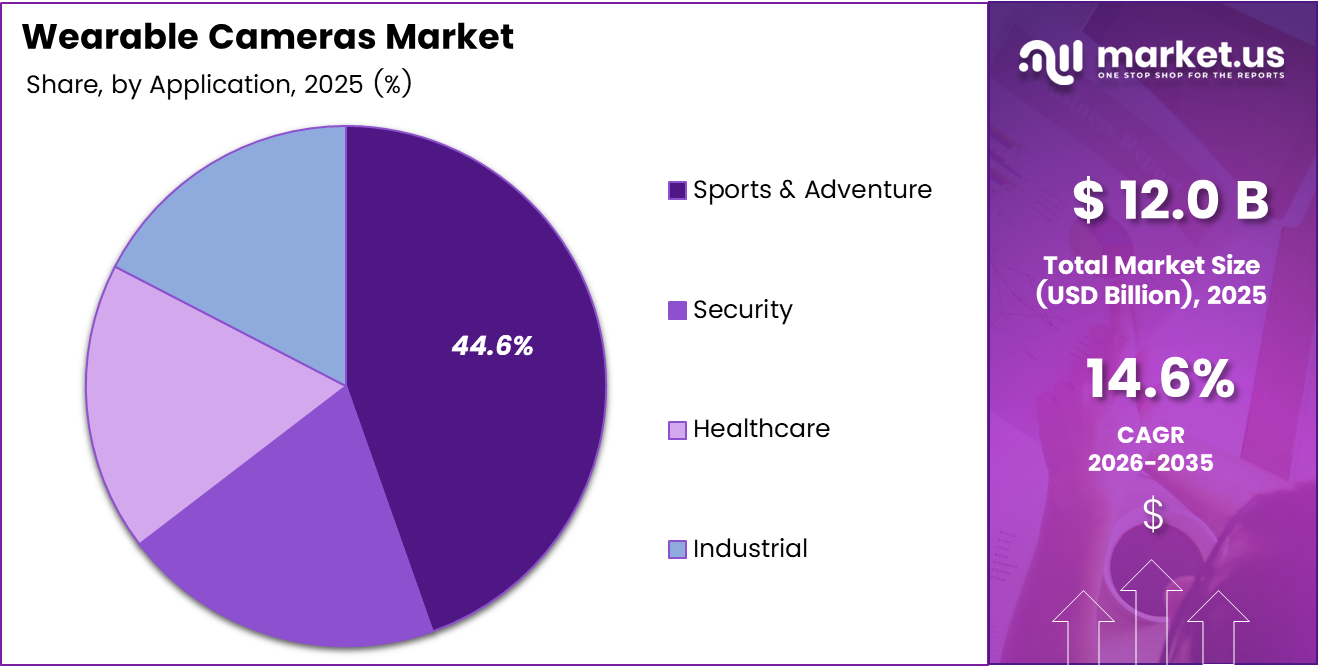
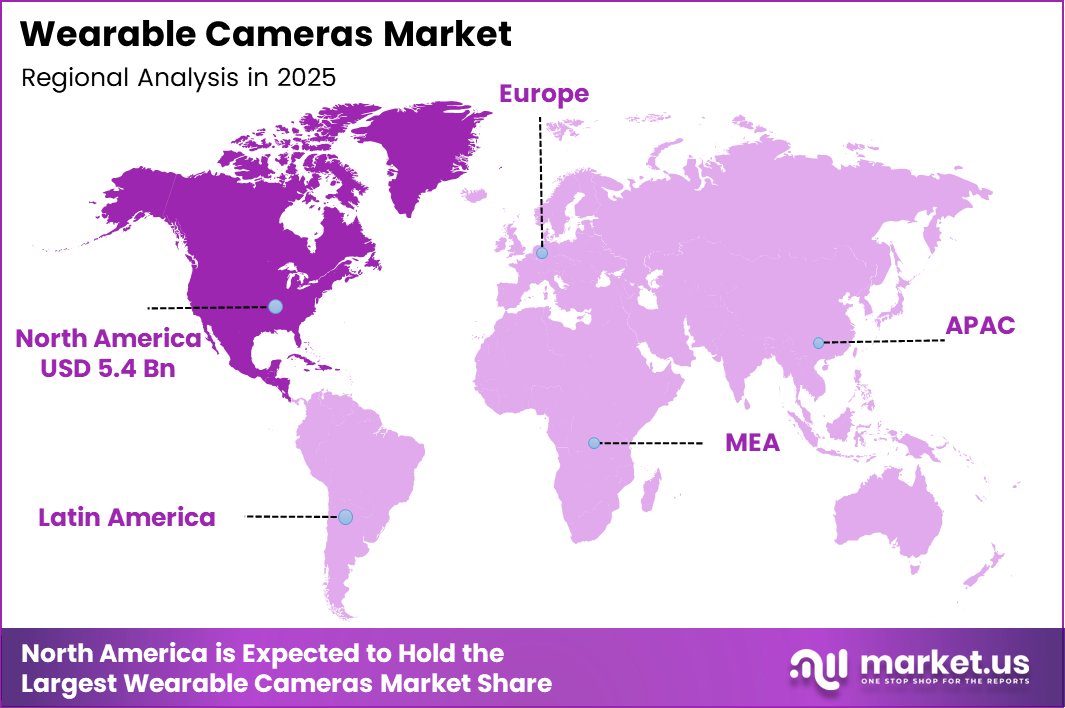
Law enforcement and public safety agencies are increasingly deploying body-worn cameras to improve accountability and transparency. Government mandates across North America and Europe require officers to wear recording devices during active duty. This regulatory push is creating consistent and large-scale demand for professional-grade wearable cameras in the security sector. Consumer demand for hands-free content creation and live streaming is another significant driver. Social media platforms and adventure sports culture have created a growing audience for first-person video content. Moreover, the ease of mounting wearable cameras on helmets, chest rigs, and clothing makes them the preferred choice for active users. Advancements in miniaturization, battery efficiency, and high-resolution imaging are making wearable cameras more powerful and accessible. Manufacturers are developing lighter, more compact devices with improved optical performance. Consequently, these technical improvements are expanding the addressable market by attracting both professional and casual users across diverse application segments. Data privacy remains one of the most significant challenges for the wearable cameras market. Continuous recording raises concerns about the unauthorized capture of individuals in private or sensitive settings. Consequently, regulators in several regions have introduced restrictions on where and how wearable cameras can be used, limiting their deployment in certain environments. Compliance with evolving privacy laws, such as GDPR in Europe, requires manufacturers and users to implement data management protocols. This adds operational complexity and cost, particularly for enterprise buyers. Moreover, public resistance to surveillance-style recording devices can slow adoption in consumer-facing applications like retail and hospitality sectors. Limited battery life and storage capacity are additional constraints for compact wearable camera devices. Users in field-intensive applications such as law enforcement or outdoor sports often require extended recording sessions. However, the physical size restrictions inherent to wearable form factors make it technically challenging to significantly increase power or storage capacity without compromising usability. Expanding applications in healthcare monitoring and remote medical training present a major growth opportunity for the wearable cameras market. Surgeons, paramedics, and trainers are increasingly using wearable recording devices to capture procedures in real time. Additionally, telemedicine platforms are integrating wearable cameras to enable remote consultations and expert guidance in clinical settings. The integration of wearable cameras with artificial intelligence, augmented reality, and real-time analytics platforms is significantly enhancing device value. AI-powered features such as facial recognition and object detection are opening new use cases in security and industrial monitoring. Moreover, AR-enabled smart glasses with embedded cameras are becoming viable tools for workforce training and remote assistance. Increasing adoption in industrial safety and workforce monitoring is driving demand from manufacturing, logistics, and construction sectors. Companies are using wearable cameras to track operations, improve safety compliance, and enable remote expert support. Furthermore, affordable smart wearables are gaining traction in emerging markets, expanding the global customer base for wearable camera manufacturers. Integration of wearable cameras with smart glasses and head-mounted displays is one of the most significant trends shaping the market. Manufacturers are embedding cameras directly into eyewear and headgear to create seamless, hands-free experiences. Moreover, this convergence is particularly relevant in enterprise applications such as remote assistance, field service, and augmented reality-guided workflows. Rising demand for cloud-connected and live-streaming wearable camera solutions is transforming how footage is captured and distributed. Users increasingly expect real-time video sharing through mobile networks and cloud platforms. Consequently, camera manufacturers are prioritizing built-in cellular and Wi-Fi capabilities to support instant content upload, remote monitoring, and collaborative viewing across connected devices. Adoption of AI-based facial recognition and object detection is expanding the analytical capabilities of wearable cameras beyond simple recording. Law enforcement, security, and industrial clients are leveraging these features for real-time identification and situational awareness. Additionally, growing popularity of modular and multi-sensor camera designs is allowing users to customize their devices for specific application requirements. North America leads the global wearable cameras market, holding a 45.80% share valued at USD 5.4 Billion. The region benefits from strong law enforcement adoption of body-worn cameras, high consumer spending on action cameras, and a well-established technology ecosystem. Moreover, federal mandates requiring police departments to use body cameras continue to drive sustained procurement activity. Europe represents a significant market for wearable cameras, supported by growing adoption in public safety, sports, and industrial sectors. Countries such as Germany, the UK, and France are investing in body-worn camera programs for law enforcement. However, stringent GDPR regulations require careful data handling practices, which adds compliance considerations for both manufacturers and enterprise buyers. Asia Pacific is emerging as a fast-growing region in the wearable cameras market, driven by increasing consumer electronics demand and expanding manufacturing capabilities. China and Japan are key contributors, with strong domestic production and rising adoption in sports and security applications. Additionally, affordable wearable camera models are gaining popularity among younger consumers across developing markets in the region. The Middle East and Africa market is gradually expanding, driven by infrastructure development and security-focused investments. Government agencies in GCC countries are deploying wearable cameras for public safety and border monitoring. Furthermore, rising interest in smart city initiatives across the region is expected to create additional demand for connected wearable imaging solutions over the forecast period. Latin America presents emerging growth potential for the wearable cameras market, with Brazil and Mexico leading regional adoption. Law enforcement modernization programs and growing sports culture are key demand drivers. Moreover, increasing smartphone penetration and social media usage are encouraging consumer investment in wearable content creation devices across urban populations in the region. North America Europe Asia Pacific Latin America Middle East & Africa JVCKENWOOD USA Corporation is a well-established player in the wearable cameras market, with a strong focus on body-worn camera solutions for law enforcement and public safety. The company offers rugged, reliable devices designed for demanding field conditions. Its deep experience in professional audio-visual technology positions it as a trusted supplier for government and enterprise security procurement programs. Sony Corporation brings significant optical and imaging expertise to the wearable cameras market. Sony’s action cameras and wearable imaging products are recognized for high-resolution performance, advanced stabilization, and compact design. Moreover, the company continuously invests in sensor technology and AI integration, allowing it to compete effectively across both consumer and professional wearable camera segments globally. Xiaomi has established a strong presence in the affordable wearable camera segment, particularly across Asia Pacific and emerging markets. The company leverages its broad consumer electronics ecosystem to offer competitively priced action cameras with solid performance. Additionally, Xiaomi’s strong online distribution network and brand recognition among younger consumers give it a distinct advantage in high-volume, price-sensitive markets. VIEVU LLC specializes in body-worn cameras designed specifically for law enforcement agencies and security professionals. The company focuses on evidence management solutions that integrate seamlessly with police records systems. Consequently, VIEVU has developed a loyal customer base among municipal and federal agencies seeking compliant, enterprise-grade wearable camera and data management platforms.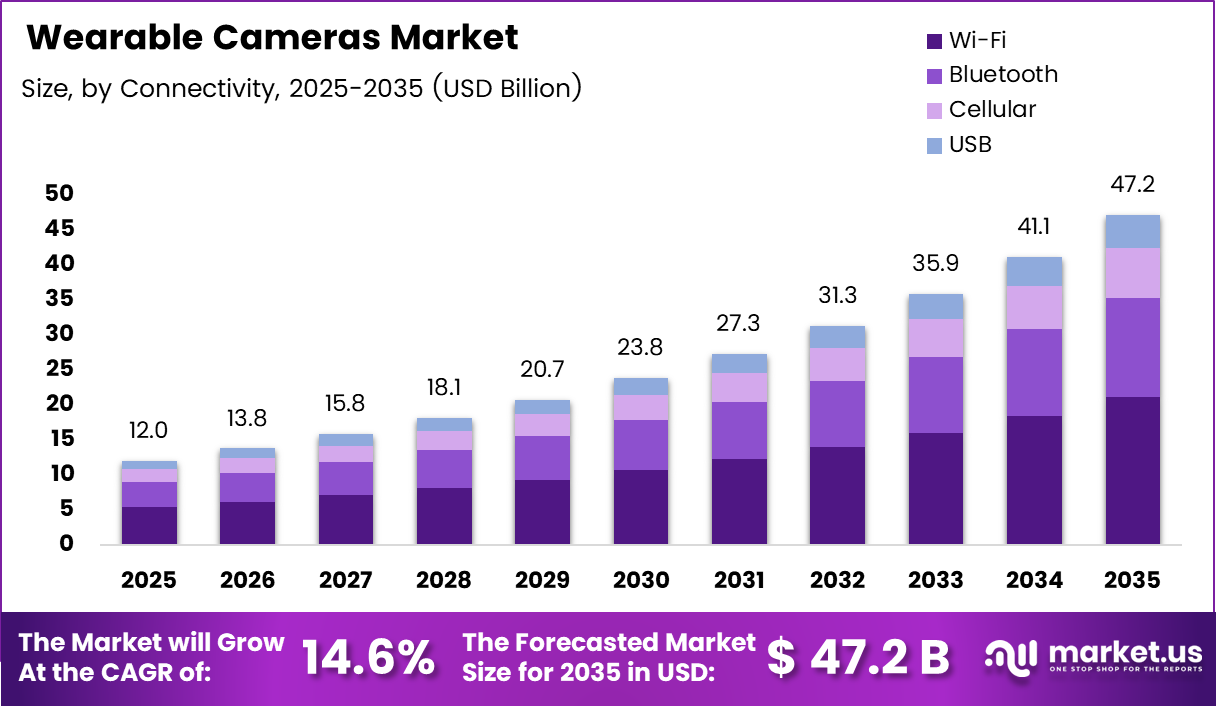
Key Market Segments
By Product
By Type
By Connectivity
By Application
Drivers
Rising Adoption of Body-Worn Cameras and Demand for Hands-Free Imaging Drive Market Growth
Restraints
Data Privacy Concerns and Battery Limitations Restrain Wearable Camera Market Growth
Growth Factors
AI Integration, Healthcare Adoption, and Emerging Markets Accelerate Wearable Camera Growth
Emerging Trends
Smart Integration, Cloud Connectivity, and AI Features Reshape the Wearable Camera Market
Regional Analysis
North America Dominates the Wearable Cameras Market with a Market Share of 45.80%, Valued at USD 5.4 Billion
Europe Wearable Cameras Market Trends
Asia Pacific Wearable Cameras Market Trends
Middle East and Africa Wearable Cameras Market Trends
Latin America Wearable Cameras Market Trends
Key Regions and Countries
Key Company Insights
Key Players
Recent Developments









