


Report Overview
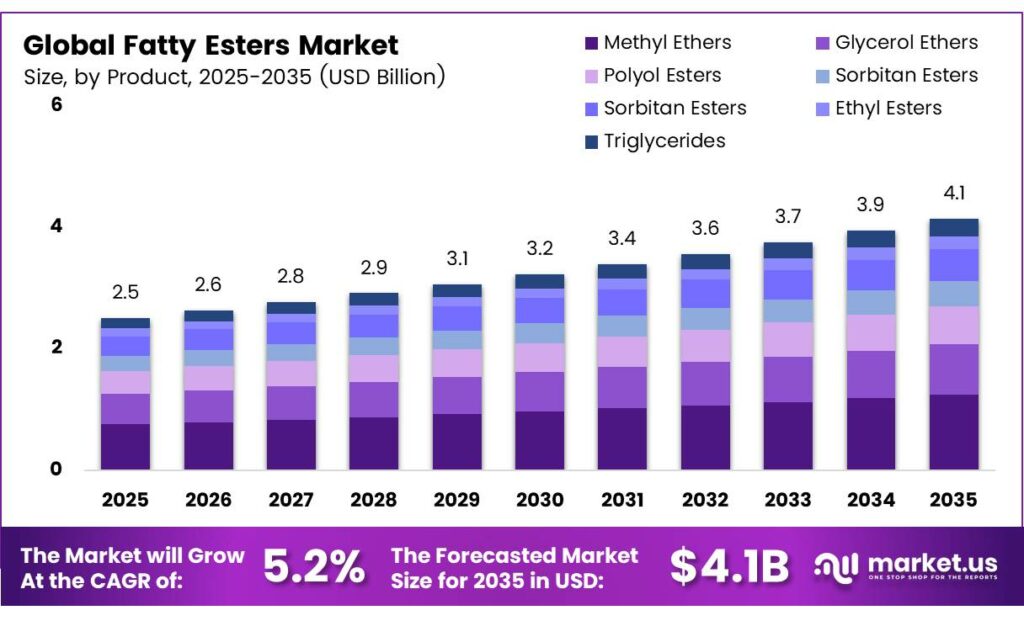
The Global Fatty Esters Market size is expected to be worth around USD 4.1 billion by 2035 from USD 2.5 billion in 2025, growing at a CAGR of 5.2% during the forecast period 2026 to 2035.
Fatty esters are organic compounds formed by the reaction of fatty acids with alcohols. Industries use these compounds widely as emulsifiers, lubricants, surfactants, and biodiesel feedstocks. Moreover, their bio-based origin makes them attractive alternatives to petroleum-derived chemicals across multiple sectors.
The market spans several end-use industries, including personal care, pharmaceuticals, food processing, and agrochemicals. Manufacturers produce fatty esters from natural feedstocks such as vegetable oils and animal fats. Consequently, the market aligns well with the global shift toward sustainable and renewable chemical inputs.
- Indonesia’s biodiesel (FAME) production reached 13.15 million kiloliters in 2024, surpassing the government’s annual target of 11.3 million kiloliters under the B35 mandatory blending program. This milestone reflects the massive and growing demand for fatty acid methyl esters as a clean fuel alternative in Asia’s largest economy.
Government policies supporting biodiesel and green chemistry accelerate market growth significantly. Regulatory frameworks in the European Union, Southeast Asia, and North America incentivize bio-based chemical adoption. Therefore, fatty ester producers benefit from favorable policy environments that reduce dependence on fossil-fuel-derived alternatives.
- Malaysia’s palm-based oleochemicals exports reached 2,993,592 tonnes in 2024, up 4.5% from 2,864,004 tonnes in 2023, generating export revenue of approximately USD 3.9 billion. This growth signals strong international demand for palm-derived fatty esters and related oleochemicals used in industrial and consumer applications.
Investment in oleochemical infrastructure across Asia and Europe strengthens the supply chain for fatty esters. Countries like Malaysia and Indonesia lead feedstock production, while Europe invests in downstream processing capacity. Additionally, rising demand from cosmetics and pharmaceutical companies creates strong pull-side dynamics for specialty ester grades.
Key Takeaways
- The Global Fatty Esters Market is valued at USD 2.5 billion in 2025 and is projected to reach USD 4.1 billion by 2035, at a CAGR of 5.2% during the forecast period 2026 to 2035.
- The Methyl Esters hold the dominant share at 34.6% in 2025.
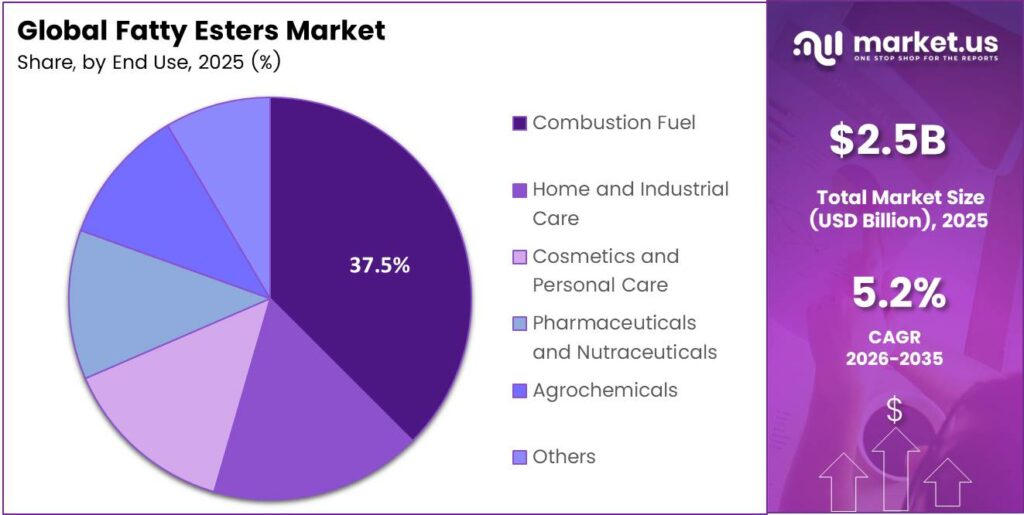
- The Combustion Fuel leads with a 37.5% market share in 2025.
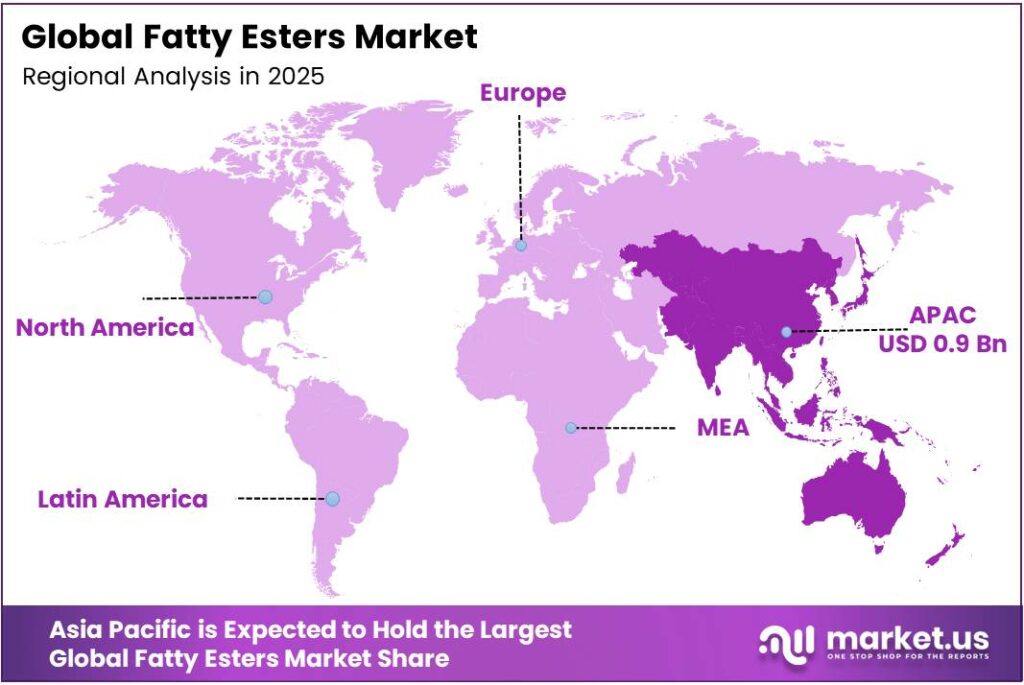
- Asia Pacific dominates regionally with a 38.1% share, valued at USD 0.9 billion in 2025.
By Product Type Analysis
Methyl Esters dominates with 34.6% due to strong biodiesel demand and industrial lubricant applications.
In 2025, Methyl Esters held a dominant market position in the By Product Type segment of the Fatty Esters Market, with a 34.6% share. These compounds serve as the primary component in biodiesel production globally. Moreover, their use as solvents and intermediates in personal care and industrial chemical formulations further strengthens demand across multiple end-use sectors.
Glycerol Esters represent a significant product category used extensively in food emulsification and pharmaceutical excipient applications. Manufacturers value glycerol esters for their safety profile and compatibility with biological systems. Additionally, the clean-label food trend drives manufacturers to replace synthetic emulsifiers with glycerol ester-based alternatives in processed food products.
Polyol Esters serve critical functions in high-performance lubricants, particularly for aviation and automotive applications. These esters offer superior thermal stability and low-temperature fluidity compared to mineral-based alternatives. Consequently, the aerospace and industrial machinery sectors consistently drive demand for polyol ester-based lubricant formulations.
Sorbitan Esters find wide application as non-ionic surfactants in cosmetics, food processing, and pharmaceutical formulations. Their emulsifying properties make them valuable across oil-in-water and water-in-oil systems. Furthermore, their GRAS (generally recognized as safe) status supports adoption in regulated food and personal care product categories.
Isopropyl Esters, including isopropyl myristate and isopropyl palmitate, remain key ingredients in cosmetics and personal care formulations. These esters enhance skin absorption and provide a non-greasy texture in lotions and creams. The growing premium skincare segment drives consistent demand for high-purity isopropyl ester grades.
Ethyl Esters serve both the pharmaceutical and food supplement industries, particularly as carriers for omega-3 fatty acids. Their higher bioavailability compared to triglyceride forms supports growth in nutraceutical applications. Moreover, pharmaceutical companies increasingly use ethyl esters in drug delivery systems requiring precise lipid-based formulations.
Medium-Chain Triglycerides (MCTs) have seen surging demand driven by the health and wellness industry. MCTs serve as energy substrates in sports nutrition, ketogenic diets, and clinical nutrition products. Additionally, their antimicrobial properties expand their application in food preservation and pharmaceutical formulations.
By End Use Analysis
Combustion Fuel dominates with 37.5% due to large-scale biodiesel adoption and government blending mandates.
In 2025, Combustion Fuel held a dominant market position in the By End Use segment of the Fatty Esters Market, with a 37.5% share. Biodiesel programs in Indonesia, Brazil, and the European Union drive massive consumption of fatty acid methyl esters. Government blending mandates make combustion fuel the single largest demand driver for fatty esters globally.
Home and Industrial Care applications use fatty esters as surfactants, emulsifiers, and lubricants in cleaning products and industrial fluids. Manufacturers prefer bio-based fatty esters over petrochemical surfactants due to better biodegradability. Additionally, stricter environmental regulations on synthetic detergent ingredients support the shift toward fatty ester-based cleaning formulations.
Cosmetics and Personal Care represent one of the fastest-growing end-use segments for specialty fatty esters. Emollients, skin conditioners, and texture agents derived from isopropyl and sorbitan esters dominate premium skincare formulations. Furthermore, the global rise in demand for natural and sustainable beauty products strengthens this segment’s growth trajectory.
Pharmaceuticals and Nutraceuticals rely on fatty esters as excipients, drug carriers, and active pharmaceutical ingredients. Ethyl esters of omega-3 fatty acids serve as FDA-approved treatments for hypertriglyceridemia. Moreover, the expanding nutraceutical market for MCT-based supplements and lipid-based drug delivery systems supports consistent volume growth in this segment.
Agrochemicals use fatty esters as adjuvants, carriers, and emulsifiers in pesticide and herbicide formulations. These bio-based esters improve active ingredient penetration and reduce runoff in field applications. Consequently, growing adoption of precision agriculture and bio-compatible agrochemical formulations expands the role of fatty esters in this segment.
Key Market Segments
By Product Type
- Methyl Esters
- Glycerol Esters
- Polyol Esters
- Sorbitan Esters
- Isopropyl Esters
- Ethyl Esters
- Medium-Chain Triglycerides (MCTs)
By End Use
- Combustion Fuel
- Home and Industrial Care
- Cosmetics and Personal Care
- Pharmaceuticals and Nutraceuticals
- Agrochemicals
- Others
Emerging Trends
Sustainability and Innovation Reshape the Fatty Esters Market Landscape
Advanced production technologies such as enzymatic esterification and continuous flow chemistry improve fatty ester manufacturing efficiency. These methods reduce energy consumption and improve product purity compared to traditional batch processes. Moreover, producers increasingly invest in process automation to lower operating costs and meet rising quality standards across the personal care and pharmaceutical sectors.
- The fatty esters market shifts steadily toward sustainable solutions driven by corporate sustainability commitments and consumer preferences. Bio-based esters replace petroleum-derived ingredients in industrial lubricants, home care products, and cosmetic formulations. Malaysia and Indonesia together supply approximately 55-60% of global crude palm oil, the primary feedstock for lauric-chain and palmitic-chain fatty acid esters widely used in personal care and industrial applications.
Fatty acid methyl esters continue to dominate biodiesel and lubricant applications as the most cost-effective bio-based fuel component. Meanwhile, rising preference for tall-oil-based esters over traditional tallow-derived variants reflects changing feedstock economics and animal-free sourcing requirements. Consequently, tall-oil and plant-based ester variants gain traction among European and North American manufacturers prioritizing non-animal supply chains.
Drivers
Biodiesel Demand, Sustainability Goals, and Personal Care Growth Drive the Fatty Esters Market
Consumer preference for natural and specialty esters drives significant product innovation across cosmetics, food, and pharmaceutical industries. Brands reformulate products using bio-derived emulsifiers and skin-conditioning agents to meet clean-label demands. Evonik Industries Nutrition and Care division — which includes care solutions products using fatty acid esters — posted FY2024 sales of €3,764 million, a 4% improvement year-on-year, demonstrating strong market pull for specialty ester ingredients in personal care applications.
- Environmental regulations and government biodiesel mandates create structural demand for fatty acid methyl esters as a sustainable fuel alternative. Global FAME biodiesel production reached approximately 46 million metric tonnes, with the Asia-Pacific region surpassing the EU as the world’s leading biodiesel-producing region for the first time. This milestone confirms the central role of biodiesel mandates in driving fatty ester consumption at an industrial scale.
The personal care industry expands its use of fatty esters as emulsifiers, moisturizers, and texture agents in skin and hair care products. Rising disposable incomes in emerging markets fuel demand for premium cosmetic products formulated with specialty esters. Therefore, manufacturers invest in high-purity isopropyl, sorbitan, and glycerol ester production capacity to serve the growing global beauty and personal care sector.
Restraints
Raw Material Price Volatility and Regulatory Compliance Costs Constrain Market Growth
Volatility in vegetable oil and animal fat prices directly impacts fatty ester production costs and profit margins. Palm oil, soybean oil, and tallow represent key raw materials subject to agricultural yield fluctuations, weather events, and geopolitical trade disruptions. Consequently, manufacturers face difficulty in maintaining stable pricing for downstream customers, particularly in competitive commodity ester markets such as biodiesel feedstocks.
- Stringent regulatory standards governing product safety, environmental impact, and labeling increase compliance costs for fatty ester producers. Croda International, a leading specialty chemical producer, reported that its FY2024 total group sales declined to £1,628.1 million from £1,694.5 million in FY2023, partly reflecting challenging demand conditions and pricing pressure in specialty chemical segments where fatty ester derivatives serve as key inputs. Regulatory complexity adds operational burden across supply chains targeting regulated markets.
Smaller producers and new market entrants face barriers related to capital investment requirements for bio-based ester manufacturing facilities. Compliance with REACH, FDA, and other regional chemical regulations demands significant technical and administrative resources. Moreover, evolving sustainability certification requirements for palm-derived feedstocks add further complexity to procurement and supply chain management for fatty ester producers globally.
Growth Factors
Biodiesel Expansion, Pharmaceutical Innovation, and Green Chemistry Open New Growth Avenues
Emerging applications in sustainable chemical processes and industrial recycling expand the addressable market for fatty acid esters. Green chemistry initiatives promote fatty esters as biodegradable process aids and reactive intermediates in polymer and surfactant manufacturing. The European Union’s FAME production reached approximately 9.8 million tonnes in 2024, while EU anti-dumping measures against Chinese biodiesel support domestic oleochemical producers and strengthen European fatty ester market fundamentals.
- The pharmaceutical sector offers high-value growth opportunities through bio-based ester formulations for drug delivery systems and nutraceutical products. Ethyl esters of omega-3 fatty acids, MCT-based excipients, and lipid nanoparticle carriers represent expanding application areas with premium pricing potential. IOI Corporation’s Resource-Based Manufacturing segment — which includes oleochemicals producing fatty esters and soap noodles — posted a profit of RM329.3 million in FY2024, reflecting continued investment in value-added ester product lines despite short-term margin pressure.
Favorable green technology policies and biodiesel blending mandates support long-term expansion of fatty ester production capacity globally. Governments in Brazil, Indonesia, Malaysia, and the European Union maintain or strengthen biofuel blend targets, ensuring consistent baseline demand for fatty acid methyl esters. Therefore, producers investing in integrated oleochemical complexes benefit from policy-backed demand stability while developing specialty product lines for higher-margin end markets.
Regional Analysis
Asia Pacific Dominates the Fatty Esters Market with a Market Share of 38.1%, Valued at USD 0.9 Billion
Asia Pacific leads the global fatty esters market with a 38.1% share valued at USD 0.9 billion in 2025. The region’s dominance stems from large-scale oleochemical production in Malaysia and Indonesia, both of which supply the primary palm-based feedstocks for fatty ester manufacturing. Moreover, strong domestic biodiesel mandates, growing personal care industries in China and India, and rising pharmaceutical manufacturing capacity collectively reinforce the Asia Pacific’s market leadership position through the forecast period.
North America represents a mature but innovation-driven fatty ester market focused on specialty and high-purity grades for pharmaceutical, personal care, and industrial applications. The United States supports bio-based chemical adoption through renewable fuel standards and green chemistry incentives. Additionally, growing demand for MCT-based nutritional supplements and clean-label food ingredients drives premium segment growth across the region.
Europe maintains a strong fatty esters market supported by robust biodiesel production infrastructure and stringent sustainability regulations. Germany, France, and the Netherlands lead regional FAME biodiesel output, collectively accounting for nearly half of EU production volume. Furthermore, the EU’s REACH framework and Cosmetics Regulation drive demand for well-characterized, bio-based ester ingredients in personal care and specialty chemical applications.
Latin America holds significant growth potential in the fatty esters market, primarily driven by Brazil’s large-scale biodiesel program using soybean oil feedstocks. Brazil ranks as the second-largest FAME biodiesel producer globally, creating strong regional demand for fatty acid methyl esters. Moreover, expanding personal care and agrochemical industries in Mexico and Brazil support additional volume growth in non-fuel fatty ester applications.
Key Regions and Countries
North America
- US
- Canada
Europe
- Germany
- France
- The UK
- Spain
- Italy
- Rest of Europe
Asia Pacific
- China
- Japan
- South Korea
- India
- Australia
- Rest of APAC
Latin America
- Brazil
- Mexico
- Rest of Latin America
Middle East & Africa
- GCC
- South Africa
- Rest of MEA
Key Players Analysis
Arkema is a leading specialty chemicals and advanced materials company with a significant presence in the fatty ester supply chain through its bio-based polymer and oleochemical intermediate businesses. The company focuses on sustainable chemistry solutions that align with growing market demand for bio-derived surfactants and ester-based additives. Its research and development investments target high-performance bio-based materials for industrial and consumer applications.
BASF SE operates one of the world’s most comprehensive portfolios in care chemicals, including a broad range of fatty esters used in personal care, home care, and industrial applications. The company serves global customers through integrated manufacturing sites and a strong technical service network. BASF’s commitment to sustainable innovation drives the continued development of bio-based ester ingredients that meet evolving regulatory and performance requirements.
Cargill Incorporated leverages its extensive agricultural and oleochemical supply chain to produce a wide range of fatty acids, glycerides, and ester derivatives for food, personal care, and industrial markets. The company’s integrated model from crop sourcing to specialty chemical manufacturing gives it a distinct competitive advantage in cost and traceability. Cargill’s investments in bio-refinery technologies support its growing position in the specialty fatty ester segment.
Top Key Players in the Market
- Arkema
- BASF SE
- Cargill Incorporated
- Cayman Chemical
- Elevance Renewable Sciences Inc.
- Krishi Oils Limited
- Larodan AB (ABITEC)
- Merck KGaA
- TCI Chemicals (India) Pvt. Ltd
- Wilmar International Ltd
Recent Developments
- In 2025, Arkema’s Oleris range of bio-based C7 and C11 oleochemicals, derived from renewable castor oil, received the USDA BioPreferred product label. This includes high-purity, carbon-neutral fatty acids, alcohols, and esters such as Oleris n-Heptanoic Acid (a bio-based C7 linear fatty acid), Oleris Methyl Undecylenate (a bifunctional fatty ester), and related products.
- In 2025, BASF completed the sale of its Food and Health Performance Ingredients Business to Louis Dreyfus Company (LDC). This includes health ingredients such as plant sterol esters (fatty acid esters used for cholesterol management in human nutrition), conjugated linoleic acid (CLA), and omega-3 oils. The move sharpens BASF’s focus on prioritized segments while expanding LDC’s plant-based ingredients portfolio.









