


Report Overview
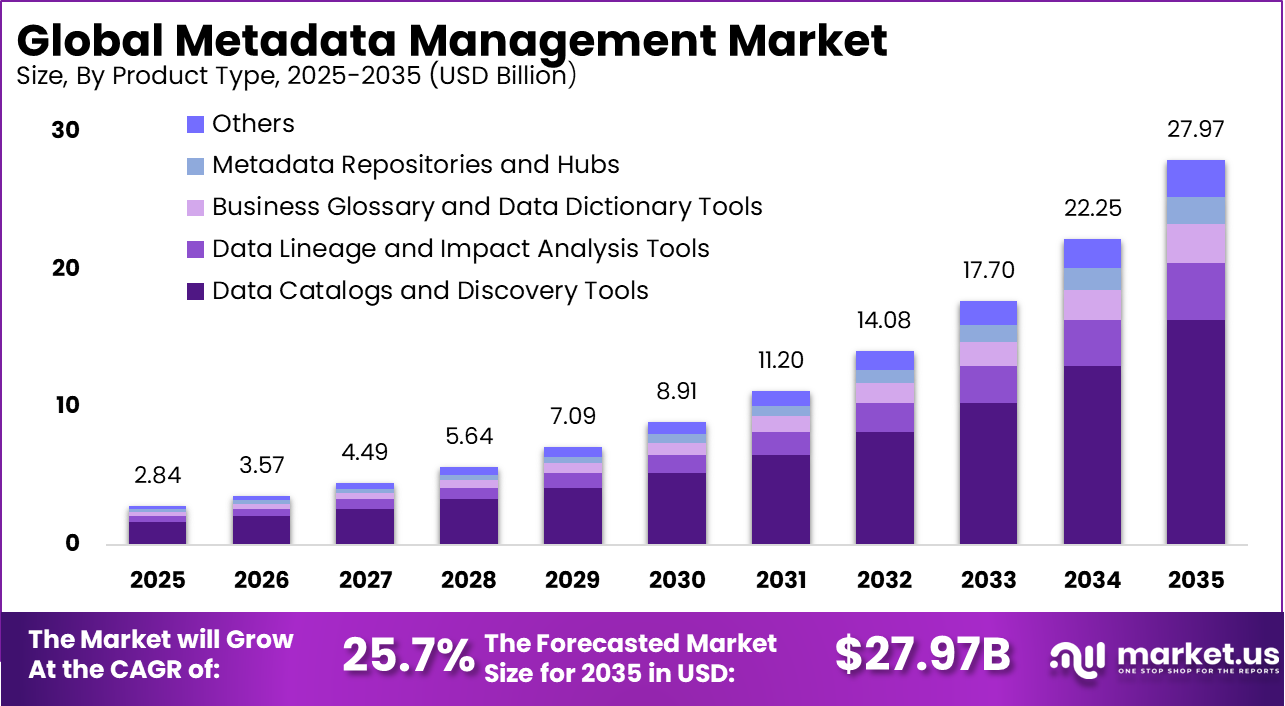
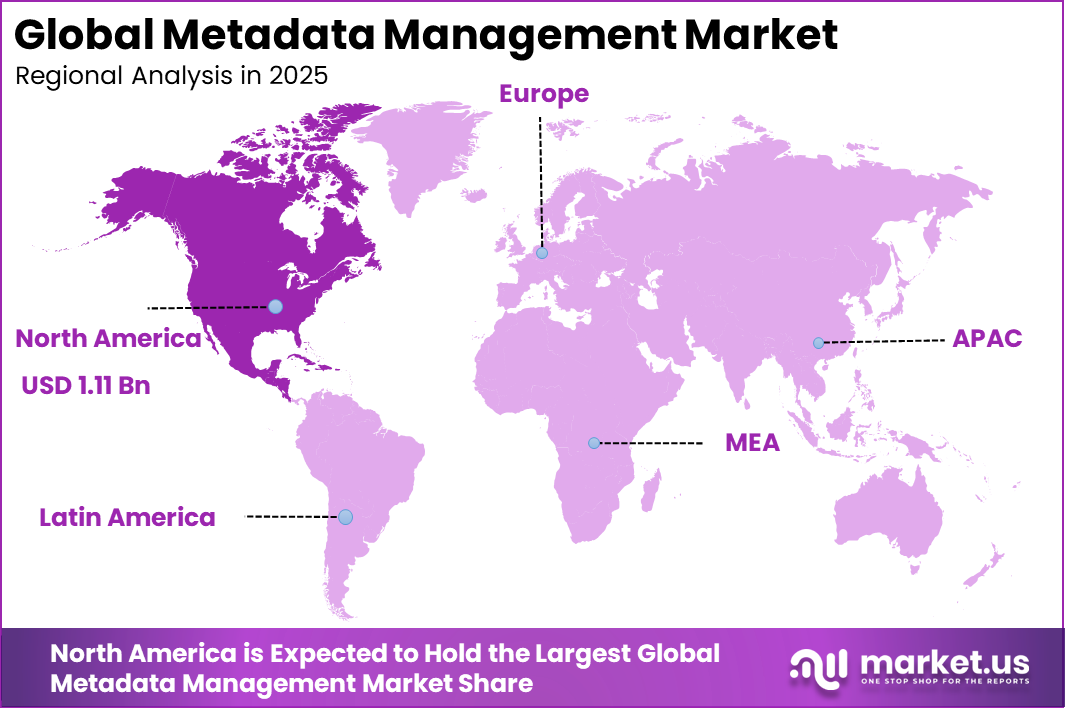
The Global Metadata Management Market size is expected to be worth around USD 27.97 billion by 2035, from USD 2.84 billion in 2025, growing at a CAGR of 25.7% during the forecast period from 2025 to 2035. North America held a dominant market position, capturing more than a39.15% share, holding USD 1.11 billion in revenue.
The Metadata Management market describes systems, platforms and practices that capture, organize and maintain metadata across data assets within an organization. Metadata refers to descriptive information about data such as source, context, lineage, ownership, definitions and usage patterns. Effective metadata management enables enterprises to understand what data exists, where it came from and how it is used in analytics, reporting and operational processes.
One primary driver is the expansion of enterprise data ecosystems across multiple cloud and on premises systems. As businesses adopt cloud computing and distributed data architectures, tracking data lineage and ownership becomes more complex. Metadata platforms provide unified visibility and standardized classification across environments. This reduces operational silos and improves decision reliability. Demand is concentrated among large global enterprises that manage extensive data volumes and operate across multiple jurisdictions.
Emerging Trend Analysis
An important emerging trend in the Metadata Management market is the adoption of AI and machine learning to automate cataloging and metadata extraction. Traditional metadata capture often relied on manual tagging and rule-based techniques, which could be slow and inconsistent. Modern systems now use machine learning to scan data assets, infer context and automatically generate rich metadata, including semantic relationships and usage patterns.
Another emerging trend involves integration of metadata management with data observability and quality frameworks. Instead of maintaining isolated catalogs, organizations are connecting metadata to operational metrics, lineage and quality scores to create a unified data context. This integrated approach supports faster issue resolution and improves confidence in analytics by linking quality insights directly to data definitions and lineage.
Key Market Segments
By Product Type
- Data Catalogs and Discovery Tools
- Data Lineage and Impact Analysis Tools
- Business Glossary and Data Dictionary Tools
- Metadata Repositories and Hubs
- Others
By Deployment Model
- Cloud and SaaS Subscription
- On-Premises Software License
- Open Source
By Target Organization Size
- Large Global Enterprises
- Mid-Market and Tech-Native Companies
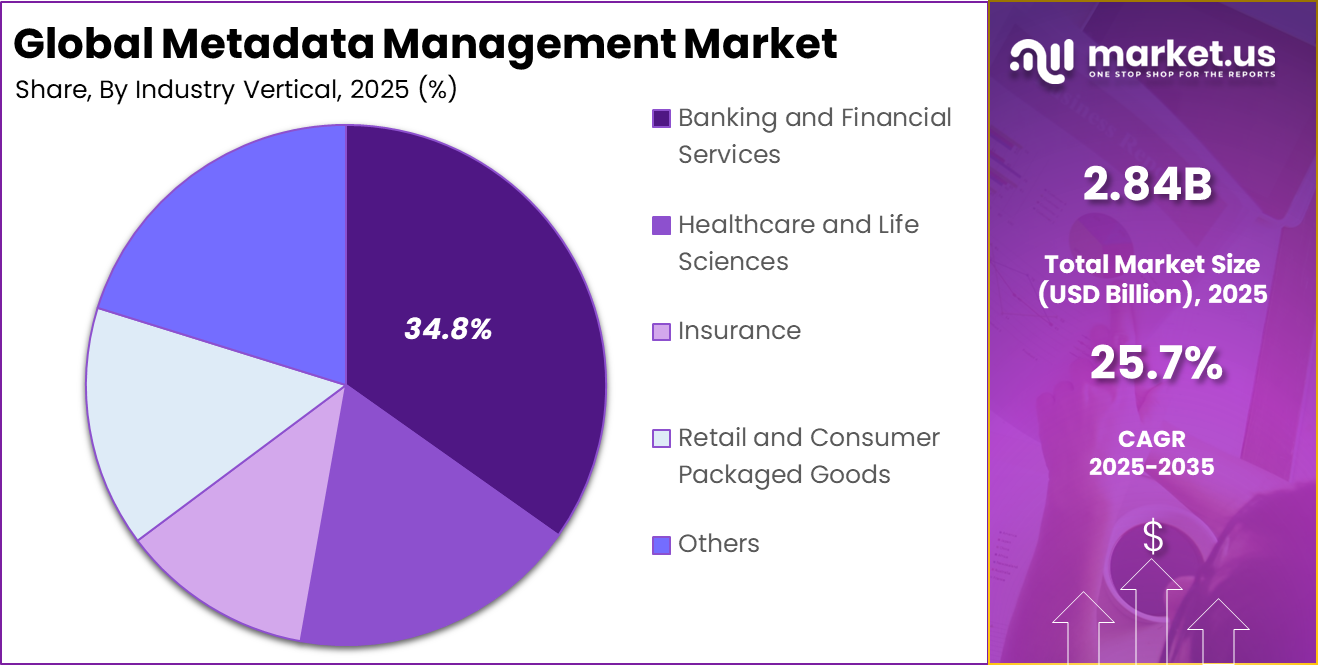
By Industry Vertical
- Banking and Financial Services
- Healthcare and Life Sciences
- Insurance
- Retail and Consumer Packaged Goods
- Others
Key Regions and Countries
North America
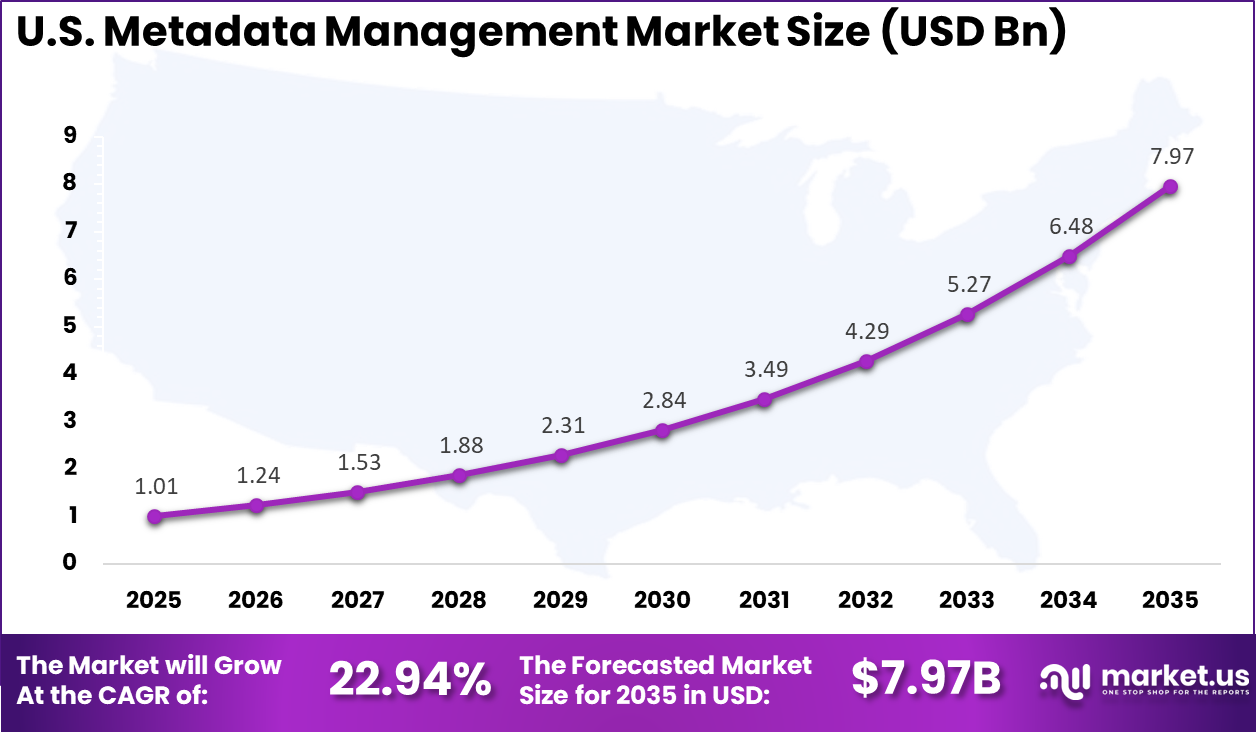
- US
- Canada
Europe
- Germany
- France
- The UK
- Spain
- Italy
- Russia
- Netherlands
- Rest of Europe
Asia Pacific
- China
- Japan
- South Korea
- India
- Australia
- Singapore
- Thailand
- Vietnam
- Rest of APAC
Latin America
- Brazil
- Mexico
- Rest of Latin America
Middle East & Africa
- South Africa
- Saudi Arabia
- UAE
- Rest of MEA
Drivers
Growing Need for Data Governance
A major driver of metadata management is the rising importance of data governance and compliance. Organisations are handling increasing volumes of sensitive information and need to ensure accuracy, transparency, and accountability. Metadata practices provide visibility into where data comes from and how it is used, helping teams maintain trust and reliability across operations.
Improved governance also enhances collaboration between departments. When data definitions and lineage are clearly documented, employees can make informed decisions faster and reduce errors in reporting. Organisations benefit from more efficient operations and stronger confidence in their analytics outputs.
For instance, in June 2025, Collibra rolled out updates focused on data governance with GenAI-powered quality checks and automated workflows. This helps teams track data lineage end-to-end and prioritize fixes based on real business needs. Such moves show how governance tools meet the rising call for reliable data handling in daily operations.
Restraint
High Implementation Costs
One of the key restraints in metadata management adoption is the high cost of implementation. Tools, integration processes, and ongoing maintenance require substantial investment, which can be challenging for smaller organisations or those with limited IT budgets. These costs often delay adoption or limit full deployment of metadata solutions.
In addition to upfront expenses, metadata management systems require skilled personnel for setup, configuration, and ongoing optimisation. Hiring or training staff adds to the overall financial burden, making it difficult for organisations without dedicated resources to maintain robust metadata practices consistently.
For instance, in September 2025, Informatica launched a major upgrade to its metadata platform, but reports highlighted steep setup demands on resources and time. Many users noted the heavy lift for customization across legacy systems, underscoring costs that slow adoption for budget-conscious firms. This reflects broader hurdles in justifying big spends upfront.
Opportunities
Integration with Advanced Analytics and AI
Metadata management offers strong opportunities when integrated with advanced analytics and AI. Automation in classification, tagging, and discovery helps organisations reduce manual work while improving data quality. These tools allow users to find and interpret datasets more efficiently, enhancing reporting and decision-making.
Integrating metadata systems with cloud platforms and AI-driven analytics creates cohesive data environments. Organisations can unify fragmented data sources, streamline workflows, and gain deeper insights. This integration also opens possibilities for innovation and improved operational efficiency across multiple business functions.
For instance, in November 2025, Alation deepened ties with AI analytics by adding semantic search and auto-tagging features to its catalog. This lets users blend metadata with machine learning models for quicker insights from scattered data sources. It opens paths for smarter data use in decision-making across teams.
Challenges
Complex Integration and Technical Skill Gaps
A major challenge in metadata management is integrating new solutions with existing IT infrastructure. Legacy systems and fragmented data environments can make connecting to modern metadata tools difficult. Achieving seamless integration often requires technical expertise, careful planning, and custom development.
Another challenge is the shortage of skilled professionals experienced in metadata governance and tools. Without trained personnel, organisations may face inconsistent practices, uneven data quality, and delays in realising the benefits of metadata management. Training and knowledge building are essential to overcome these gaps.
For instance, in January 2026, IBM faced pushback on its metadata integration push with hybrid cloud setups, citing skill shortages in handling complex lineage mapping. Teams struggled to align old and new systems without deep expertise, delaying full rollout. This points to ongoing gaps in technical know-how needed for seamless merges.
Key Players Analysis
The Metadata Management Market is shaped by a mix of enterprise software leaders and modern data catalog specialists. IBM, Microsoft, Oracle, and SAP provide integrated metadata governance capabilities within their broader data management suites. Their platforms support large scale enterprises that require centralized data lineage, compliance tracking, and master data control. Strong cloud integration and hybrid deployment flexibility have reinforced their adoption across regulated industries.
Cloud hyperscalers are expanding metadata services as part of modern data platforms. Amazon Web Services and Google embed metadata cataloging, discovery, and lineage tools within analytics and data lake environments. These providers benefit from growing enterprise migration to cloud native architectures. Metadata management is increasingly positioned as a foundation for AI driven analytics and data governance frameworks.
Specialized vendors focus on collaborative data cataloging and automated lineage mapping. Collibra, Alation, and Informatica emphasize user friendly data discovery and stewardship workflows. Emerging players such as Atlan, MANTA Software, Alex Solutions, Adaptive, and Precisely compete through automation, active metadata capabilities, and integration with modern data stacks.
Top Key Players in the Market
- Collibra
- Alation
- Informatica
- IBM
- Microsoft
- Amazon Web Services
- Oracle
- SAP
- Atlan
- world
- MANTA Software
- Alex Solutions
- Adaptive
- Precisely
- Others
Recent Developments
- In October 2025, Alex Solutions upgraded its AI‑first metadata platform with no‑code customization, ML‑driven anomaly detection, and a business knowledge graph that connects technical and business terms. The platform now supports full‑lifecycle metadata governance in hybrid environments.
- In April 2025, data.world enhanced its metadata governance platform with real‑time updates, AI‑driven tagging, and a knowledge‑graph‑based catalog that improves result accuracy over traditional systems. The company now emphasizes live, collaborative metadata workflows for data consumers.









