


Report Overview
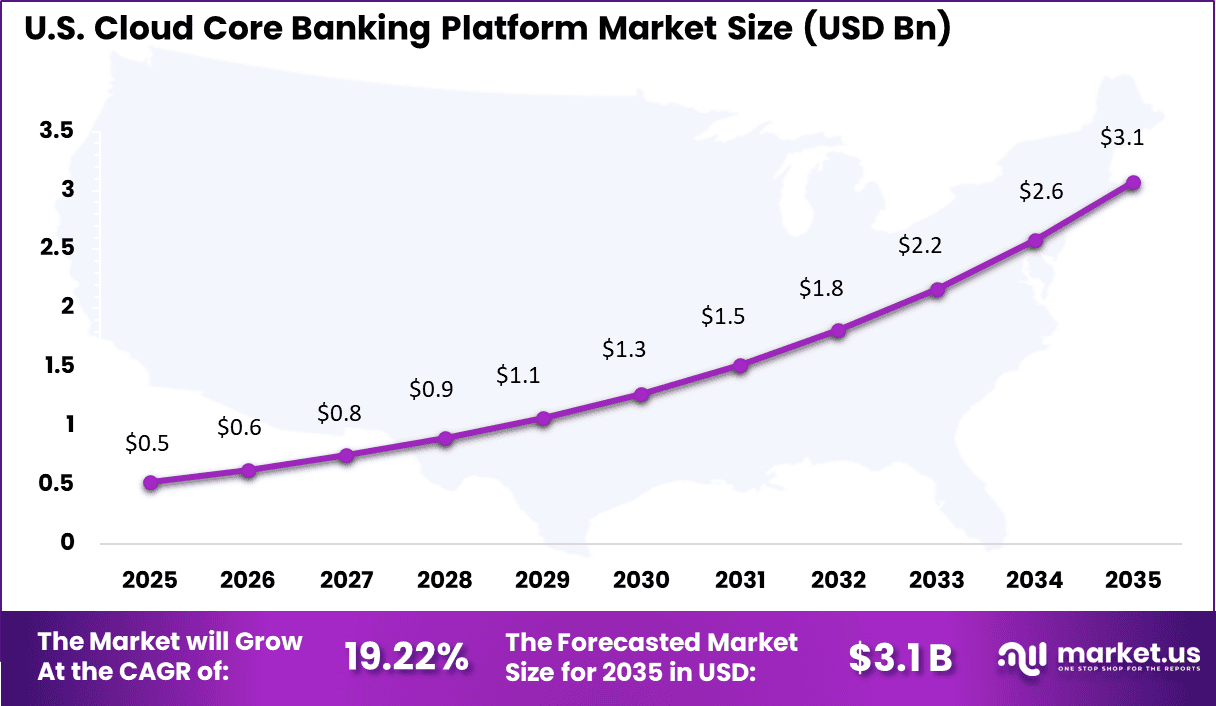
The Global Cloud Core Banking Platform Market generated USD 1.6 billion in 2025 and is predicted to register growth from USD 1.9 billion in 2026 to about USD 11.1 billion by 2035, recording a CAGR of 21.40% throughout the forecast span. In 2025, North America held a dominan market position, capturing more than a 36.7% share, holding USD 0.58 Billion revenue.
The Cloud Core Banking Platform Market refers to the ecosystem of banking technology solutions where core banking functions are delivered through cloud infrastructure instead of traditional on premises data centers. These platforms manage critical operations such as deposits, lending, payments processing, customer records, and regulatory reporting within a centralized digital framework. Cloud deployment enables banks to access systems remotely, scale resources based on transaction volumes, and support continuous software updates.
Top driving factors include the rapid digitalization of banking services and the growing need for real time financial transactions. Customers now expect instant payments, mobile banking access, and personalized services, which require modern and scalable backend systems. Regulatory compliance requirements have also become more complex, prompting banks to adopt platforms that support automated reporting and stronger data governance.
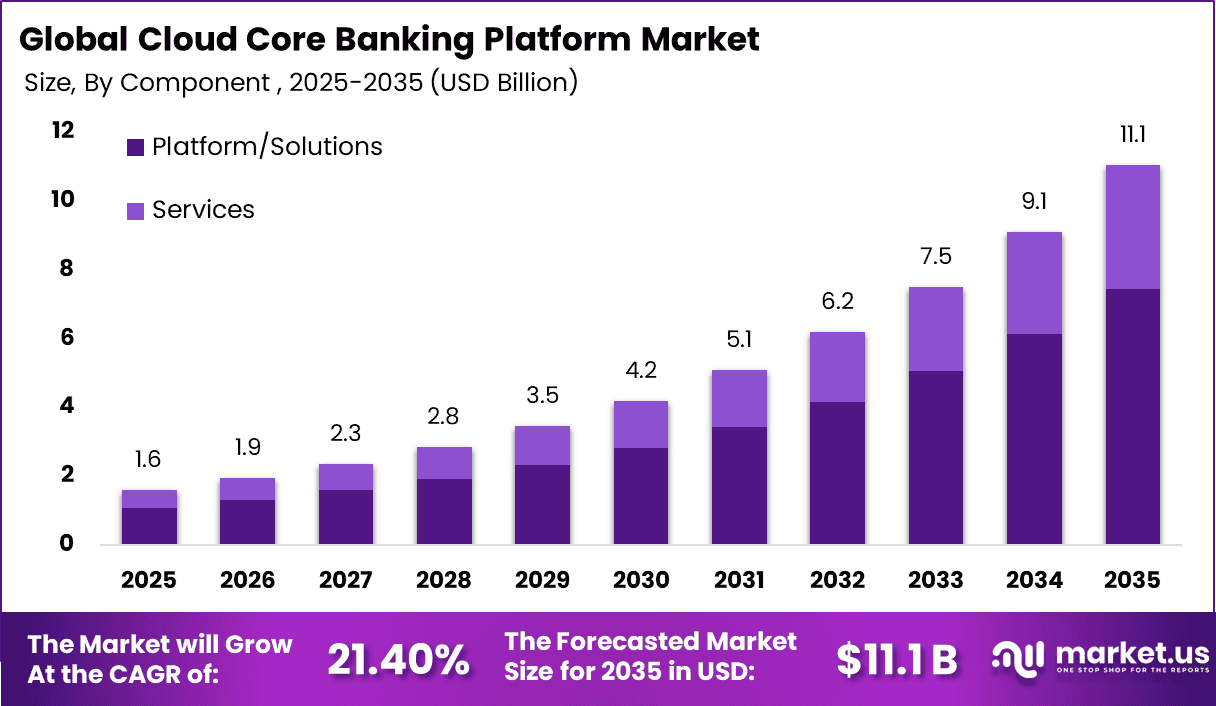
Demand analysis shows strong interest from both traditional banks and digital only financial institutions. Established banks are modernizing legacy core systems to remain competitive, while challenger banks are building operations entirely on cloud based infrastructure. Demand is particularly strong in regions where mobile banking adoption is high and financial inclusion initiatives are expanding.
Growth in the cloud core banking platform market is supported by the shift toward modular and scalable technology architectures. Banks are increasingly adopting phased migration strategies to reduce operational risk while modernizing critical systems. Improved data access and processing speed further enhance decision making and customer experience.
Top Market Takeaways
- By component, platform/solutions account for 67.4% of the market, offering modular core systems for accounts, transactions, lending, and compliance via microservices architecture.
- By deployment model, public cloud represents 58.9%, enabling rapid scaling, pay-as-you-go economics, and multi-tenant efficiency for agile banking operations.
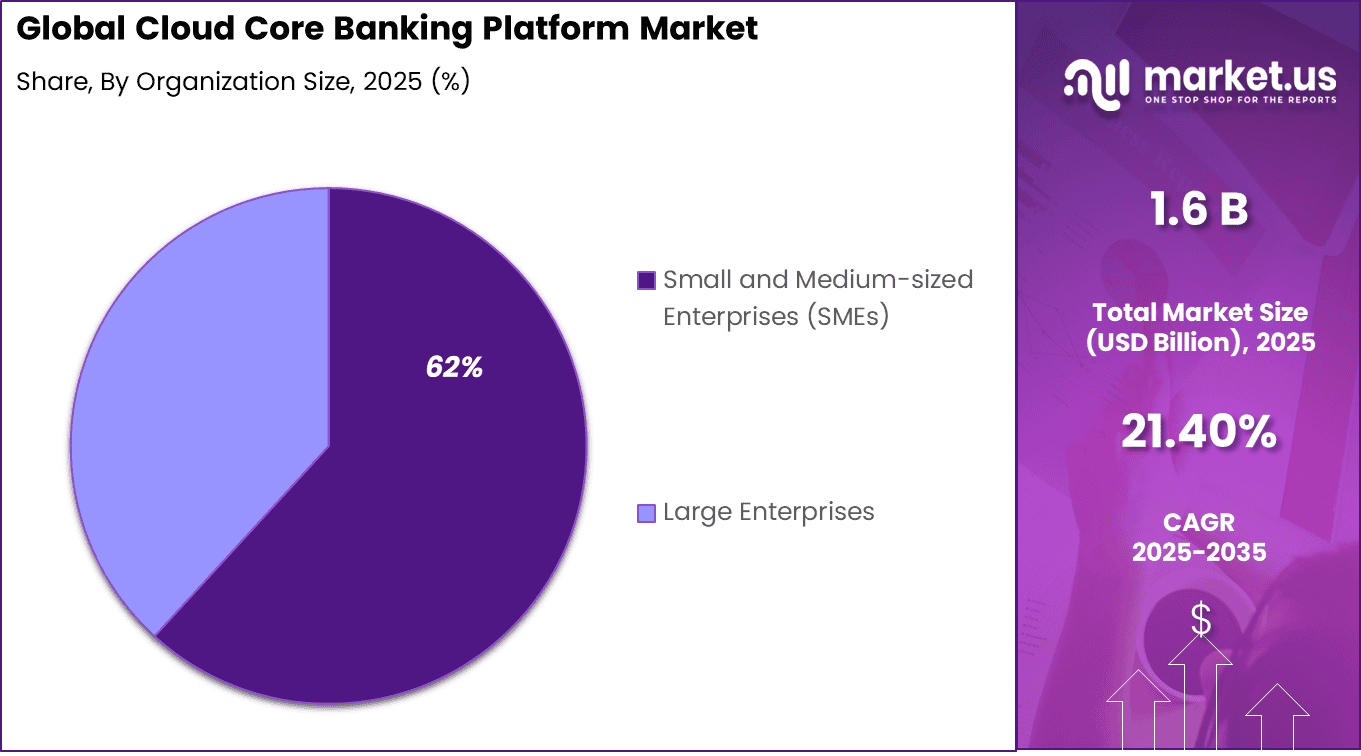
- By organization size, SMEs & neobanks hold 61.8% share, benefiting from affordable entry to modern cores without legacy migration burdens.
- By application, retail banking captures 52.7%, powering digital accounts, payments, personal loans, and customer self-service features.
- By end-user, neobanks & FinTechs command 47.3%, leveraging cloud platforms to launch competitive services quickly amid traditional bank digitization.
- By region, North America leads with 36.7% of the global market, where the U.S. is valued at USD 0.53 billion with a projected CAGR of 19.22%, fueled by challenger bank proliferation and cloud-native innovation.
Drivers Impact Analysis
| Key Driver | Impact on CAGR Forecast (~%) | Geographic Relevance | Impact Timeline |
|---|---|---|---|
| Accelerated shift from on-premise to cloud-native banking cores | +5.9% | North America, Europe | Short to medium term |
| Rapid growth of digital banks and fintech-led institutions | +4.8% | Europe, Asia Pacific | Medium term |
| Demand for scalability, cost efficiency, and faster product launches | +4.3% | Global | Medium term |
| Rising adoption of real-time payments and always-on banking | +3.6% | Global | Short to medium term |
| Expansion of open banking and Banking-as-a-Service models | +2.8% | North America, Asia Pacific | Medium to long term |
Restraints Impact Analysis
| Key Restraint | Impact on CAGR Forecast (~%) | Geographic Relevance | Impact Timeline |
|---|---|---|---|
| Data security and regulatory compliance concerns | −3.9% | Europe, North America | Short to medium term |
| Complexity of migrating legacy core systems to the cloud | −3.3% | Global | Medium term |
| Limited cloud readiness among traditional banks | −2.8% | Asia Pacific, Latin America | Medium term |
| Dependence on cloud service providers and vendor lock-in | −2.3% | Global | Medium term |
| Long procurement and approval cycles in regulated institutions | −1.9% | North America, Europe | Medium to long term |
Emerging Trends
In the Cloud Core Banking Platform market, a strong trend is the move toward modular, cloud-native cores that can be upgraded in smaller steps instead of large, high-risk replacements. Banks are increasingly adopting API-first designs so new digital services, partner products, and payment features can be connected faster with fewer constraints from legacy systems.
Another visible shift is the use of configuration over customization, where standard product templates and rule engines are preferred to reduce future upgrade complexity. As a result, cloud core programs are being positioned as continuous transformation journeys, not one-time technology projects.
Growth Factors
A key growth factor is the need to improve speed and resilience in everyday banking operations, especially for real-time payments, instant account updates, and always-on digital service expectations. Cloud platforms support elastic capacity, stronger disaster recovery options, and faster release cycles, which helps banks manage peak demand without overbuilding infrastructure.
Another important driver is cost and efficiency pressure across IT operations, where maintaining older cores often requires scarce skills and high maintenance effort. Cloud core banking reduces infrastructure burden and enables automation across environments, allowing banks to redirect resources toward product development, risk controls, and customer service improvements.
Investor Impact Analysis
| Investor Type | Growth Sensitivity | Risk Exposure | Geographic Focus | Investment Outlook |
|---|---|---|---|---|
| Cloud core banking platform providers | Very High | Medium | North America, Europe | Strong recurring SaaS revenue |
| Cloud infrastructure and hyperscale providers | Very High | Medium | North America | Strategic backbone of cloud banking |
| Banks and financial institutions | High | Medium | Global | Long-term modernization investment |
| Private equity firms | Medium | Medium | North America, Europe | Platform consolidation and scale |
| Venture capital investors | High | High | North America | Focus on cloud-native banking stacks |
Technology Enablement Analysis
| Technology Enabler | Impact on CAGR Forecast (~%) | Primary Function | Geographic Relevance | Adoption Timeline |
|---|---|---|---|---|
| Cloud-native, SaaS-based core banking platforms | +6.1% | Scalability and cost efficiency | Global | Short term |
| API-first and microservices architecture | +5.3% | Rapid product innovation | Global | Medium term |
| Real-time processing and event-driven systems | +4.6% | Instant transaction handling | Global | Medium term |
| AI-driven automation for operations and compliance | +3.9% | Reduced operating cost | North America, Europe | Medium to long term |
| Built-in open banking and ecosystem integrations | +3.1% | Platform extensibility | Europe, Asia Pacific | Long term |
Key Challenges
- Concerns around data security and regulatory compliance in cloud environments
- Difficulty in migrating large volumes of legacy banking data to cloud platforms
- Dependence on reliable cloud infrastructure and network availability
- Integration complexity with existing banking applications and channels
- Resistance to change within traditional banking organizations
By Component
Platform and solution based offerings account for 67.4% of adoption in the cloud core banking platform market, as institutions seek unified systems to manage core banking functions. These platforms combine account management, transaction processing, and customer data within a single cloud native environment. This integration helps reduce system fragmentation and improves operational consistency.
Financial institutions prefer platform led solutions because they support faster configuration and ongoing upgrades. Modular design allows banks to add new features without disrupting core operations. This flexibility continues to strengthen demand for comprehensive platform based offerings.
By Deployment Model
Public cloud deployment holds 58.9%, driven by its scalability and cost efficiency. Public cloud environments allow banks to expand capacity quickly in response to customer growth. This is especially important for digital first institutions with variable transaction volumes.
Public cloud models also reduce infrastructure management burden. Automatic updates and built in resilience improve system availability. These benefits support strong adoption of public cloud based core banking platforms.
By Organization Size
SMEs and neobanks represent 62% of adoption, reflecting their need for agile and low cost banking infrastructure. These organizations typically operate without legacy systems, making cloud platforms easier to implement. Cloud core banking supports faster market entry and product launches.
Smaller institutions also benefit from pay as you grow models. This allows them to align technology costs with business expansion. As a result, cloud platforms are well suited to the operational needs of SMEs and neobanks.
By Application
Retail banking accounts for 52.7% of application usage, as cloud core platforms support high volume customer transactions. These systems manage deposits, payments, and everyday banking services efficiently. Reliability and real time processing are key requirements in retail banking environments.
Cloud platforms also enable improved customer experience through faster service delivery. Digital channels integrate easily with core systems. This strengthens adoption in retail focused banking operations.
By End User
Neobanks and FinTechs hold 47.3% of end user adoption due to their digital only operating models. These organizations rely on cloud core platforms to deliver banking services without physical branches. Speed and flexibility are critical to their business models.
Cloud core systems also support rapid experimentation and innovation. FinTechs can launch new products quickly while maintaining regulatory compliance. This alignment continues to drive strong adoption among digital banking players.
Key Market Segments
By Component
- Platform/Solutions
- Services
By Deployment Model
- Public Cloud
- Private Cloud
- Hybrid Cloud
By Organization Size
- Large Enterprises
- Small and Medium-sized Enterprises (SMEs)
By Application
- Retail Banking
- Corporate Banking
- Wealth Management
- Others
By End-User
- Banks
- Credit Unions
- Neobanks & FinTechs
Regional Analysis
North America holds a 36.7% share of the cloud core banking platform market, supported by early cloud adoption and strong digital transformation across financial institutions. Banks in the region are shifting core systems to cloud environments to improve scalability, system resilience, and deployment speed. Demand is reinforced by the need to support real-time payments, open banking initiatives, and continuous product innovation without heavy on-premise infrastructure.
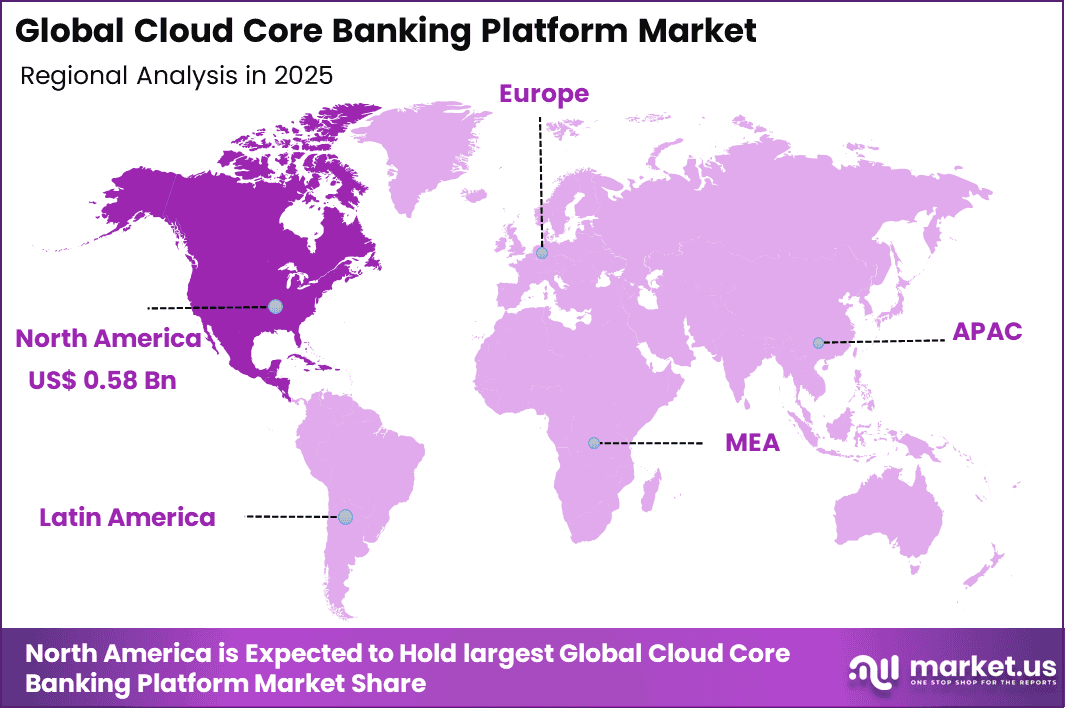
The United States market is valued at USD 0.53 Bn and is growing at a CAGR of 19.22%, reflecting accelerating migration from legacy core systems to cloud-native platforms. Adoption is influenced by cost optimization goals, faster time-to-market for new services, and enhanced disaster recovery capabilities. Growth is further supported by regulatory acceptance of cloud deployment models and increased focus on security, compliance, and operational flexibility.
Key Regions and Countries
- North America
- US
- Canada
- Europe
- Germany
- France
- The UK
- Spain
- Italy
- Russia
- Netherlands
- Rest of Europe
- Asia Pacific
- China
- Japan
- South Korea
- India
- Australia
- Singapore
- Thailand
- Vietnam
- Rest of APAC
- Latin America
- Brazil
- Mexico
- Rest of Latin America
- Middle East & Africa
- South Africa
- Saudi Arabia
- UAE
- Rest of MEA
Competitive Analysis
The Cloud Core Banking Platform market is led by established banking technology providers such as Temenos, Oracle, SAP, Fiserv, FIS, Finastra, Jack Henry, Infosys, and Tata Consultancy Services. These players compete on full scale core replacement capability, regulatory compliance, and integration with existing banking systems. Their platforms are commonly selected by large and mid sized banks that prefer proven solutions with long term vendor support and broad product coverage.
Cloud native and modular platform providers including Thought Machine, Mambu, nCino, Backbase, and ERI Bancaire compete through faster deployment, API driven architecture, and flexible product configuration. Competition in this segment is driven by demand for scalability, quicker product launches, and reduced dependence on legacy infrastructure.
Top Key Players in the Market
- Thought Machine Group, Ltd.
- Mambu GmbH
- Temenos AG
- Oracle Corporation
- SAP SE
- Fiserv, Inc.
- FIS (Fidelity National Information Services, Inc.)
- Finastra
- nCino, Inc.
- Jack Henry & Associates, Inc.
- Backbase B.V.
- Infosys, Ltd.
- Tata Consultancy Services, Ltd.
- ERI Bancaire
- Others
Future Outlook
The future outlook for the Cloud Core Banking Platform Market is positive as banks and financial institutions continue shifting from traditional systems to cloud-based solutions. Demand for cloud core banking platforms is expected to grow because these systems offer scalability, cost efficiency, and faster deployment of new services.
Adoption of technologies such as API integration, real-time processing, and enhanced security features will support broader implementation. Growth can be attributed to rising customer expectations for digital services, regulatory requirements, and the need to reduce IT complexity. Overall, the market is expected to expand steadily as institutions prioritize innovation and operational resilience.
Recent Developments
- September 2025, Mastercard announced deeper collaboration with Thought Machine to accelerate core banking modernization, highlighting Vault Core and Vault Payments as cloud‑native components.
- August 2025, Mambu announced that OYAK ANKER Bank completed a full‑stack modernization and core migration to Mambu’s cloud banking platform, replacing legacy systems with cloud‑native infrastructure.









