


Report Overview
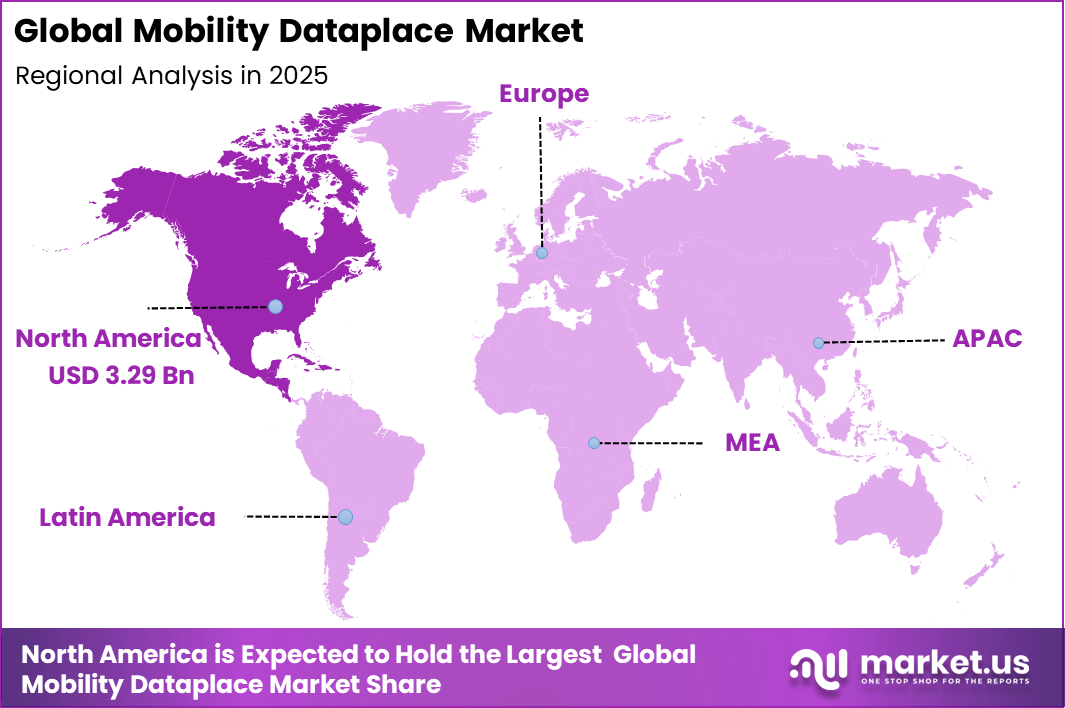
The Global Mobility Dataplace Market generated USD 8.8 billion in 2025 and is predicted to register growth from USD 10.2 billion in 2026 to about USD 40.3 billion by 2035, recording a CAGR of 16.50% throughout the forecast span. In 2025, North America held a dominant market position, capturing more than a 37.7% share, holding USD 3.29 Billion revenue.
The Mobility Dataplace Market represents a rapidly expanding segment within the digital mobility ecosystem. Mobility dataplace platforms enable the collection, sharing, and monetization of transportation and mobility-related data generated by vehicles, infrastructure systems, mobile devices, and connected sensors. These platforms are increasingly used by governments, transportation agencies, and mobility service providers to improve traffic management, urban planning, and fleet optimization through data-driven insights.
Mobility dataplace platforms serve as intermediaries between data providers and data consumers. Transportation agencies, city planners, logistics companies, and ride-sharing operators use these platforms to access real-time mobility information. By combining datasets from different sources, these platforms support predictive analytics, route optimization, and infrastructure planning for modern transportation systems.
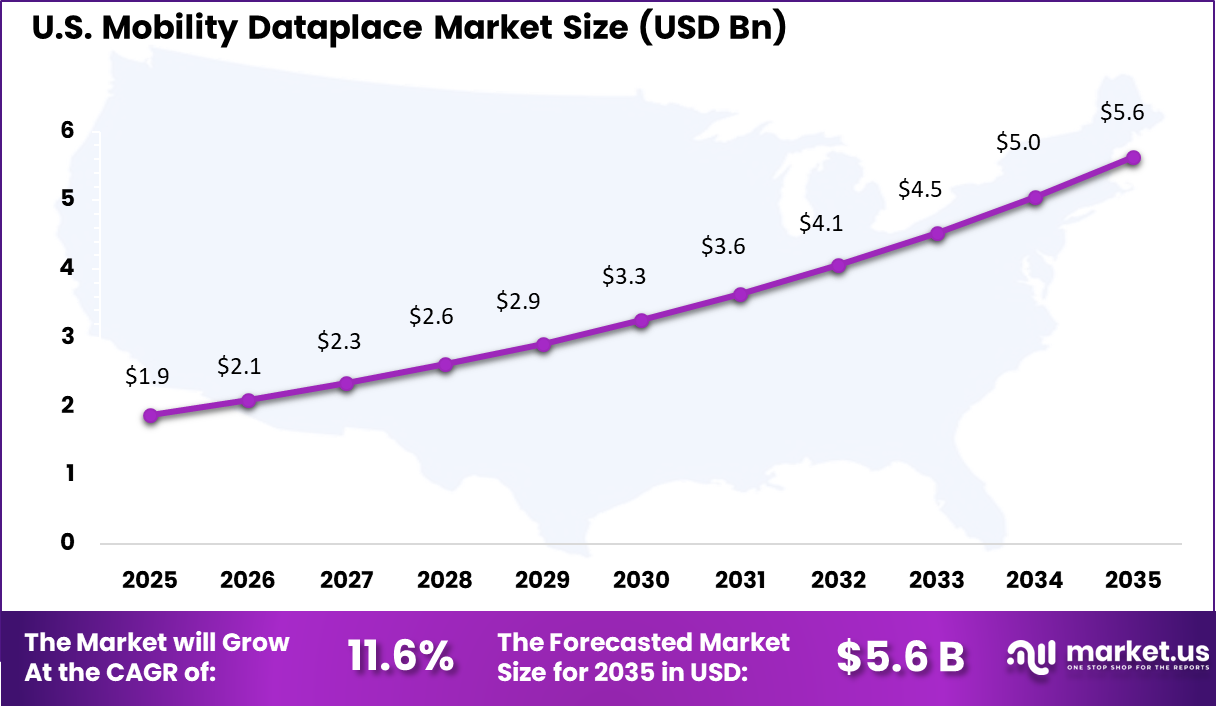
The U.S. market is valued at USD 1.88 Bn and is expanding at a CAGR of 11.6%, reflecting growing investment in smart mobility and digital transportation ecosystems. Adoption is influenced by increasing use of connected vehicle data, ride-sharing analytics, and real-time traffic monitoring systems. Growth is further supported by collaboration between government agencies and mobility technology providers to enhance transportation planning, infrastructure optimization, and sustainable urban mobility strategies. The Mobility Dataplace market is led by global mapping, navigation, and transportation technology providers such as TomTom, HERE Technologies, INRIX, Google, Apple, Uber, Waze, Esri, Trimble, Siemens Mobility, Bosch Mobility Solutions, Cubic Transportation Systems, and Alstom. These companies compete on large scale mobility data collection, location intelligence, and integration with navigation and smart city systems. Their platforms are widely used by governments, mobility service providers, and urban planners that require accurate traffic insights, route optimization, and transportation network analytics. Mobility analytics and transportation solution providers including Moovit, PTV Group, Transdev, Geotab, StreetLight Data, Otonomo, Iteris, and others compete through specialized mobility datasets and analytical tools. Competition in this segment is driven by real time traffic monitoring, vehicle data integration, and advanced urban mobility planning capabilities. These vendors are often selected by cities and transportation agencies that need reliable mobility insights to support infrastructure planning and traffic management. The future outlook for the Mobility Dataplace Market is positive as transportation systems increasingly depend on data sharing and analytics to improve mobility services. Mobility dataplaces enable organizations to exchange and analyze large volumes of mobility data from vehicles, public transport networks, and infrastructure systems. This supports better traffic planning, route optimization, and improved mobility services for cities and transportation providers. Demand for these platforms is expected to grow as smart city projects, connected vehicles, and digital transportation networks expand worldwide. Adoption of real time data platforms, cloud technologies, and advanced analytics will further strengthen the role of mobility dataplaces in transportation planning. Growth can be attributed to rising urbanization, need for efficient traffic management, and increasing focus on intelligent mobility ecosystems.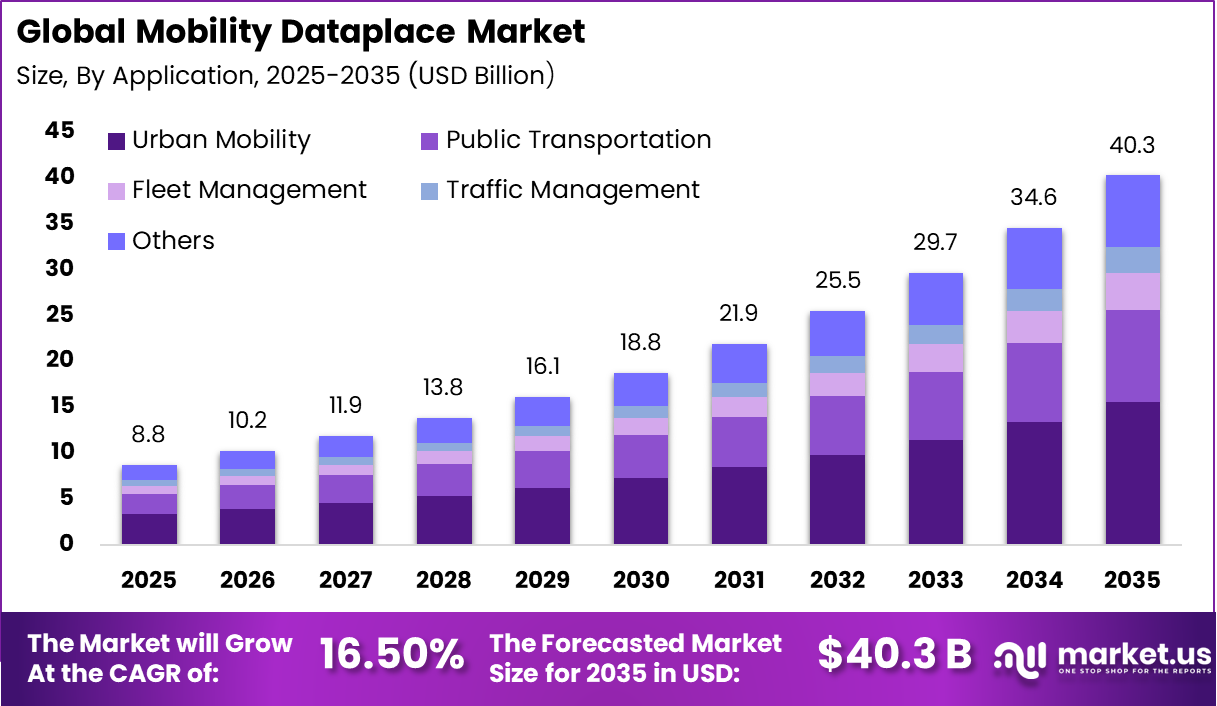
Key Regions and Countries
Competitive Analysis
Top Key Players in the Market
Future Outlook
Recent Developments









