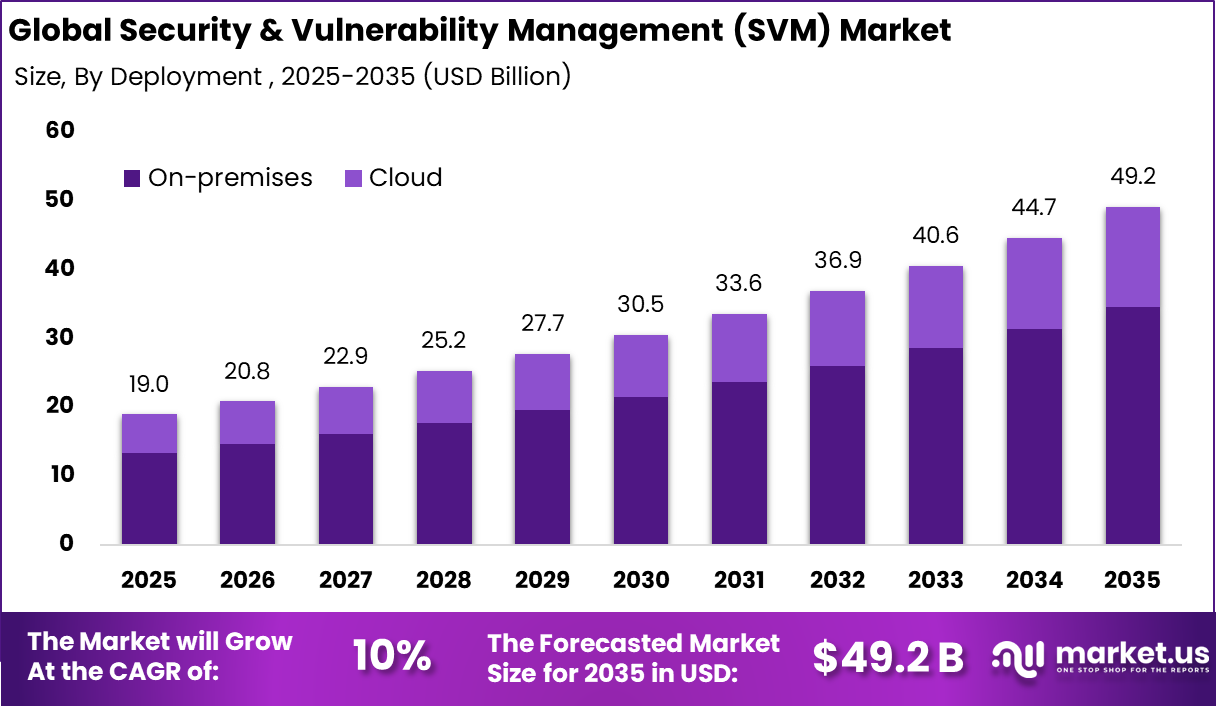
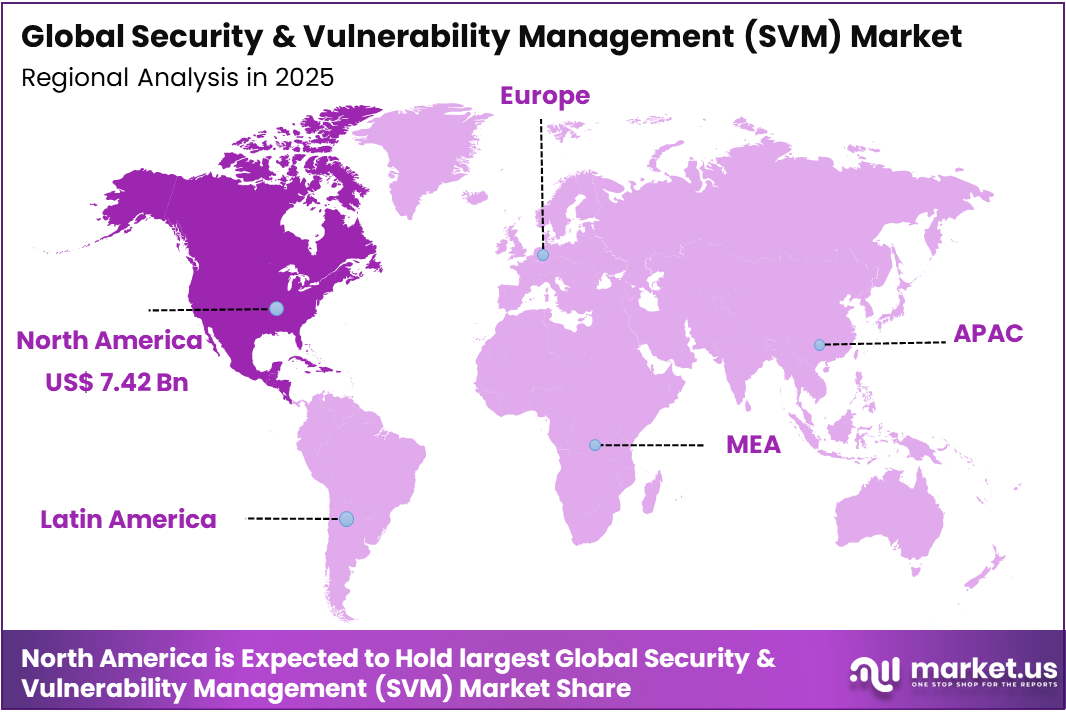
The Global Security & Vulnerability Management (SVM) Market generated USD 19 billion in 2025 and is predicted to register growth from USD 20.8 billion in 2026 to about USD 49.2 billion by 2035, recording a CAGR of 10% throughout the forecast span. In 2025, North America held a dominan market position, capturing more than a 39.2% share, holding USD 7.42 Billion revenue.
The Security and Vulnerability Management (SVM) Market represents a critical component of the global cybersecurity ecosystem. SVM solutions are designed to identify, assess, prioritize, and remediate vulnerabilities within IT infrastructure, applications, networks, and cloud environments. These solutions help organizations maintain strong cybersecurity posture by continuously monitoring potential security weaknesses and enabling proactive risk mitigation strategies.
The increasing digitalization of enterprises has significantly expanded the attack surface of modern organizations. Businesses are adopting cloud computing, remote work technologies, Internet of Things (IoT) devices, and interconnected systems that generate complex security environments. As a result, security and vulnerability management platforms have become essential tools for detecting and addressing security gaps before they can be exploited by cyber threats.
One of the primary drivers for the SVM market is the rapid increase in cyber threats and security vulnerabilities across digital systems. Organizations operate complex infrastructures that include cloud services, mobile devices, and interconnected applications, which significantly expand the potential attack surface. Continuous vulnerability monitoring enables security teams to detect weaknesses quickly and reduce the risk of exploitation by attackers.
Top Market Takeaways
By Component, software dominates with 74.8% share, delivering automated scanning, patch orchestration, and risk prioritization across sprawling attack surfaces.
By Type, endpoint security claims 35.6%, securing laptops, servers, and IoT devices against zero-days and privilege escalation exploits.
By Target, content management vulnerabilities lead at 43.4%, addressing CMS exploits, file upload weaknesses, and document workflow exposures.
By Deployment, on-premises captures 70.4%, ensuring sovereign scanning, air-gapped assessments, and integration with legacy enterprise stacks.
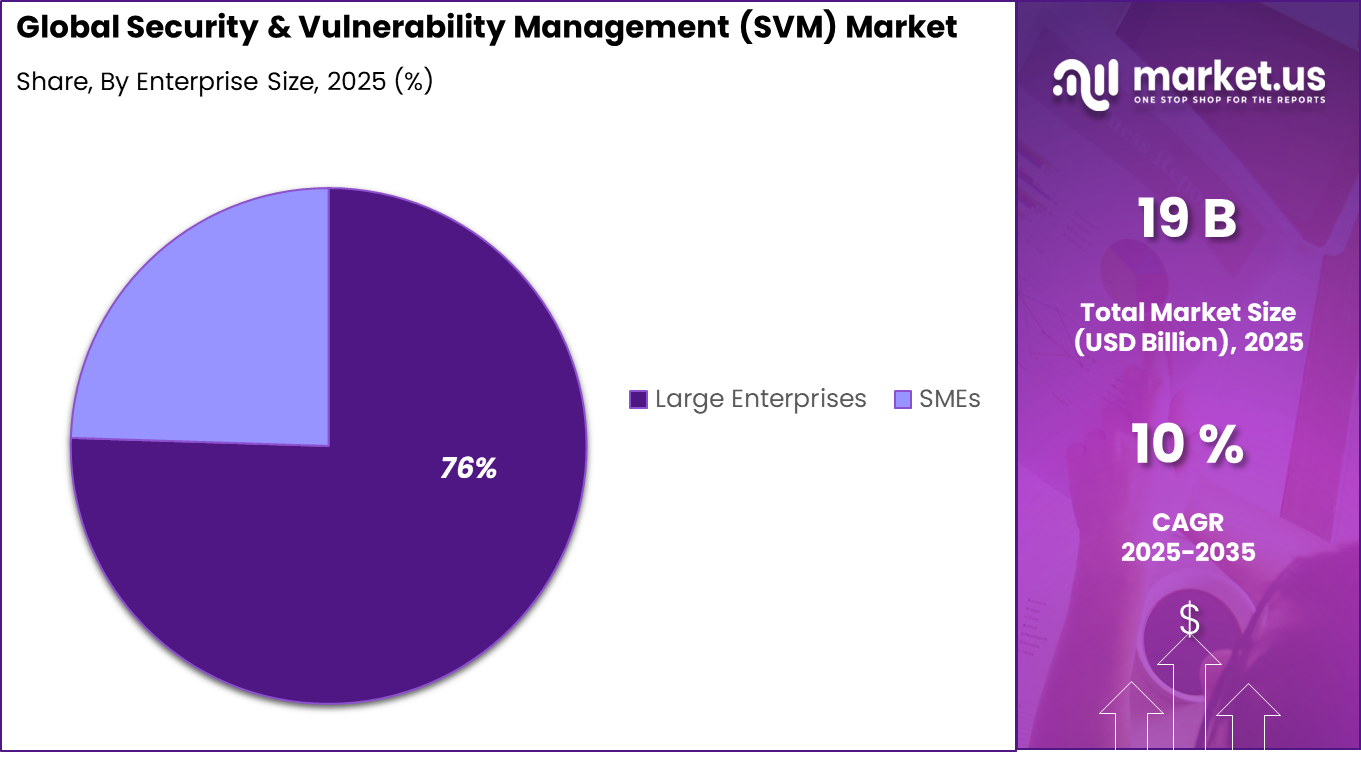
By Enterprise Size, large enterprises hold 75.5%, managing continuous vulnerability intelligence across global hybrid infrastructures.
By Vertical, BFSI commands 39.9%, prioritizing financial app hardening, transaction layer protection, and regulatory audit trails.
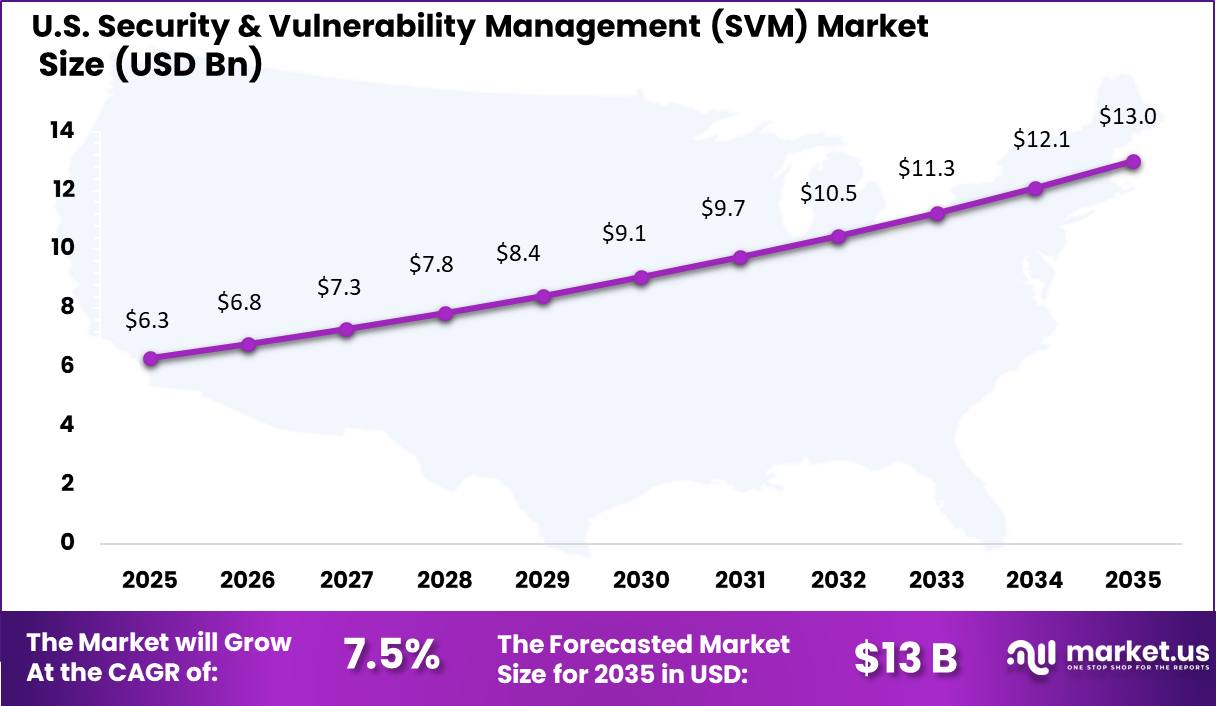
Regionally, North America accounts for 39.2% global share, with the U.S. market valued at USD 6.31 billion and a CAGR of 7.5%, driven by SEC cybersecurity rules and ransomware pressures.
Drivers Impact Analysis
Key Drivers
Impact on CAGR Forecast (~%)
Geographic Relevance
Impact Timeline
Strategic Importance
Rising Frequency of Cyber Attacks and Data Breaches
+2.8%
Global
Short to Long Term
Drives continuous vulnerability monitoring
Increasing Adoption of Cloud and Hybrid Infrastructure
+2.3%
North America, Europe
Medium Term
Expands attack surface requiring management tools
Regulatory Compliance Requirements for Cybersecurity
+2.0%
North America, Europe
Medium Term
Encourages enterprise security assessments
Growth in IoT and Connected Devices
+1.6%
APAC, North America
Long Term
Increases vulnerability exposure points
Integration with Enterprise Risk Management Platforms
+1.3%
Global
Medium Term
Enhances organizational risk visibility
Restraints Impact Analysis
Key Restraints
Impact on CAGR Forecast (~%)
Geographic Relevance
Impact Timeline
Market Constraint Level
Shortage of Skilled Cybersecurity Professionals
-1.9%
Global
Medium Term
Slows deployment and management
Complexity of Multi-cloud Security Environments
-1.6%
North America, Europe
Medium Term
Increases configuration challenges
High Implementation and Integration Costs
-1.3%
Emerging Markets
Short to Medium Term
Budget constraints for smaller organizations
False Positives in Vulnerability Detection Tools
-1.0%
Global
Medium Term
Reduces operational efficiency
By Component
Software represents 74.8% of the market, reflecting the growing reliance on automated security tools that continuously scan and assess enterprise systems. These platforms help organizations identify vulnerabilities across networks, applications, and operating environments before they can be exploited. Security software provides centralized dashboards that enable cybersecurity teams to monitor risk exposure and prioritize remediation actions.
The dominance of software solutions is also supported by their ability to integrate with security information and event management platforms and threat intelligence systems. Automated scanning and patch management capabilities allow organizations to maintain stronger system defenses. As cyber threats become more sophisticated, software based vulnerability management platforms continue to play a central role in enterprise security strategies.
By Type
Endpoint security accounts for 35.6% of the market, highlighting the importance of protecting devices that connect to enterprise networks. Laptops, mobile devices, servers, and industrial systems represent potential entry points for cyber attackers. Vulnerability management platforms are widely used to monitor these endpoints and ensure that security updates and patches are applied consistently.
The expansion of remote work and mobile device usage has increased the number of endpoints that organizations must secure. Continuous monitoring tools help identify weaknesses in operating systems and installed applications. As organizations expand distributed digital environments, endpoint vulnerability management remains a critical priority.
By Target
Content management vulnerabilities represent 43.4% of the market focus due to the widespread use of digital content platforms across enterprises. Websites, internal portals, and document management systems often store sensitive information and therefore require strong protection. Security solutions are deployed to detect configuration weaknesses, outdated software components, and unauthorized access risks.
Content management platforms are frequently targeted by cyber attackers seeking to exploit web application vulnerabilities. Automated scanning tools help identify potential threats before they affect operations or compromise data integrity. As organizations continue to expand digital content platforms, protecting these systems remains an essential security objective.
By Deployment
On premises deployment accounts for 70.4% of the market, reflecting the need for direct control over cybersecurity infrastructure. Many organizations manage sensitive corporate data and therefore prefer internal security monitoring systems that operate within controlled environments. On premises deployment enables customized security configurations aligned with internal governance policies.
Industries with strict regulatory requirements often maintain security platforms within internal data centers to strengthen data protection. This approach also allows organizations to integrate vulnerability management tools with legacy systems and proprietary applications. As security concerns remain a top priority, on premises deployment continues to dominate enterprise cybersecurity environments.
By Enterprise Size
Large enterprises represent 75.5% of the market share due to the complexity and scale of their IT infrastructures. These organizations manage multiple data centers, applications, and user networks that require continuous vulnerability monitoring. Dedicated cybersecurity teams implement structured security frameworks to protect enterprise systems from potential threats.
Large organizations also face significant regulatory and compliance obligations related to data protection and risk management. Vulnerability management platforms help ensure that security policies are consistently applied across business units. As enterprise digital ecosystems expand, large companies remain the primary adopters of advanced security management solutions.
By Vertical
The BFSI sector accounts for 39.9% of market adoption due to strict regulatory oversight and the sensitive nature of financial data. Financial institutions manage large volumes of transactional information and customer records that must be protected from cyber threats. Vulnerability management systems are used to monitor infrastructure, detect potential weaknesses, and ensure compliance with security regulations.
High exposure to digital financial transactions makes the sector a frequent target for cyber attacks. Continuous vulnerability scanning and patch management are essential for maintaining secure financial systems. As digital banking and online financial services expand, cybersecurity investment within the BFSI sector continues to increase.
Investor Type Impact Matrix
Investor Type
Growth Sensitivity
Risk Exposure
Geographic Focus
Investment Outlook
Venture Capital
High
Medium to High
North America, Israel
Focus on advanced cybersecurity analytics startups
Portfolio expansion through integrated security platforms
Institutional Investors
Medium
Medium
Developed Markets
Long-term cybersecurity infrastructure allocation
Government-backed Funds
Medium
Low
North America, Europe
National cybersecurity initiatives
Technology Enablement Analysis
Technology Enabler
Impact on CAGR Forecast (~%)
Geographic Relevance
Impact Timeline
Adoption Momentum
AI-driven Threat Detection and Risk Scoring
+3.0%
North America, Europe
Medium to Long Term
Enhances predictive security monitoring
Automated Vulnerability Scanning Tools
+2.4%
Global
Short to Medium Term
Improves operational efficiency
Cloud-native Security Management Platforms
+1.9%
Global
Medium Term
Supports distributed infrastructure protection
Integration with DevSecOps Pipelines
+1.5%
North America, APAC
Medium to Long Term
Enables proactive vulnerability remediation
Continuous Attack Surface Management Systems
+1.2%
Global
Long Term
Expands enterprise visibility of risks
Key Challenges
Growing number of vulnerabilities making continuous monitoring difficult
High volume of security alerts creating alert fatigue for IT teams
Integration challenges with existing security tools and infrastructure
Shortage of skilled cybersecurity professionals to manage vulnerability programs
Difficulty in prioritizing critical vulnerabilities across large IT environments
Emerging Trends
In the Security and Vulnerability Management (SVM) market, a key trend is the growing adoption of continuous vulnerability monitoring across enterprise infrastructure. Organisations are moving beyond periodic security checks and are implementing systems that scan networks, applications, and endpoints on an ongoing basis to detect weaknesses as soon as they appear.
This approach improves visibility of security gaps and helps teams respond quickly before issues escalate into larger threats. Another trend is the growing use of risk-based prioritisation models that evaluate vulnerabilities according to system exposure, asset importance, and real operational impact. This helps security teams focus on the issues that matter most instead of managing long lists of alerts with equal urgency.
Growth Factors
A major growth factor in this market is the increasing complexity of digital infrastructure across organisations. Businesses rely on a wide range of cloud platforms, applications, connected devices, and remote systems, which expands the number of potential security entry points.
Managing vulnerabilities across such environments requires structured tools that help identify, track, and resolve weaknesses efficiently. Security and vulnerability management platforms provide a clear framework that supports faster remediation and better control over system integrity.
Key Market Segments
By Component
Software
Vulnerability Scanners
Patch Management
Security Incident & Event Management
Risk Assessment
Threat Intelligence
Others
Services
Professional Services
Consulting & Deployment
Pen Testing
Vulnerability Assessment
Incident Response
Support & Maintenance
Managed Services
By Type
Endpoint Security
Cloud Security
Network Security
Application Security
Infrastructure Protection
Data Security
Others (Wireless Security, Web & Content Security, etc.)
By Target
Content Management Vulnerabilities
IoT Vulnerabilities
API Vulnerabilities
Others
By Deployment
Cloud
On-premises
By Enterprise Size
Large Enterprises
SMEs
By Vertical
BFSI
Healthcare
Defense/Government
IT and Telecom
Energy
Retail
Manufacturing
Others
Regional Analysis
North America accounts for 39.2% of the security and vulnerability management (SVM) market, supported by strong cybersecurity investments and strict regulatory frameworks across financial services, healthcare, and government sectors.
Organizations in the region are increasingly deploying vulnerability management platforms to continuously identify, assess, and remediate security weaknesses across complex IT infrastructures. Demand is driven by rising cyber threats, expanding cloud environments, and the need to maintain compliance with evolving data protection and security standards.
The U.S. market is valued at USD 6.31 Bn and is growing at a CAGR of 7.5%, reflecting sustained focus on enterprise risk management and cyber resilience. Adoption is influenced by the increasing number of connected devices, frequent vulnerability disclosures, and growing pressure to strengthen defensive security strategies. Growth is further supported by integration of automated scanning, risk prioritization tools, and continuous monitoring solutions that help organizations manage security exposures more effectively.
Key Regions and Countries
North America
US
Canada
Europe
Germany
France
The UK
Spain
Italy
Russia
Netherlands
Rest of Europe
Asia Pacific
China
Japan
South Korea
India
Australia
Singapore
Thailand
Vietnam
Rest of APAC
Latin America
Brazil
Mexico
Rest of Latin America
Middle East & Africa
South Africa
Saudi Arabia
UAE
Rest of MEA
Competitive Analysis
The Security and Vulnerability Management (SVM) Market is led by global cybersecurity and technology providers that deliver integrated threat detection and vulnerability assessment platforms. Microsoft, Cisco Systems, Inc., and IBM Corporation provide enterprise grade security frameworks combined with cloud security monitoring and endpoint protection tools. Their solutions are widely used across government, healthcare, and financial institutions where strong vulnerability management practices are required.
Dedicated cybersecurity firms contribute specialized vulnerability scanning and risk assessment capabilities. CrowdStrike, Qualys, Inc., Rapid7, and Tenable, Inc. offer advanced platforms for continuous vulnerability detection and threat prioritization. These vendors emphasize real time monitoring, automated remediation workflows, and risk based vulnerability scoring.
Security consulting firms and infrastructure providers further strengthen the ecosystem. AT&T Intellectual Property, Fortra, LLC, and RSI Security deliver managed security services and compliance driven vulnerability management solutions. These organizations support enterprises in implementing risk assessments, regulatory audits, and continuous security monitoring.
Top Key Players in the Market
AT&T Intellectual Property.
CrowdStrike
Cisco Systems, Inc.
Fortra, LLC
IMB Corporation
Microsoft
Qualys, Inc.
Rapid7
RSI Security.
Tenable, Inc.
Others
Future Outlook
The future outlook for the Security & Vulnerability Management (SVM) Market is positive as organizations continue to strengthen their cybersecurity strategies. Demand for SVM solutions is expected to grow because these tools help identify security weaknesses, manage risks, and protect systems from cyber threats.
Increasing use of cloud computing, connected devices, and digital platforms is creating a greater need for continuous vulnerability monitoring and faster threat response. Overall, the market is expected to expand as businesses prioritize proactive security management and stronger protection of their digital infrastructure.
Recent Developments
In January 2025, Absolute Software Corporation expanded its Absolute Resilience Platform by adding integrated patch management, vulnerability scanning, remediation tools, workflow automation, and remote endpoint recovery. This integrated framework strengthens enterprise security operations while reducing endpoint management costs and improving system resilience. As a result, organizations can maintain continuous protection against cyber threats and operational disruptions.
In January 2025, Hackuity.io formed a partnership with cloud security provider Wiz, Inc. through the Wiz Integration Network (WIN) to strengthen risk-based vulnerability management. The collaboration supports seamless security workflows and prioritizes vulnerabilities using Hackuity’s True Risk Score (TRS) methodology. This capability allows IT teams to focus on the most critical threats and improve overall security response efficiency.