


Report Overview
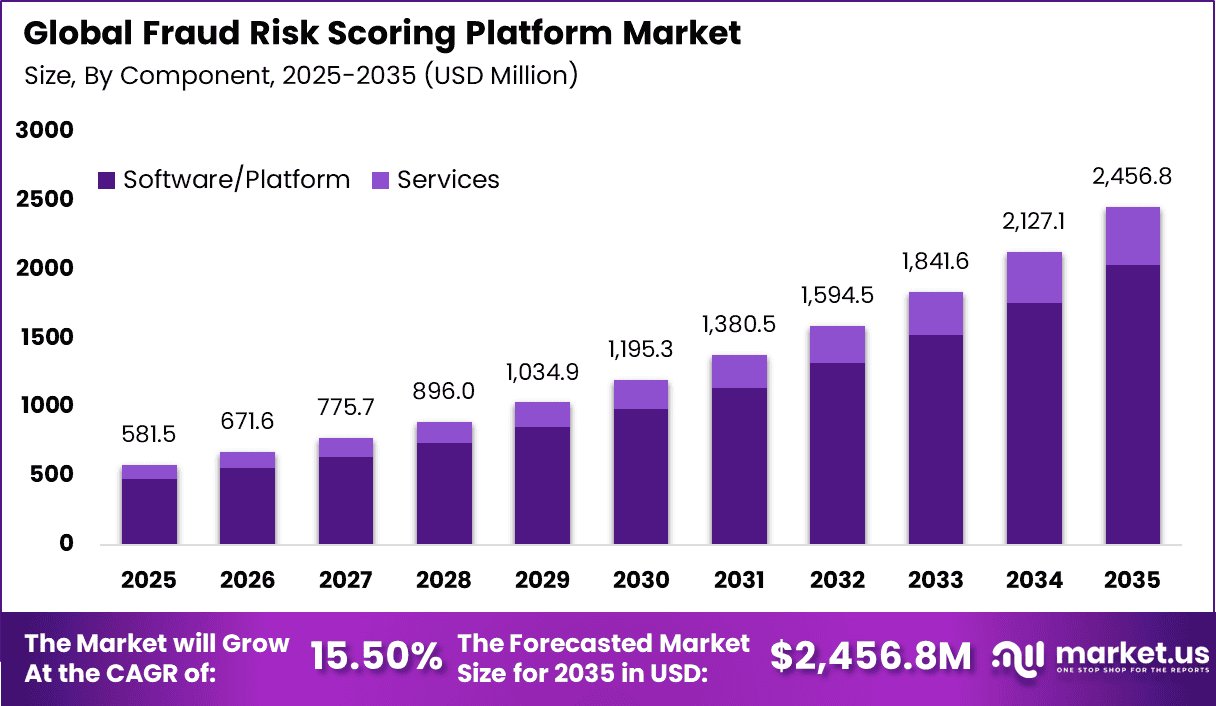
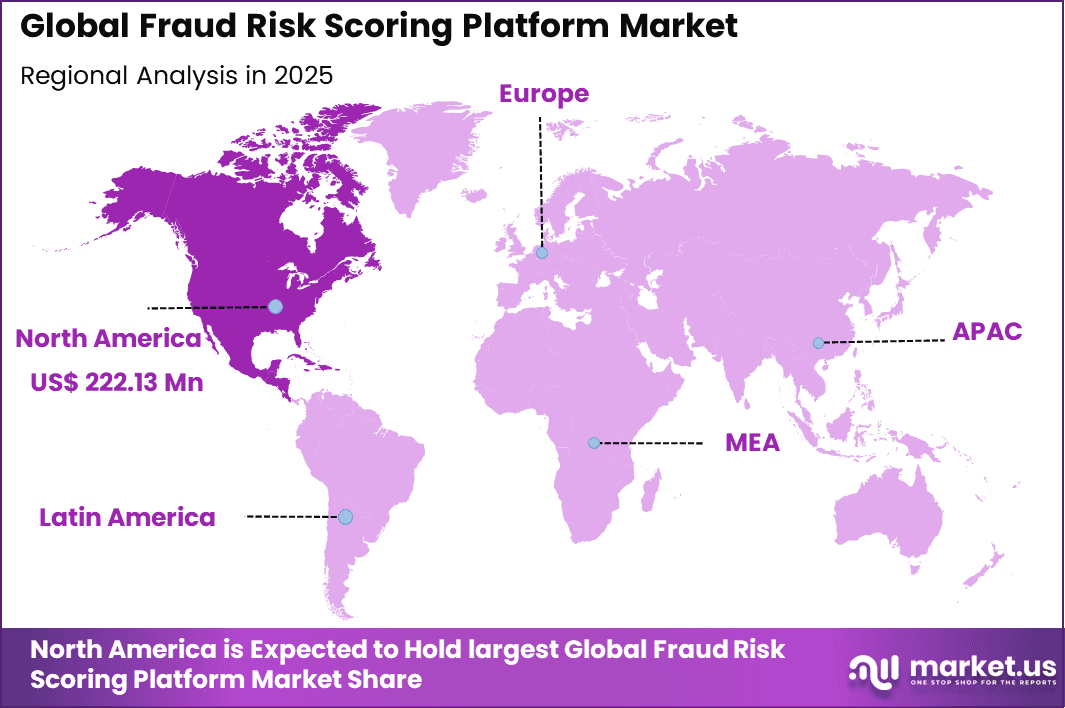
The Global Fraud Risk Scoring Platform Market generated USD 581.5 million in 2025 and is predicted to register growth from USD 671.6 million in 2026 to about USD 2,456.8 million by 2035, recording a CAGR of 15.50% throughout the forecast span. In 2025, North America held a dominan market position, capturing more than a 38.2% share, holding USD 222.13 Million revenue.
The Fraud Risk Scoring Platform Market refers to software platforms that evaluate the likelihood of fraudulent activity by assigning risk scores to transactions, users, accounts, or behaviors. These platforms analyze large volumes of structured and unstructured data to identify patterns associated with fraud. Risk scores help organizations decide whether to approve, review, or block activities in real time.
The market has become essential as digital transactions and automated processes increase across industries. A primary driver of the fraud risk scoring platform market is the rising volume and complexity of digital fraud. As consumers and businesses transact across mobile apps, online portals, and API networks, fraudsters exploit multiple vectors including identity theft, account takeover, synthetic identities, and transaction manipulation.
Demand for fraud risk scoring platforms is strongest among financial institutions and payment providers managing high transaction volumes. These organizations face continuous fraud attempts that require rapid and accurate decisions. Risk scoring improves approval rates while controlling losses. This balance sustains strong demand.
Top Market Takeaways
- By component, software/platform accounts for 82.7% of the market, providing AI-powered engines for real-time transaction scoring and behavioral risk analysis.
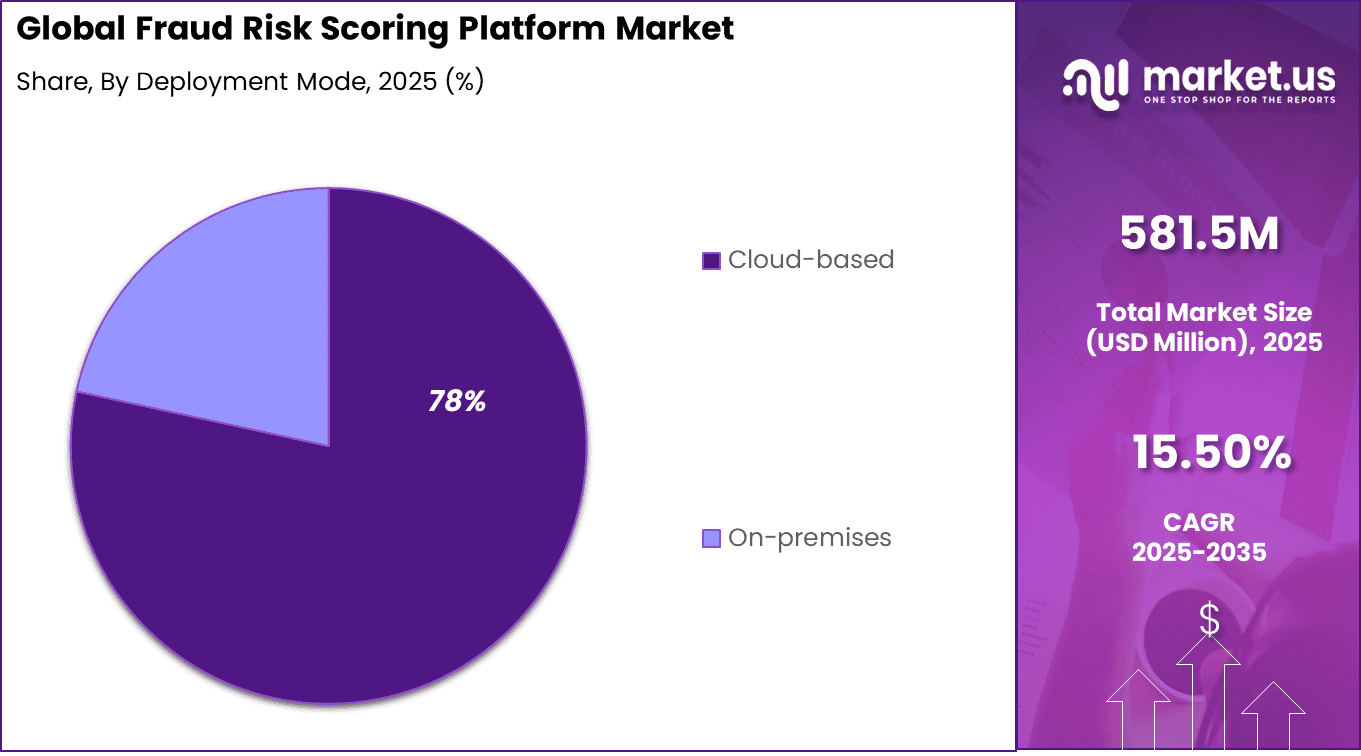
- By deployment mode, cloud-based solutions represent 78.4%, offering agility, auto-scaling, and seamless API integrations for high-velocity financial data streams.
- By organization size, large enterprises hold 71.6% share, deploying these platforms to manage enterprise-wide fraud across diverse channels and jurisdictions.
- By application, payment fraud prevention captures 45.1%, targeting card-not-present schemes, account takeovers, and synthetic identities in digital payments.
- By end-user industry, BFSI commands 65.3%, driven by rising cyber threats, regulatory fines, and needs for adaptive scoring models.
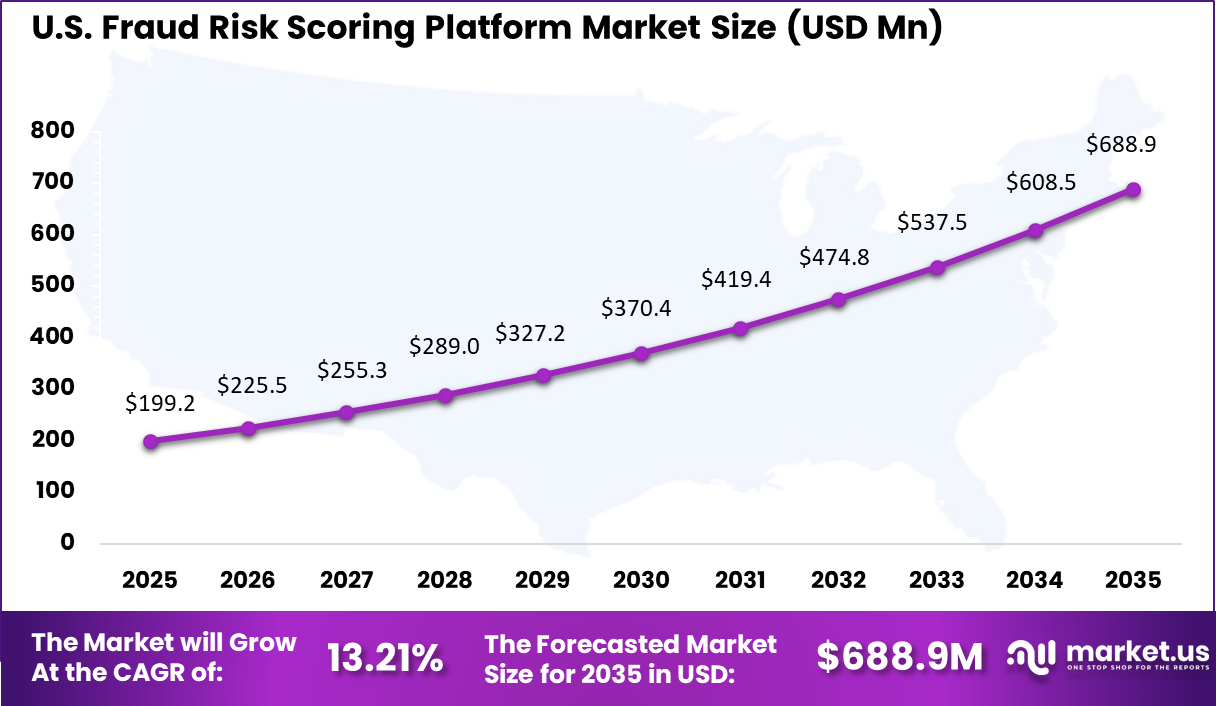
- By region, North America leads with 38.2% of the global market, where the U.S. is valued at USD 199.2 million with a projected CAGR of 13.21%, supported by advanced analytics adoption and open banking initiatives.
Operational Performance Statistics
- Organizations lose an estimated 5% of annual revenue to fraud, highlighting the persistent financial exposure across industries.
- Online payment fraud losses are expected to exceed USD 362 billion between 2023 and 2028, indicating sustained growth in digital fraud activity.
- Proactive data monitoring and analytics can make fraud detection 54% less costly and reduce investigation duration by 50% compared with reactive approaches.
- Advanced fraud scoring models, including approaches such as XGBoost, can achieve 92% precision and 88% recall, balancing detection accuracy with coverage.
- AI driven scoring systems can reduce false positives by up to 70%, minimizing disruption to legitimate customers.
- High performance platforms built on technologies such as Redis Enterprise aim for latency below 100 milliseconds, enabling real time decisions during checkout.
- Platforms such as Sift and Worldline commonly apply risk scales ranging from 0 to 100 or 0 to 1000, categorizing transactions into low, medium, or high risk segments for action.
Drivers Impact Analysis
| Key Driver | Impact on CAGR Forecast (~%) | Geographic Relevance | Impact Timeline |
|---|---|---|---|
| Rising digital fraud across banking, payments, and e-commerce | +4.6% | Global | Short term |
| Rapid growth of real-time payments and instant digital transactions | +3.9% | North America, Europe | Short to medium term |
| Increasing regulatory focus on fraud prevention and risk controls | +3.3% | North America, Europe | Medium term |
| Expansion of online and mobile banking channels | +2.7% | Global | Medium term |
| Adoption of AI-driven decisioning in credit and transaction workflows | +2.4% | North America, Asia Pacific | Medium to long term |
Restraints Impact Analysis
| Key Restraint | Impact on CAGR Forecast (~%) | Geographic Relevance | Impact Timeline |
|---|---|---|---|
| High implementation and integration costs | -2.9% | Emerging Markets | Short to medium term |
| Complexity in tuning risk models and thresholds | -2.4% | Global | Medium term |
| Data quality and availability challenges | -2.0% | Global | Medium term |
| Model explainability and regulatory transparency concerns | -1.7% | Europe, North America | Medium term |
| Limited adoption among smaller financial institutions | -1.5% | Asia Pacific, Latin America | Medium to long term |
By Component
Software and platform based solutions accounted for 82.7% of adoption, reflecting enterprise preference for centralized and configurable systems. These platforms integrate data ingestion, scoring logic, and decision workflows within a single environment. Centralization improves visibility and control. This reduces operational complexity for fraud teams.
Software platforms support rapid updates to scoring models. Organizations can adjust thresholds as fraud patterns change. This flexibility improves long term effectiveness. Software driven solutions therefore remain dominant.
Advanced reporting and analytics further strengthen value. Fraud teams gain insight into trends and root causes. This supports proactive risk management. Software platforms continue to lead due to adaptability and scale.
By Deployment Mode
Cloud based deployment represented 78.4% of usage, driven by scalability and real time processing needs. Cloud platforms support high transaction volumes without infrastructure constraints. Organizations benefit from faster deployment and lower maintenance overhead. This aligns with cloud first security strategies. Cloud delivery enables continuous model updates and monitoring.
Fraud teams can access insights from any location. Alerts are generated instantly when risk thresholds are exceeded. This improves response speed. Security controls in cloud environments have matured significantly. Encryption and access management protect sensitive data. As a result, cloud based deployment has become widely accepted.
By Organization Size
Large enterprises accounted for 71.6% of adoption due to their high transaction volumes and exposure to fraud risk. These organizations operate across multiple channels and regions. Consistent scoring is critical for enterprise wide risk control. Automated platforms support this need. Large enterprises also face higher regulatory and reputational risk.
Robust scoring systems improve audit readiness and compliance. Standardized risk metrics support governance. This reinforces adoption. Greater investment capacity supports advanced analytics integration. Large organizations embed scoring platforms into broader security frameworks. This strengthens their leading position.
By Application
Payment fraud prevention accounted for 45.1% of usage, highlighting the importance of transaction level risk assessment. Digital payments are a primary target for fraud attempts. Risk scoring evaluates transactions in real time. This enables immediate intervention. Automated scoring reduces reliance on manual review. Legitimate transactions proceed without delay.
Fraudulent activity is flagged early. This improves customer experience and loss prevention. As payment channels expand, transaction complexity increases. Risk scoring platforms scale efficiently with volume. Payment fraud prevention remains the leading application area.
By End User Industry
Banking, financial services, and insurance accounted for 65.3% of adoption due to their exposure to financial fraud. These institutions process large volumes of sensitive transactions. Effective risk scoring is essential to protect assets and trust. Platforms support this requirement.
Regulatory oversight in BFSI is strict. Institutions must demonstrate proactive fraud controls. Risk scoring platforms provide documented evidence of monitoring. This reduces compliance risk. Digital transformation has increased fraud surfaces in BFSI. Continuous scoring helps manage this complexity. The sector remains the dominant end user industry.
Investor Type Impact Matrix
| Investor Type | Growth Sensitivity | Risk Exposure | Geographic Focus | Investment Outlook |
|---|---|---|---|---|
| Fraud analytics and risk software providers | Very High | Medium | North America, Europe | Strong recurring SaaS growth |
| Fintech and digital payment platforms | High | Medium | Global | Strategic fraud mitigation investment |
| Banks and financial institutions | Medium | Low to Medium | Global | Compliance and loss reduction focus |
| Private equity firms | Medium | Medium | North America, Europe | Consolidation of analytics platforms |
| Venture capital investors | High | High | North America | Innovation-led growth in AI risk models |
Technology Enablement Analysis
| Technology Enabler | Impact on CAGR Forecast (~%) | Primary Function | Geographic Relevance | Adoption Timeline |
|---|---|---|---|---|
| AI and machine learning-based fraud scoring engines | +4.9% | Real-time risk assessment | Global | Short to medium term |
| Behavioral and transaction pattern analytics | +4.1% | Anomaly detection | Global | Medium term |
| Real-time decisioning and low-latency scoring platforms | +3.6% | Instant fraud prevention | North America, Europe | Medium term |
| Cloud-based fraud risk platforms | +3.0% | Scalability and speed | Global | Medium to long term |
| Explainable AI and audit-ready reporting tools | +2.4% | Regulatory transparency | Europe, North America | Long term |
Key Market Segments
By Component
- Software/Platform
- Services
By Deployment Mode
- Cloud-based
- On-premises
By Organization Size
- Large Enterprises
- Small and Medium-sized Enterprises (SMEs)
By Application
- Payment Fraud Prevention
- Account Takeover Protection
- Application Fraud (New Accounts)
- Synthetic Identity Fraud Detection
- Others
Emerging Trends Analysis
An emerging trend in the fraud risk scoring platform market is the adoption of self-learning and unsupervised anomaly detection. These models adapt automatically to evolving patterns without heavy reliance on historical labelled fraud cases. Self-learning improves detection of novel fraud schemes and reduces dependence on static rules.
Another trend is the convergence of fraud scoring with identity verification and customer authentication systems. Integrated detection that combines identity risk and transaction risk provides unified risk decisions that improve accuracy and reduce friction for legitimate users. This convergence supports stronger security with improved customer experience.
Growth Factors Analysis
One of the key growth factors for the fraud risk scoring platform market is continuous expansion of digital payments and online financial services. As ecommerce, mobile wallets, and digital lending grow, the volume of potentially fraudulent activity increases. Organisations invest in fraud scoring tools to protect revenue and customer trust.
Another growth factor is increasing awareness of operational risk and brand impact. High-profile fraud incidents can erode consumer confidence and invite regulatory scrutiny. Proactive risk scoring platforms help organisations demonstrate readiness and resilience, supporting long-term trust and competitive positioning.
Regional Analysis
North America holds a 38.2% share of the fraud risk scoring platform market, supported by high digital transaction volumes and a strong focus on financial crime prevention. Financial institutions in the region are increasingly using advanced risk scoring tools to assess transaction behavior, customer activity, and account-level risk in real time. Demand is reinforced by regulatory scrutiny, rising payment fraud incidents, and the need to reduce false positives while maintaining strong fraud controls.
The United States market is valued at USD 199.2 Mn and is growing at a CAGR of 13.21%, driven by rapid adoption of digital banking and online payment channels. Adoption is influenced by the need for faster fraud detection, improved decision accuracy, and better protection against evolving fraud patterns. Growth is further supported by increasing integration of automated risk scoring within transaction monitoring and customer authentication workflows.
Key Regions and Countries
- North America
- US
- Canada
- Europe
- Germany
- France
- The UK
- Spain
- Italy
- Russia
- Netherlands
- Rest of Europe
- Asia Pacific
- China
- Japan
- South Korea
- India
- Australia
- Singapore
- Thailand
- Vietnam
- Rest of APAC
- Latin America
- Brazil
- Mexico
- Rest of Latin America
- Middle East & Africa
- South Africa
- Saudi Arabia
- UAE
- Rest of MEA
Competitive Analysis
Established analytics and credit risk leaders such as FICO, SAS Institute, Inc., Experian plc, TransUnion, and LexisNexis Risk Solutions hold a strong position in the fraud risk scoring platform market. Their solutions combine behavioral data, transaction monitoring, and predictive modeling. These platforms are widely adopted in banking, payments, and insurance sectors. Demand is driven by rising digital fraud and regulatory pressure for stronger risk controls.
Financial crime and AI-driven fraud detection providers such as Feedzai, Inc., NICE Actimize, Inc., DataVisor, Inc., and Simility, Inc. focus on real-time scoring and adaptive machine learning models. These vendors emphasize explainable AI and automated case management. Adoption is strong among digital banks and fintech firms seeking scalable fraud controls.
eCommerce and payment-focused fraud prevention specialists such as Signifyd, Inc., Riskified, Ltd., Forter, Ltd., Kount, Inc., Sift Science, Inc., and Accertify, Inc. deliver specialized transaction scoring and chargeback reduction tools. These players support merchants and marketplaces with high transaction volumes. Other vendors enhance competition and innovation across global fraud risk scoring platforms.
Top Key Players in the Market
- FICO (Fair Isaac Corporation)
- SAS Institute, Inc.
- Experian plc
- TransUnion
- LexisNexis Risk Solutions
- Feedzai, Inc.
- NICE Actimize, Inc.
- Simility, Inc.
- Sift Science, Inc.
- Signifyd, Inc.
- Kount, Inc.
- Riskified, Ltd.
- Forter, Ltd.
- DataVisor, Inc.
- Accertify, Inc.
- Others
Future Outlook
The Fraud Risk Scoring Platform Market is positive as organizations increasingly focus on preventing fraud and reducing financial losses. Demand for fraud risk scoring platforms is expected to grow because these solutions help identify suspicious activity, assess risk in real time, and support faster decision making.
Adoption of artificial intelligence, machine learning, and predictive analytics will improve accuracy and detection capabilities. Growth can be attributed to rising fraud attempts, stronger compliance requirements, and the need for secure digital transactions. Overall, the market is expected to expand as businesses prioritize effective fraud management.
Recent Developments
- November, 2025 – Velera again highlighted its FICO‑powered fraud alerting transformation, migrating 715 institutions in just 8 months with zero added costs, showing how real‑time, personalized alerts are becoming table stakes for payment issuers.
- May, 2025 – FICO recognized Velera with a 2025 Decision Award for Fraud Management after the credit union service provider used FICO Platform’s omni‑channel capabilities to cut fraud alert time by 85% and boost cardholder self‑service efficiency by 76% across 715 financial institutions.









