


Report Overview
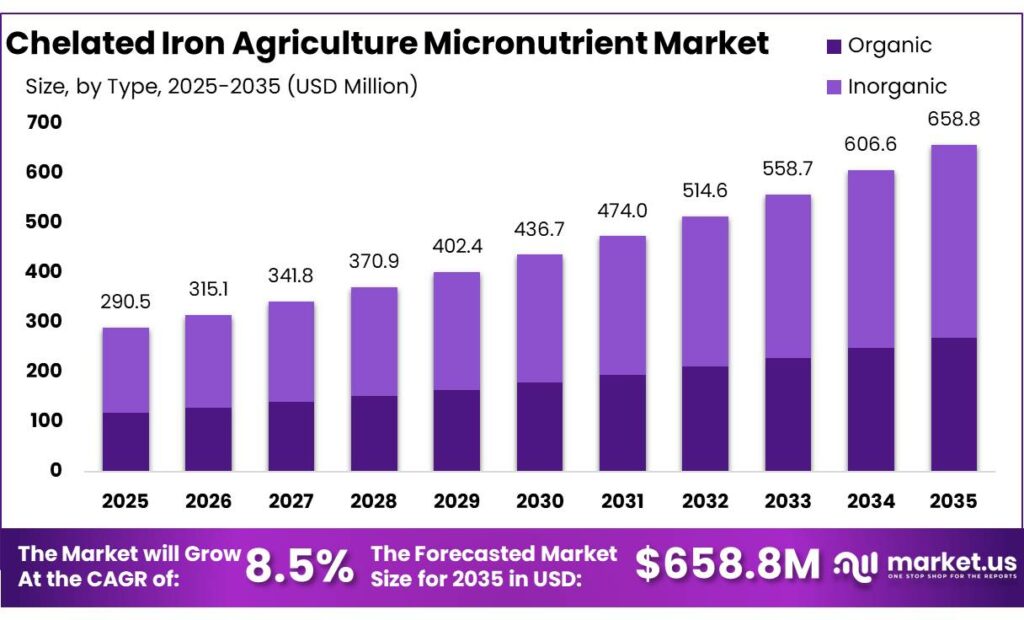
Global Chelated Iron Agriculture Micronutrient Market is expected to be worth around USD 658.8 Million by 2035, up from USD 290.5 Million in 2025, at a CAGR of 8.5% from 2026 to 2035. The North America segment maintained 45.9%, supporting a Chelated Iron Agriculture Micronutrient value of USD 136.2 Mn.
Chelated iron agricultural micronutrients represent a specialized segment within the broader agricultural fertilizer industry, primarily designed to correct iron deficiencies in soils and improve crop productivity. Iron is an essential micronutrient required for plant metabolic processes such as chlorophyll formation, enzyme activation, and photosynthesis. However, although iron is abundant in many soils, its bioavailability to plants can be limited, particularly in alkaline or calcareous soils.
 33% of the world’s soils are moderately to highly degraded due to factors such as nutrient depletion, erosion, and poor soil management practices.
Government initiatives are also accelerating this shift toward nutrient-focused farming. A clear example is India’s Soil Health Card program, which was designed to help farmers understand the nutrient condition of their soils and apply fertilizers more efficiently. The initiative connects farmers with soil testing laboratories and digital tools that provide nutrient recommendations for each field. Programs like this encourage the use of micronutrients when deficiencies are identified, including iron in soils with high pH levels where nutrient availability is limited.
Another factor supporting this trend is the growing recognition that soil micronutrients influence both crop productivity and human nutrition. Scientific research shows that micronutrients play an essential role in plant metabolic processes and overall crop health. When plants lack micronutrients, yields decline and crop quality may also be affected. Because of this, agronomists increasingly promote micronutrient fertilization as part of sustainable farming systems. This includes the use of chelated forms of nutrients, which remain more stable in soil and can be absorbed more efficiently by plant roots.
Drivers
Rising pressure to protect crop yield and quality in iron-deficient, high-pH soils
One major driving factor for the Chelated Iron Agriculture Micronutrient market is the growing need to maintain crop yield and crop quality in soils where iron is present but not easily available to plants. This is a practical farm problem, not a theoretical one. In many alkaline and calcareous soils, crops struggle to absorb iron properly, which leads to chlorosis, weak growth, and lower productivity.
Public agronomy sources show why chelated iron matters here: Utah State University notes that iron chelates containing EDDHA are the only ones that work consistently in soils above pH 7.2, while North Dakota State University states that EDDHA can keep iron soluble up to pH 9.0. A Frontiers study also notes that alkaline soils make up about 30% of the earth’s land surface, which gives this issue a very wide agricultural base. That is one of the clearest reasons demand for chelated iron continues to strengthen in commercial farming.
The demand side becomes even stronger when viewed against food production needs. FAO reported that world fruit and vegetable production reached 2.1 billion tonnes in 2023, up 1% from 2022. FAO also forecasts world cereal utilization at a record 2,943 million tonnes in 2025/26. These numbers matter because fruits, vegetables, cereals, and other field crops all depend on balanced nutrition to sustain output and quality under intensive cultivation.
When growers are expected to produce more food from the same land, they become more willing to use targeted micronutrients that solve a visible deficiency problem. Chelated iron fits that need especially well in high-value crops and in regions where conventional iron sources lose effectiveness in alkaline conditions. In simple terms, the more pressure there is to avoid nutrient-related yield loss, the stronger the case becomes for chelated iron products.
Government-backed nutrient management programs are also helping this market move forward. In India, the government stated in February 2025 that 24.74 crore Soil Health Cards had been generated, ₹1,706.18 crore had been released under the scheme, and 8,272 soil testing laboratories had been established. This kind of initiative supports the use of balanced fertilization because it brings soil testing and nutrient diagnosis closer to farmers.
Once deficiencies are identified more clearly, the use of corrective micronutrients becomes more structured and more frequent. For the chelated iron segment, this matters because its adoption often rises where farmers are made aware of pH-related nutrient lock-up and the limits of ordinary nutrient application. So, the biggest driver is clear: agriculture is being pushed to produce more, with better quality, under tougher soil conditions, and chelated iron offers a direct solution to one of those conditions.
Restraints
High Cost and Limited Affordability of Chelated Iron Products for Farmers
One of the main restraining factors for the Chelated Iron Agriculture Micronutrient market is the relatively high cost of chelated iron fertilizers compared with traditional micronutrient solutions. While chelated iron products are technically effective in correcting iron deficiency in crops, their price often limits large-scale adoption, especially among small and medium farmers.
This cost challenge becomes more visible when looking at how widespread iron deficiency is in agricultural soils. Studies indicate that iron deficiency occurs in about 30% to 50% of cultivated soils worldwide, particularly in alkaline and calcareous soils where iron becomes chemically unavailable to plant roots. In these soils, iron exists mainly in insoluble forms, meaning crops cannot absorb it even when the element is present in the soil.
The economic challenge becomes even clearer in regions dominated by smallholder farming. In countries such as India, China, and Pakistan, calcareous soils are common in several major agricultural belts, and crops grown in these areas often suffer from iron deficiency chlorosis. Research on groundnut cultivation shows that iron deficiency in such soils can reduce crop yield by around 16% to 32%, which directly affects farmer income.
Another practical barrier is the general lack of awareness and soil testing access in some agricultural regions. Soil scientists emphasize that micronutrient deficiencies often remain unnoticed without proper soil testing and nutrient management programs. Reports examining soil fertility in agriculture show that widespread micronutrient deficiencies are already present in many farming regions, including 12.8% iron deficiency recorded in certain soil surveys, indicating that nutrient imbalance is still a widespread issue.
Opportunity
Expanding Horticulture and Protected Farming Increasing Demand for Advanced Micronutrients
One of the strongest growth opportunities for the Chelated Iron Agriculture Micronutrient sector lies in the rapid expansion of horticulture and protected cultivation systems around the world. These farming systems focus on producing high-value crops such as fruits, vegetables, berries, and specialty crops, where nutrient balance directly affects quality, color, and yield. In these systems, micronutrients like iron become especially important because even small deficiencies can reduce plant performance and visual quality.
Research on horticultural crop nutrition highlights that micronutrients play a key role in plant growth, productivity, and the overall quality of fruits and vegetables. Because of this, growers increasingly rely on stable nutrient forms such as chelated iron that remain available to plants even in challenging soil conditions.
Another major area supporting future demand is the expansion of greenhouse and protected farming systems. These systems allow growers to produce crops year-round and improve productivity per unit of land. Research shows that global protected vegetable cultivation already covered about 5.6 million hectares by 2018, with China accounting for nearly 83% of this area. Greenhouse agriculture requires precise nutrient management because plants depend heavily on controlled irrigation and fertigation systems.
Protected cultivation also contributes significantly to global food supply. Studies estimate that protected agriculture produces about 150 million tonnes of horticultural crops worldwide, including vegetables, fruits, and flowers grown in greenhouses and tunnels. This type of farming is expanding in many countries because it helps increase productivity while using less land and water.
Regional Insights
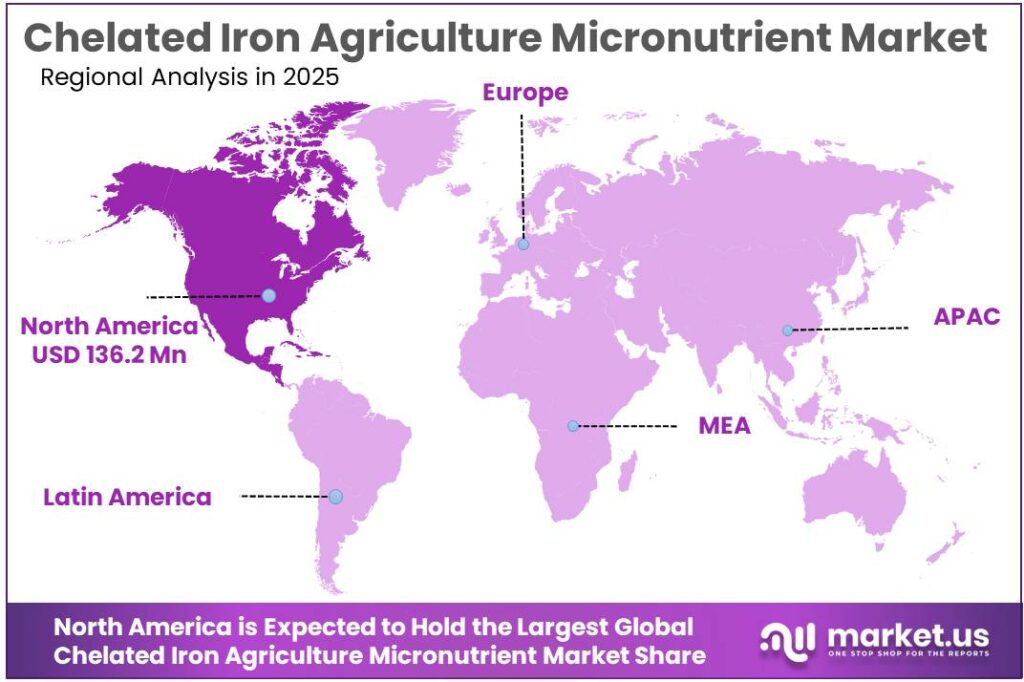
North America dominates the Chelated Iron Agriculture Micronutrient Market with 45.9% share USD 136.2 Mn
North America held a dominant position in the Chelated Iron Agriculture Micronutrient market, accounting for about 45.9% of the global share, valued at nearly USD 136.2 million. The region’s strong presence is mainly supported by highly advanced farming practices, large commercial crop farms, and early adoption of precision agriculture technologies. Countries such as the United States and Canada continue to focus on improving soil fertility and crop productivity, which has increased the use of specialized micronutrients like chelated iron.
Key Regions and Countries Insights
- North America
- US
- Canada
- Europe
- Germany
- France
- The UK
- Spain
- Italy
- Rest of Europe
- Asia Pacific
- China
- Japan
- South Korea
- India
- Australia
- Rest of APAC
- Latin America
- Brazil
- Mexico
- Rest of Latin America
- Middle East & Africa
- GCC
- South Africa
- Rest of MEA
Key Players Analysis
BASF is one of the largest agricultural input companies globally, with strong presence in crop nutrition and micronutrient solutions including chelated iron. In 2024, BASF reported total global sales of €65.3 billion, while its Agricultural Solutions division generated about €9.8 billion in revenue. The company continues to invest heavily in innovation, with a product pipeline expected to generate over €7.5 billion in peak sales potential by 2034. BASF operates in more than 90 countries and focuses on advanced crop protection, seed technologies, and specialty fertilizers to support sustainable farming systems.
Yara International is a global leader in crop nutrition and specialty fertilizers, including micronutrients used in agriculture. The company reported USD 13.9 billion in revenue in 2024 and operates in over 60 countries with around 17,000 employees. Yara supplies a wide range of crop nutrition products, and in 2024 it sold approximately 22.9 million tonnes of mineral fertilizers worldwide. Its portfolio includes specialty nutrient products designed to improve nutrient efficiency and plant health, making it an important supplier of advanced micronutrient solutions in modern agriculture.
AkzoNobel is a multinational chemical company known for coatings and specialty chemicals that also support agricultural applications through chemical intermediates and micronutrient technologies. The company operates in over 150 countries and employs approximately 35,000 people globally. AkzoNobel focuses on innovation and sustainable chemical solutions that support multiple industries, including agriculture. Through its specialty chemical technologies, the company contributes to the development of nutrient stabilization agents and chemical inputs used in fertilizer formulations, supporting modern crop nutrition practices and sustainable agricultural productivity.
Top Key Players Outlook
- BASF
- Yara International
- Syngenta
- Nouryon Chemicals
- Haifa Group
- AkzoNobel
- Grow More Inc
- The Mosaic Company
- Compass Minerals International
- DuPont
Recent Industry Developments
In 2024, BASF reported total global sales of about €65.3 billion, while its Agricultural Solutions segment generated around €9.8 billion in revenue, representing a significant share of the company’s business.
In 2024, AkzoNobel continued to operate as a major global chemical and coatings company that supports several industrial sectors, including agriculture through specialty chemical ingredients used in micronutrient and fertilizer formulations. The company reported total global revenue of about €10.71 billion in 2024, with operating income reaching €917 million and adjusted EBITDA around €1.48 billion, reflecting stable industrial demand across its product portfolio.









