


Report Overview
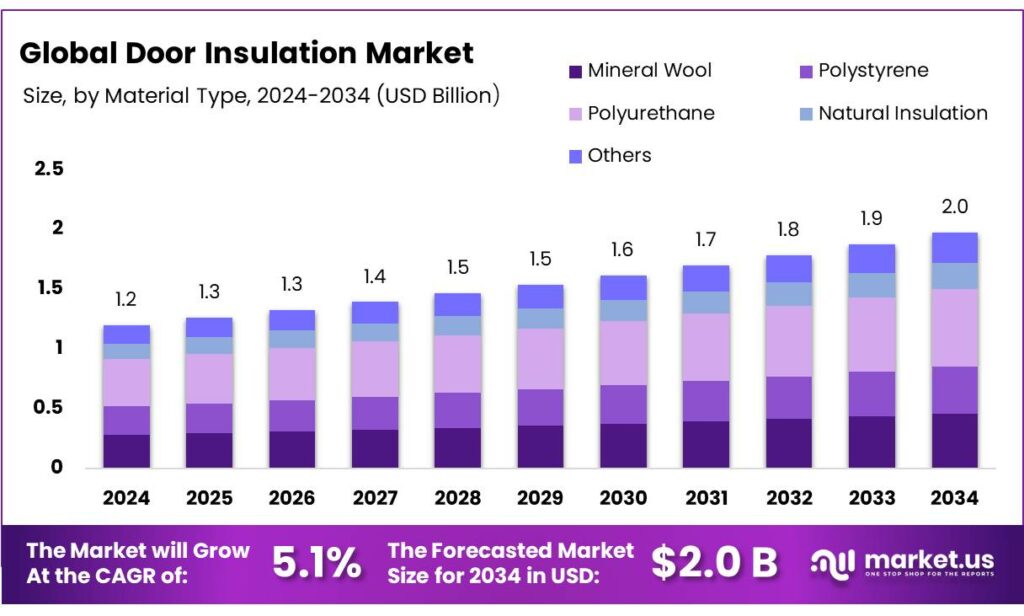
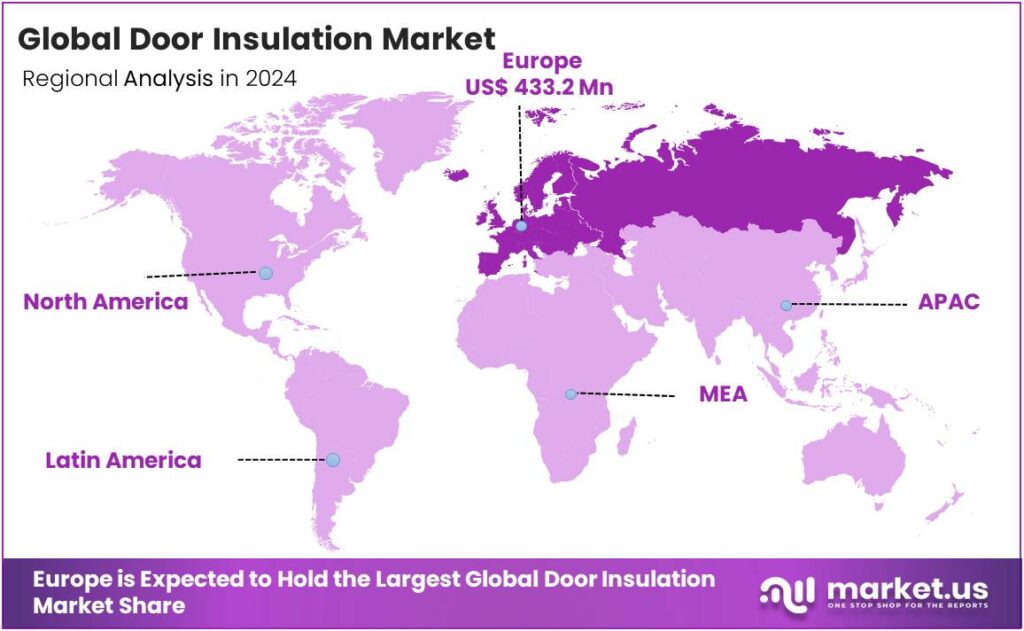
Global Door Insulation Market is expected to be worth around USD 2.0 Billion by 2035, up from USD 1.2 Billion in 2024, at a CAGR of 5.1% from 2026 to 2035. The Europe segment maintained 36.1%, supporting a Door Insulation value of USD 0.4 Bn.
Insulating a door involves installing insulating materials on a door in order to minimize the amount of heat, cold, or sound that is transmitted through the door. The market thrives amid escalating energy costs and stringent efficiency regulations, particularly in Europe, where directives mandate U-values below 1.2 W/m²K, driving adoption of polyurethane foam cores with R-values exceeding 6 per inch that curb heat loss through exterior residential doors.
Similarly, the advancements favor high-performance aerogels and multi-layer weather-stripping over alternatives such as mineral wool, prioritizing thermal over acoustic needs. However, high upfront costs per unit deter some consumers despite few year paybacks through utility savings. Furthermore, the residential sector dominates the market due to code compliance and individual fiscal incentives, outpacing commercial focus on durability and industrial emphasis on wind resistance, underscoring opportunities in sustainable, resilient solutions.
Key Takeaways:
- The global door insulation market was valued at USD 1.2 billion in 2024.
- The global door insulation market is projected to grow at a CAGR of 5.1% and is estimated to reach USD 2.0 billion by 2034.
- On the basis of materials of door insulation, polyurethane dominated the market, constituting 33.1% of the total market share.
- Based on the insulation of door insulation, thermal insulation dominated the market, with a substantial market share of around 73.6%.
- Based on the door type, exterior doors led the market, comprising 42.3% of the total market.
- On the basis of installation methods, new constructions held a dominant position in the market, with 68.9% of the market share.
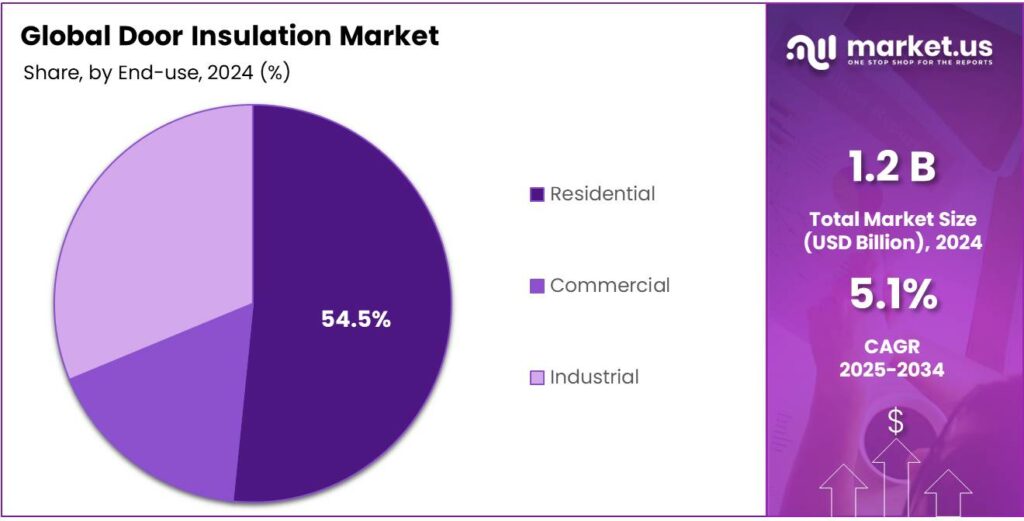
- Among the end-uses, the residential sector held a major share in the door insulation market, 54.5% of the market share.
- In 2024, Europe was the most dominant region in the door insulation market, accounting for 36.1% of the total global consumption.
Material Type Analysis
Catalytic Converters Are a Prominent Segment in the Door Insulation Market.
The door insulation market is segmented based on material type into mineral wool, polystyrene, polyurethane, natural insulation, and others. The polyurethane material led the door insulation market, comprising 33.1% of the market share. Polyurethane predominates as the preferred material for door insulation due to its thermal conductivity of 0.02-0.03 W/m·K, outperforming mineral wool’s 0.03-0.05 W/m·K by up to 30% in heat retention efficiency, enabling thinner profiles that fit constrained door frames.
Mineral wool, while fire-resistant, adds excessive weight, around twice that of polyurethane, complicating door hardware and requiring more thickness for equivalent insulation. Unlike polystyrene, which settles over time and loses effectiveness in humid conditions, polyurethane expands seamlessly via injection, eliminating gaps and boosting air-tightness. In addition, natural options such as cork or sheep’s wool absorb moisture, whereas polyurethane’s closed-cell structure resists water infiltration, ensuring longevity in residential entryways.
Insulation Type Analysis
Thermal Insulation Dominated the Door Insulation Market.
On the basis of insulation type, the market is segmented into thermal insulation and acoustic insulation. The thermal insulation dominated the door insulation market, comprising 73.6% of the market share. Thermal door insulation prevails over acoustic variants due to its direct alignment with universal energy conservation imperatives, where, according to the US Department of Energy, heat gain and heat loss through windows and doors are responsible for 25%-30% of residential heating and cooling energy use.
Regulatory mandates prioritize thermal performance, compelling new constructions to integrate foam cores, achieving R-6 ratings, far outpacing acoustic needs confined to urban dwellings near highways. In addition, many homeowners retrofitting entryways demand utility savings from thermal upgrades instead of soundproofing, underscoring thermal’s broader fiscal and compliance appeal.
Door Type Analysis
Most Door Insulations Are Utilized for Exterior Doors.
Based on the door type, the market is divided into exterior doors, interior doors, and garage doors. The market witnessed substantial dominance from the exterior doors segment, with a notable market share of 42.3%. Exterior door insulation predominates over interior or garage applications due to its critical role in mitigating total building heat loss through exposure to extreme outdoor temperatures and weather infiltration.
Exterior doors seal against wind, rain, and thermal gradients, whereas interior doors face negligible differentials, rendering added insulation redundant for room dividers. Garage doors, while benefiting from sectional insulation achieving heat retention in unheated spaces, prioritize structural durability over thermal upgrades, with very few installations incorporating foam panels per builder guidelines.
End-Use Analysis
The sResidential Sector Held a Major Share of the Door Insulation Market.
Among the end-uses, 54.5% of the total global consumption of door insulation is for the residential sector. Residential door insulation surpasses commercial and industrial applications due to heightened emphasis on individual energy conservation amid rising utility costs. Homeowners prioritize thermal insulation to comply with accessible residential codes such as IECC mandates for U-factors of 0.3 or less for most climate zones, enabling reductions in heating bills during winters.
In contrast, commercial structures deploy larger, high-traffic steel doors with minimal insulation requirements, focusing on fire-rated hardware and ADA compliance over thermal upgrades, while industrial facilities such as warehouses emphasize durable sectional doors. For instance, single-family retrofits often incorporate sealed fiberglass exteriors sealing gaps, while sporadic adoption in office buildings prioritizes ventilation systems.
Key Market Segments:
By Material Type
- Mineral Wool
- Stone Wool
- Glass Wool
- Polystyrene
- Polyurethane
- Natural Insulation
- Others
By Insulation Type
- Thermal Insulation
- Acoustic Insulation
By Door Type
- Exterior Doors
- Interior Doors
- Garage Doors
By Installation Method
- New Construction
- Retrofit / Renovation
By End-Use
- Residential
- Single Family
- Multi Family
- Commercial
- Office Buildings
- Retail Spaces
- Hospitality
- Healthcare
- Others
- Industrial
- Manufacturing
- Warehouse and Distribution
- Flex Space
Drivers
Consumer Demand for Cost Efficiency and Sustainability Drives the Door Insulation Market.
Rising energy costs, exacerbated by global supply chain disruptions and geopolitical tensions, have compelled households and businesses to prioritize thermal efficiency in building envelopes. For instance, in the US, the average price of electricity in 2024 was 16.48 cents, a rapid surge from 13.7 cents in 2021.
Similarly, in Germany, the average electricity price in 2021 was US$0.21 per kWh, while it rose to over US$0.4 per kWh in 2025. Consumers increasingly demand cost sustainability, seeking solutions that minimize long-term utility expenses amid average annual household heating bills surpassing US$135 per month in cold climates such as of the United States.
Door insulation emerges as a critical intervention, with properly sealed doors preventing up to 20% of heat loss through air infiltration. For instance, retrofitting standard wooden doors with polyurethane foam seals in residential settings has yielded reductions in winter heating demands. Similarly, in commercial applications, such as retail warehouses, insulated steel doors equipped with weatherstripping have curtailed cooling loads, enabling facility managers to defer HVAC expansions.
Restraints
High Upfront Costs Might Deter Consumers from Utilizing the Door Insulations.
High upfront costs associated with premium door insulation materials and professional installation services often deter consumers from adopting these energy-saving solutions, particularly among budget-conscious households and small enterprises. Initial expenditures for high-performance insulated doors, incorporating advanced polyurethane cores or fiberglass reinforcements, often range from US$500 to over US$2,000 per unit, excluding labor fees that can add around 30% more.
Additionally, the cost of insulated garage doors depends on size, material, insulation type, and installation. For instance, a standard residential retrofit involving magnetic weatherstripping and thermal breaks on entry doors demands an outlay of approximately US$400, prompting many homeowners to postpone upgrades despite projected payback periods of only a few years through utility savings.
Opportunity
Stringent Regulations Revolving Around Energy Efficiency Create Opportunities in the Door Insulation Market.
Stringent regulations revolving around energy efficiency, such as mandatory building codes requiring minimum R-values for thermal barriers and zero-net-energy standards in new constructions, create substantial opportunities in the door insulation market. For instance, under the UK’s Minimum Energy Efficiency Standards (MEES), property owners face fines up to EUR150,000 for letting commercial properties with substandard Energy Performance Certificate (EPC) ratings (F or G), with penalties escalating based on the duration of non-compliance.
Governments in regions such as the European Union enforce directives mandating that entry doors achieve a U-value of less than 1.3 W/m²K, compelling builders to integrate advanced foam-filled panels that reduce heat transfer by 30-40% compared to uninsulated counterparts. Furthermore, in the United States, there is a federal tax credit for installing energy-efficient exterior doors as part of the Energy Efficient Home Improvement Credit, which covers 30% of the cost, up to US$250 per door, with an annual total limit of US$500 for all doors.
Trends
Adoption of Advanced Door Insulations.
Advancements in door insulation represent a pivotal trend in the sector, emphasizing high-performance materials such as aerogels, advanced foam cores including polyurethane and polyisocyanurate (PIR), and enhanced sealing via multi-layer weather-stripping. For instance, aerogels, with thermal conductivities as low as 0.013 W/m·K, which is 2.5 times that of traditional fiberglass, enable ultra-thin panels that boost R-values per inch to 10 or more, retaining 35% more heat, according to a report by the US Department of Energy.
Similarly, Multi-layer weather-stripping, incorporating silicone bulbs and brush sweeps, lowers energy costs by 30-40%, making it one of the most cost-effective ways to get heating and cooling costs under control. These innovations collectively enhance durability and efficiency, driving adoption in both residential and industrial applications seeking superior thermal barriers. Leveraging the trend, many players are innovating their product offerings. For instance, in July 2023, Kingspan Insulated Panels North America announced the launch of its QuadCore Technology in the region, which achieves an R-value of R-9 per inch for cold storage applications.
Geopolitical Impact Analysis
Geopolitical Tensions Have Affected the Door Insulation Market by Disrupting Major Supply Chains.
The geopolitical tensions, particularly the Russia-Ukraine conflict and attendant energy crises, profoundly disrupted the door insulation sector by inflating raw material costs and accelerating demand for thermal efficiency solutions. For instance, natural gas prices in Europe surged over 400% from pre-conflict baselines, compelling households to opt for door insulation where uninsulated doors accounted for 15-20% of heat loss across countries such as Germany and Poland.
In addition, the supply chain disruptions delayed polyurethane foam deliveries by 40-60 days, prompting manufacturers in Italy and the Netherlands to stockpile resins and innovate with bio-based alternatives that maintained R-values above 6 per inch. Similarly, in the U.S., secondary effects from LNG export diversions raised foam production energy costs and drove commercial retrofits in Midwest warehouses where insulated rolling doors curbed infiltration.
Increased sanctions on Russian timber exports increased wooden door frame prices and cut Russia’s timber exports by over 30%, shifting door projects to fiberglass composites. These disruptions strained logistics and catalyzed resilience through localized sourcing and efficiency upgrades, underscoring the sector’s adaptability amid volatility.
Regional Analysis
Europe Held the Largest Share of the Global Door Insulation Market.
In 2024, Europe dominated the global door insulation market, holding about 36.1% of the total global consumption. The region maintains the predominant position in the global door insulation landscape, propelled by rigorous energy performance mandates and a cultural emphasis on sustainable architecture.
The European Union’s Energy Performance of Buildings Directive enforces minimum U-values of 1.2 W/m²K or lower for residential settings and 1.4 W/m²K or lower for commercial settings, resulting in over 70% of new residential constructions incorporating insulated variants with thermal breaks, with countries such as Finland already hitting nearly 100% adoption in renovations to meet strict U-values.
Similarly, Germany leads in Passivhaus standards, a rigorous German-developed voluntary building benchmark for extreme energy efficiency, comfort, and air quality, requiring exceptional insulation, airtightness, and high-efficiency heat recovery ventilation to achieve nearly zero energy use, becoming a global model for low-energy construction. These factors collectively affirm Europe’s leadership through regulatory enforcement and innovation in high-efficiency solutions.
Key Regions and Countries
- North America
- The US
- Canada
- Europe
- Germany
- France
- The UK
- Spain
- Italy
- Russia & CIS
- Rest of Europe
- APAC
- China
- Japan
- South Korea
- India
- ASEAN
- Rest of APAC
- Latin America
- Brazil
- Mexico
- Rest of Latin America
- Middle East & Africa
- GCC
- South Africa
- Rest of MEA
Key Players Analysis:
Companies in the door insulation sector employ targeted strategies to enhance market shares and boost sales. The players mainly focus on product development by investing in research and development to innovate their product portfolio by introducing high-performance door insulation. In addition, the companies leverage partnerships with builders and retailers to bundle insulation kits with new constructions. Similarly, these players emphasize diversification of their distribution lines. Moreover, the companies focus on geographic expansion to increase their market reach.
The Major Players in The Industry
- Rockwool A/S
- BASF SE
- 3M Company
- Kingspan Group
- Johns Manville
- Saint-Gobain
- Knauf Insulation
- Owens Corning
- Synthos SA
- Soudal Holding N.V.
- Covestro AG
- Selena Group
- Sika AG
- Anco Products
- tesa SE
- Other Key Players
Key Development
- In July 2025, Rockwool collaborated with AJ Manufacturing Inc., a U.S.-based international leader in the design and manufacturing of high-performance door and wall panel products, to introduce Rockwool-insulated door and wall panels for air handling unit (AHU) applications.
- In December 2025, BASF launched WALLTITE RSB, a next-generation, closed-cell spray polyurethane foam insulation, advancing sustainability in construction materials.









