


Report Overview
The Global AI-powered Human Resources Tool Market size is expected to be worth around USD 27.90 billion by 2035, from USD 4.94 billion in 2025, growing at a CAGR of 18.9% during the forecast period from 2025 to 2035. North America held a dominant market position, capturing more than a33.5% share, holding USD 1.65 billion in revenue.
The AI Powered Human Resources Tool Market is expanding as organizations increasingly integrate artificial intelligence into workforce management and talent development processes. AI driven HR platforms support functions such as recruitment, employee engagement, performance evaluation, and workforce analytics. These tools analyze large volumes of employee data to improve hiring decisions, optimize workforce planning, and streamline HR operations.
The major driving force comes from organizations managing growing workforces without increasing HR staff. Companies handle thousands of applications, and AI helps filter candidates faster and more accurately. Studies show about 50% better productivity when AI tools support onboarding and training. Continuous employee feedback through quick surveys also helps managers detect morale issues early and improve workplace engagement.
Another driver is the increasing adoption of remote and hybrid work models. As organizations manage distributed teams across multiple locations, HR platforms must support digital onboarding, performance tracking, and employee engagement monitoring. AI-powered HR tools provide analytics and automation capabilities that help organizations manage remote workforce operations efficiently. For instance, in October 2025, Eightfold.ai launched an update to its talent platform that matches skills from resumes to job openings almost instantly. Busy hiring managers love how it pulls hidden talent from internal pools, speeding up fills for hard-to-staff roles. The tool keeps teams lean while filling seats without endless scrolling through profiles. One restraint affecting the AI-powered human resources tool market is the concern related to employee data privacy and ethical use of AI algorithms. HR platforms often process sensitive personal information including employee performance records, behavioral data, and demographic information. Organizations must ensure that AI systems comply with data protection regulations and maintain transparency in decision-making processes. Another restraint involves the potential bias in AI algorithms used for recruitment and performance evaluation. If training data contains historical biases, AI systems may unintentionally produce unfair recommendations. Organizations must implement monitoring and auditing mechanisms to ensure fairness and accuracy in AI-driven HR decisions. For instance, in February 2026, Workday faced questions after a patch revealed gaps in how employee data flows through its AI modules. HR leaders paused rollouts to tighten consent features, ensuring personal details stay locked down during analytics runs. This move bought time to rebuild trust with cautious workforces wary of leaks. A significant opportunity in the AI-powered human resources tool market lies in the development of intelligent workforce planning solutions. AI platforms can analyze labor market data, internal workforce metrics, and organizational goals to recommend hiring strategies and talent development initiatives. These insights help organizations maintain a competitive workforce and adapt to changing business needs. Another opportunity involves integrating AI HR tools with learning and development platforms. By analyzing employee performance data and skill gaps, AI systems can recommend personalized training programs that support career development and improve workforce capabilities. For instance, in March 2026, IBM unveiled a dashboard in its Watson HR tools that tracks team morale through everyday interactions. Managers use it to spot burnout early and tweak schedules, turning raw data into actionable plans for happier groups. This positions HR as a strategic partner in keeping people engaged long-term. One of the key challenges in the AI-powered human resources tool market is integrating advanced AI platforms with existing HR management systems. Many organizations operate legacy HR software that may not support modern analytics or automation capabilities. Migrating data and integrating new AI tools can require significant technical effort and organizational planning. Another challenge involves ensuring user trust and adoption of AI systems within HR processes. Employees and managers may initially be hesitant to rely on automated recommendations for recruitment or performance evaluation. Organizations must provide transparency and training to ensure that AI tools are accepted as supportive decision-making systems rather than replacements for human judgment. For instance, in September 2025, Pymetrics refined its game-based assessments to better align with varied backgrounds, following studies on trait predictions. Early users note improvements, yet stress the need for human review to catch lingering biases in high-stakes hires. This reflects the tough reality of perfecting AI for equitable decisions. The AI powered Human Resources Tool Market is led by enterprise technology companies that integrate artificial intelligence into talent management, workforce analytics, and employee engagement platforms. SAP, Oracle, Workday, and IBM provide advanced HR platforms that support recruitment automation, workforce planning, and predictive talent analytics. Their solutions are widely adopted by large enterprises seeking to improve hiring efficiency and workforce productivity. Digital recruitment and talent intelligence platforms contribute significant innovation within the market. HireVue, Eightfold.ai, SmartRecruiters, and Phenom provide AI driven candidate screening, video interview analysis, and skills matching tools. These technologies help organizations reduce hiring time while improving candidate evaluation accuracy. Their platforms are increasingly used by multinational companies to streamline high volume recruitment processes. Cloud based HR software vendors and workforce management providers further expand the competitive ecosystem. Adobe, Google, Zoho, BambooHR, and Cornerstone OnDemand deliver platforms that combine HR automation with analytics and employee engagement tools. Additional providers including Ultimate Software, Pymetrics, and Ngage focus on behavioral analytics, workforce insights, and AI driven talent development systems.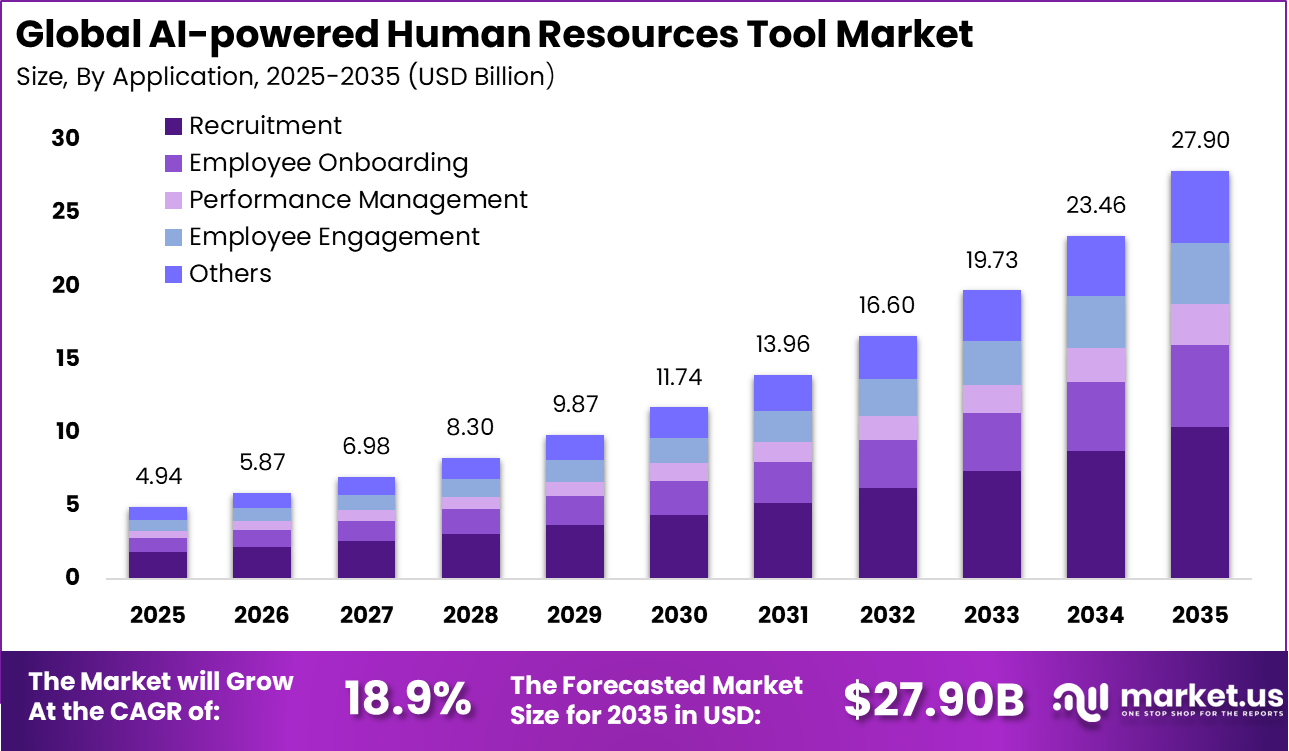
Restraint Analysis
Data Privacy and Ethical Concerns
Opportunity Analysis
Intelligent Workforce Planning
Challenge Analysis
Integration with Legacy HR Systems
Key Players Analysis
Top Key Players in the Market
Recent Developments









