


Report Overview
The Schedule Change Automation Market is witnessing strong growth as organizations increasingly adopt digital tools to manage dynamic workflows, shifting timelines, and real-time operational changes. Schedule change automation solutions help businesses automatically adjust tasks, update timelines, notify stakeholders, and reallocate resources when disruptions occur.
These tools are widely used across industries such as aviation, logistics, healthcare, manufacturing, and project management, where frequent schedule changes can impact efficiency and service delivery. By automating schedule updates, organizations can reduce manual intervention, improve accuracy, and ensure timely communication across teams.
In 2025, the global Schedule Change Automation Market is valued at approximately USD 2.45 billion. The market is projected to expand at a compound annual growth rate of 18.00%, reaching an estimated value of around USD 12.82 billion by 2035. This rapid growth reflects the increasing demand for automation in workflow management and the need for real-time decision-making in complex operational environments.
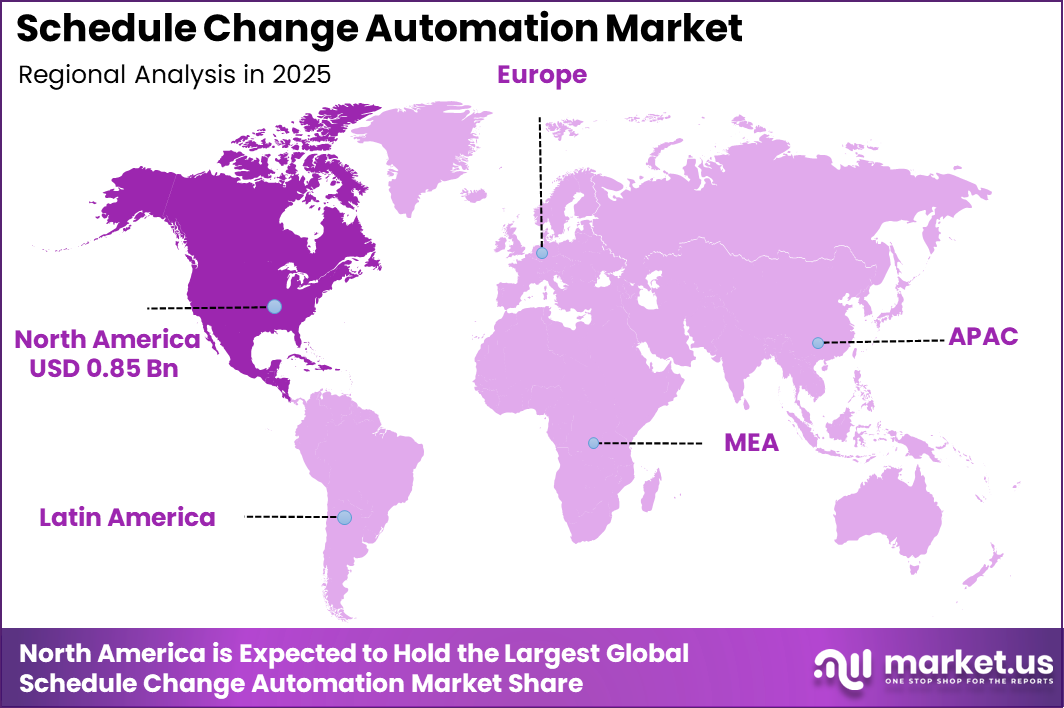
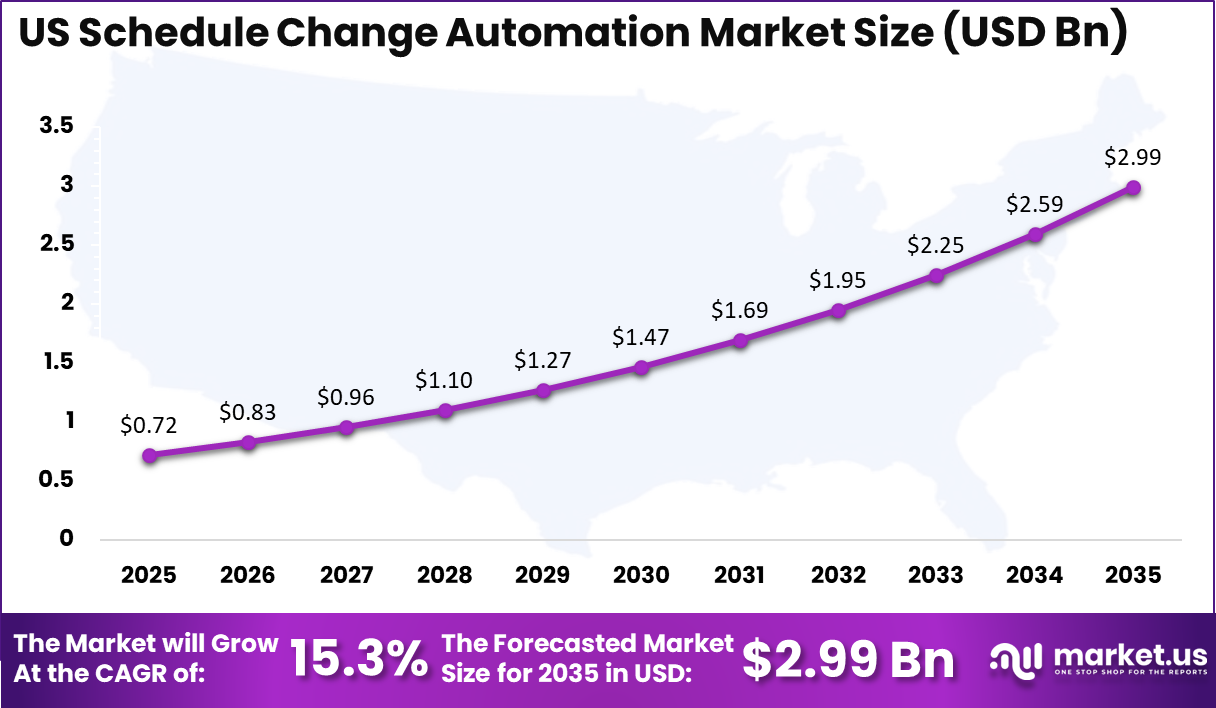
North America holds a leading position in the market with a 34.8% share, generating about USD 0.85 billion in revenue in 2025. The United States accounts for approximately USD 0.72 billion of this value. The US market is expected to reach nearly USD 2.99 billion by 2035, growing at a CAGR of 15.3%, driven by strong adoption of automation technologies across enterprise operations.
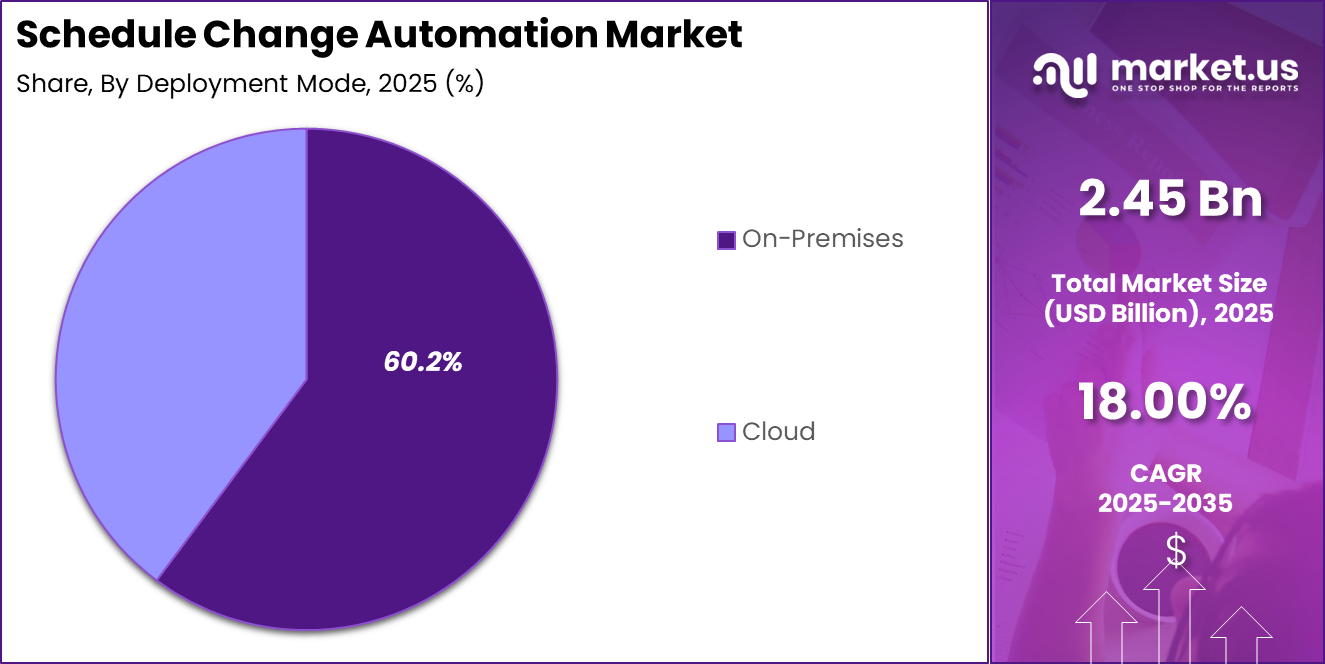
In addition, the growing adoption of remote and hybrid work models is driving demand for flexible scheduling tools. Companies need systems that can adjust work schedules in real time and ensure smooth coordination among distributed teams. As operational environments become more dynamic, the adoption of schedule change automation solutions is expected to increase steadily, supporting long term market expansion. The Schedule Change Automation Market is segmented by component, deployment mode, organization size, application, and end user, each reflecting how businesses adopt automation to manage dynamic scheduling needs. These segments highlight the increasing reliance on digital tools to improve operational efficiency and real-time decision-making. By component, software dominates the market with a share of 75.8%. Software solutions provide the core functionality required to automate scheduling processes, including real-time updates, notifications, and resource allocation. These tools are widely used across industries to reduce manual intervention and improve workflow accuracy. By deployment mode, on-premises solutions account for 60.2% of the market. Many organizations prefer on-premises systems to maintain control over data security and system integration, especially in industries with strict compliance requirements. By organization size, large enterprises hold the largest share at 70.3%, as they manage complex operations and require advanced scheduling automation tools. By application, workforce management accounts for 38.6% of the market, as organizations automate employee scheduling and shift management. By end user, BFSI leads with 35.7%, driven by the need for accurate scheduling in operations, compliance management, and customer service activities. The component segment of the Schedule Change Automation Market includes software and services, with software holding the dominant share at 75.8%. Software solutions lead because they provide the core capabilities required to automate scheduling processes across organizations. These tools enable real-time updates, automated notifications, resource allocation, and workflow adjustments when schedule changes occur. Businesses rely on software platforms to reduce manual effort, improve accuracy, and ensure timely communication across teams. Advanced features such as predictive scheduling, rule-based automation, and integration with enterprise systems further enhance their value in complex operational environments. The services segment supports the implementation and optimization of these solutions. It includes professional services such as consulting, system integration, and training, along with managed services for ongoing maintenance and support. Organizations often require these services to ensure smooth deployment and alignment with existing workflows. Service providers help customize automation tools based on industry-specific requirements and operational needs. As companies continue to adopt digital transformation strategies, both software and supporting services are expected to see steady demand, with software remaining the primary driver of market growth due to its direct impact on operational efficiency. The deployment mode segment of the Schedule Change Automation Market includes on-premises and cloud-based solutions, with on-premises holding the dominant share at 60.2%. Many organizations prefer on-premises deployment because it provides greater control over data, system configuration, and security. This is especially important for industries such as BFSI, healthcare, and government, where sensitive data and regulatory compliance are critical. On-premises solutions allow companies to integrate scheduling automation tools directly into their internal IT infrastructure, ensuring better customization and alignment with existing systems. These solutions are often used by large enterprises that manage complex workflows and require stable, secure environments for scheduling operations. Cloud-based deployment is gaining momentum as organizations seek flexibility and scalability. Cloud solutions enable real-time access to scheduling systems from multiple locations, making them suitable for remote and hybrid work environments. They also reduce the need for upfront infrastructure investment and allow faster implementation. Cloud-based tools often support automatic updates, integration with other cloud applications, and easier collaboration across teams. As digital transformation continues, adoption of cloud deployment is expected to increase, although on-premises solutions remain important for organizations prioritizing security and control. The organization size segment of the Schedule Change Automation Market includes small and medium enterprises and large enterprises, with large enterprises holding the dominant share at 70.3%. Large organizations manage complex operations involving multiple departments, locations, and large workforces, which increases the need for efficient scheduling systems. These enterprises frequently deal with dynamic changes in staffing, project timelines, and operational workflows. Schedule change automation tools help them manage these complexities by enabling real-time updates, automated notifications, and efficient resource allocation. This reduces manual errors and ensures smooth coordination across teams. Large enterprises also have the financial capability to invest in advanced automation technologies and integrate them with existing enterprise systems such as ERP and workforce management platforms. These tools support large-scale operations by improving visibility and control over scheduling processes. Small and medium enterprises are also adopting schedule automation solutions as they seek to improve efficiency and reduce operational delays. SMEs often prefer cost-effective and scalable solutions that can support their growing business needs. As digital adoption increases across organizations of all sizes, the use of schedule change automation tools is expected to expand steadily in both segments. The application segment of the Schedule Change Automation Market includes workforce management, project management, transportation and logistics, healthcare, education, and other sectors. Workforce management holds the largest share at 38.6%. Organizations rely on automated scheduling tools to manage employee shifts, attendance, and task assignments efficiently. These solutions help businesses quickly adjust schedules in response to absenteeism, demand fluctuations, or operational changes. Automated notifications and real-time updates improve coordination among teams and reduce scheduling conflicts, making workforce management a key area of adoption. Project management is another important application, where schedule automation helps track timelines, allocate resources, and adjust deadlines when project conditions change. In transportation and logistics, automated scheduling systems are used to manage route planning, delivery timelines, and fleet operations, ensuring timely service despite disruptions. Healthcare organizations use these tools to manage staff rosters, patient appointments, and emergency scheduling needs. In education, institutions apply scheduling automation for class timetables, faculty allocation, and exam planning. Other sectors also benefit from these tools by improving workflow efficiency and reducing manual scheduling efforts. As industries continue to handle dynamic operations, adoption across these application areas is expected to grow steadily. The end user segment of the Schedule Change Automation Market includes BFSI, healthcare, retail, manufacturing, IT and telecom, education, and other industries. BFSI holds the largest share at 35.7%. Financial institutions operate in highly dynamic environments where scheduling accuracy is critical for transaction processing, customer service, compliance tasks, and workforce management. Automated scheduling tools help banks and financial organizations manage employee shifts, system operations, and service availability in real time. These solutions reduce manual errors, improve operational efficiency, and ensure the timely execution of tasks across departments. Healthcare is another key segment, where scheduling automation is used to manage staff rosters, patient appointments, and emergency workflows. In retail, businesses use these tools to align employee schedules with customer demand and seasonal fluctuations. Manufacturing companies rely on scheduling automation to coordinate production cycles, maintenance schedules, and workforce allocation. In IT and telecom, these tools help manage project timelines, service operations, and technical support schedules. The education sector uses automation for class scheduling and resource planning. Other industries also adopt these solutions to improve workflow efficiency. As operational complexity increases across sectors, the demand for schedule change automation tools is expected to grow steadily. North America holds a leading position in the Schedule Change Automation Market, accounting for approximately 34.8% of the global share. The regional market reached around USD 0.85 billion in 2025, reflecting strong adoption of automation technologies across enterprises. Organizations in North America operate in highly dynamic environments where schedules frequently change due to operational demands, customer expectations, and external factors. This has increased the need for automated tools that can manage schedule updates in real time and improve coordination across teams. The region benefits from a strong presence of technology companies, software developers, and enterprise solution providers that focus on workflow automation and digital transformation. Industries such as BFSI, healthcare, logistics, and IT services are major adopters of schedule change automation tools, as they require efficient management of workforce schedules, project timelines, and service operations. These tools help organizations reduce manual errors and enhance productivity. In addition, the growing adoption of cloud computing and remote work models in North America supports market expansion. Businesses are increasingly investing in solutions that provide flexibility, scalability, and real-time access to scheduling systems. As organizations continue to prioritize efficiency and automation, the demand for schedule change automation tools in the region is expected to grow steadily. The United States Schedule Change Automation Market generated approximately USD 0.72 billion in revenue and represents the largest share within North America. The demand for schedule automation tools in the US is driven by the need to manage dynamic workflows across industries such as BFSI, healthcare, logistics, and information technology. Organizations in the country handle complex operations that require frequent adjustments in employee schedules, project timelines, and service delivery. Manual scheduling processes often lead to delays and inefficiencies, which is encouraging businesses to adopt automated solutions that can update schedules in real time and improve coordination. The market is projected to reach around USD 2.99 billion by 2035, growing at a compound annual growth rate of 15.3%. This strong growth is supported by the increasing adoption of digital transformation strategies and automation technologies across enterprises. Companies are investing in tools that enhance operational efficiency, reduce errors, and ensure timely communication of schedule changes. The integration of cloud-based platforms and advanced analytics is further improving the effectiveness of scheduling systems. In addition, the widespread adoption of remote and hybrid work models in the United States is increasing the need for flexible scheduling tools. As organizations continue to prioritize efficiency and real-time decision-making, the adoption of schedule change automation solutions is expected to grow steadily across the US market. The Schedule Change Automation Market is driven by the increasing need for real-time workflow management across industries. Businesses operate in dynamic environments where schedules frequently change due to operational demands, customer requirements, and external disruptions. Manual scheduling processes often lead to delays and errors, which affect productivity. Automation tools help organizations update schedules instantly, notify stakeholders, and reallocate resources efficiently. The growing adoption of digital transformation strategies is also supporting demand, as companies seek to streamline operations and reduce manual intervention. In addition, the expansion of remote and hybrid work models has increased the need for flexible scheduling solutions that can manage distributed teams effectively and ensure smooth coordination. The Schedule Change Automation Market is driven by the increasing need for real-time workflow management across industries. Businesses operate in dynamic environments where schedules frequently change due to operational demands, customer requirements, and external disruptions. Manual scheduling processes often lead to delays and errors, which affect productivity. Automation tools help organizations update schedules instantly, notify stakeholders, and reallocate resources efficiently. The growing adoption of digital transformation strategies is also supporting demand, as companies seek to streamline operations and reduce manual intervention. In addition, the expansion of remote and hybrid work models has increased the need for flexible scheduling solutions that can manage distributed teams effectively and ensure smooth coordination. One of the key restraints in the Schedule Change Automation Market is the high initial cost associated with implementing advanced automation systems. Small and medium enterprises may find it challenging to invest in such solutions due to budget limitations. Additionally, integrating schedule automation tools with existing enterprise systems can be complex and time-consuming. Organizations may face compatibility issues or require customization, which increases implementation efforts. There is also resistance to change among employees who are accustomed to traditional scheduling methods. Concerns related to data security and system reliability can further slow adoption, especially in industries where sensitive information is involved. These factors can limit market growth in certain segments. Several trends are shaping the Schedule Change Automation Market as digital work environments evolve. One major trend is the increasing adoption of cloud-based scheduling solutions that provide real-time access and scalability. These platforms allow users to manage schedules from multiple devices and locations. Another trend is the integration of artificial intelligence, which helps predict schedule changes and optimize resource allocation automatically. Organizations are also focusing on user-friendly interfaces and mobile accessibility to improve adoption among employees. In addition, there is a growing demand for systems that offer automated notifications and seamless integration with communication tools. These trends are helping transform scheduling processes into more efficient and intelligent systems. The competitive landscape of the Schedule Change Automation Market is characterized by the presence of large enterprise software providers and specialized automation vendors competing to deliver efficient workflow solutions. Major players include companies such as IBM, Oracle, SAP, ServiceNow, and Microsoft, which offer integrated automation platforms as part of broader enterprise software ecosystems. These companies focus on combining scheduling automation with workflow orchestration, cloud services, and artificial intelligence to enhance operational efficiency. Their strong market presence is supported by widespread enterprise adoption and continuous investment in digital transformation technologies. In addition to large vendors, specialized providers such as BMC Software, Redwood Software, Stonebranch, and SMA Technologies focus specifically on workload automation and scheduling solutions. These companies compete by offering advanced features such as real-time scheduling, predictive analytics, and multi-cloud integration. The competitive intensity is increasing as more organizations adopt automation tools. Around 36% of organizations already use workflow automation software, while nearly 50% of business leaders plan to expand automation adoption, indicating strong future demand. Competition is driven by innovation, scalability, and integration capabilities. Vendors are focusing on cloud-based deployment, low-code platforms, and AI-driven scheduling systems to gain a competitive edge. As enterprises continue to automate complex workflows, competition among providers is expected to intensify further.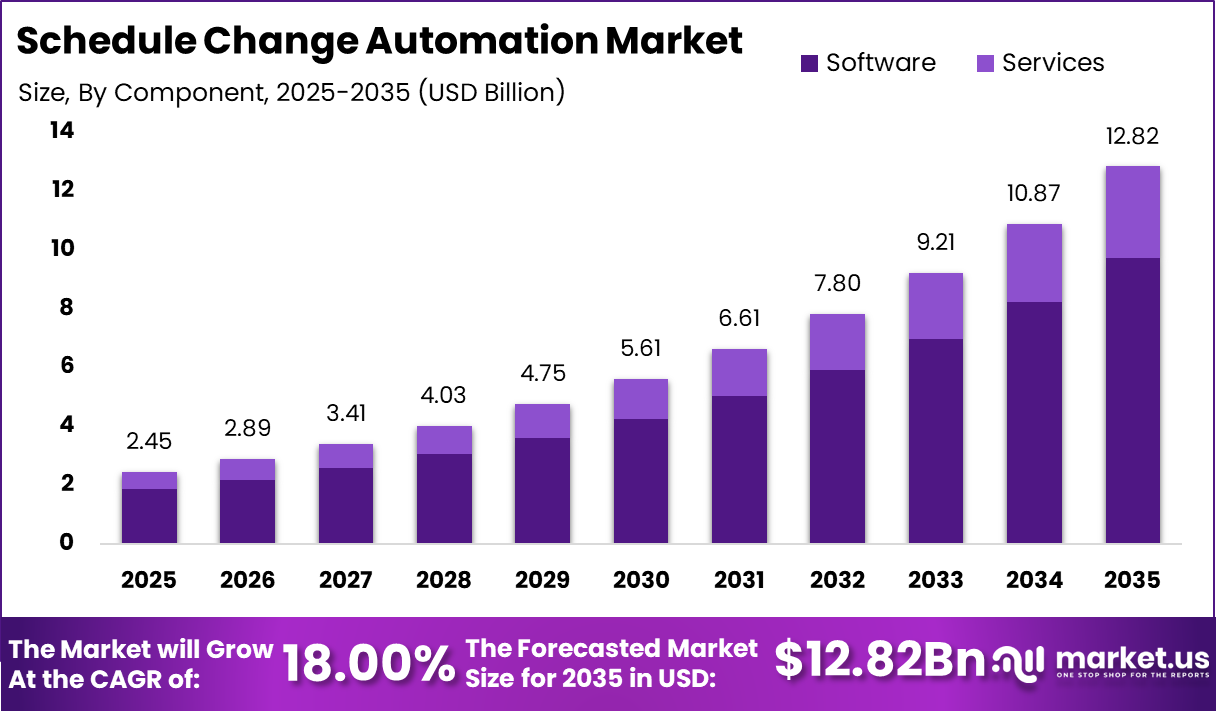
Key Market Segments
Research-Based Segments
By Component
By Deployment Mode
By Organization Size
By Application
By End-User
By Component
By Deployment Mode
By Organization Size
By Application
By End-User
Regional Analysis
US Market Size
Regional Analysis and Coverage
Driving Factors
Restraint Factors
Growth Opportunities
Trending Factors
Competitive Analysis
Top Key Players in the Market
Recent Developments









