By blending the distinct strengths of Hai Phong and Hai Duong, the new administrative unit can fully leverage its competitive advantages. While Hai Duong was an important center for both industry and agriculture production, Hai Phong plays a crucial role in national defense, industrialization, and economic modernization, serving as a key hub for industry, trade, and logistics.
This consolidation combines historical significance with a strategic transformation to drive the next stage of development in the Red River Delta.
After the merger: A larger, unified administrative and economic footprint
The post-merger Hai Phong City covers a total area of 3,194.72 km² and has a combined population of over 4.7 million, making it one of Vietnam’s largest municipal economies in terms of both population and land area.
Early implementation results show faster administrative procedures, higher on-time project deployment rates, and stronger coordination between city and district agencies, supporting industrial and urban growth. After seven consecutive years ranked among the top 10 nationwide, Hai Phong rose to first place in the Provincial Competitiveness Index (PCI) in 2025, marking a significant milestone in the city’s governance and business-environment reform efforts.
Hai Phong now leads the national rankings across four major governance and sustainability indicators, including:
- Provincial Competitiveness Index (PCI);
- Public Administration Reform Index (PAR Index);
- Satisfaction Index of Public Administrative Services (SIPAS) 2024; and
- Provincial Green Index.
Category | Key information |
Merger scope | Hai Phong City and Hai Duong Province |
Total area | 3,195 km² |
Current population | Over 4 million people |
Administrative structure | 114 commune-level units (67 wards, 45 communes, 2 special zone) |
GRDP | US$29.4 billion |
GRDP per capita | US$7,944.5 |
Newly licensed investment projects | 37 projects; US$3.09 billion total capital |
State budget revenue | US$7.21 billion |
Key infrastructure projects |
|
Strategic planning and special support
To support Hai Phong’s transformative growth, Vietnam’s National Assembly approved Resolution No. 226/2025/QH15 in June 2025. Effective July 1, 2025, this resolution introduces pilot special mechanisms and policies to unlock the city’s development potential and boost its competitiveness nationally.
Enhanced investment management authority
- The People’s Committee of Hai Phong is empowered to approve investment decisions for large port and marine infrastructure projects with a capital of VND 2.3 trillion (US$88.85 million) or more without needing prior Prime Minister approval.
- The city can also adjust investment approvals for such port-related projects that were previously sanctioned at the central level.
- These procedures follow provincial investment approval standards, shortening administrative timelines for major logistics and port developments.
Retained local revenue from inland transport infrastructure
- Hai Phong will retain 100 percent of the fee and charge revenues collected from national inland waterways and inland ports within its territory.
- The city is authorized to use these funds, alongside state budget and other lawful financing, to invest in, maintain, and operate inland waterways and inland port systems, strengthening the logistics base for industrial and export activities.
Free Trade Zone with superior incentives
- Resolution 226 mandates the establishment of a Hai Phong Free Trade Zone (FTZ) with enhanced policy instruments designed to attract FDI and global firms, including:
- Preferential corporate income tax rates (expected within the FTZ framework);
- Visa exemptions and long-term temporary residence permits (up to 10 years) for foreign experts, scientists, highly skilled personnel, and their immediate families;
- Simplified investment and business procedures tailored to international investors.
- The FTZ is positioned as a strategic platform for export-oriented industries and international trade expansion.
Preferential tax and residence incentives for talent
- Resolution 226 includes a 10-year personal income tax reduction (50 percent) for experts, scientists, specialists, managers, and highly skilled workers with salary income in approved industrial and economic zones (including the FTZ).
- Visa and residency policy flexibility is also extended to family members, making Hai Phong more attractive for foreign professionals and global talent mobility.
Financial and budget authority
- The city can borrow through local government bonds and other financing channels (domestic and re-lent foreign loans) up to a defined limit tied to retained budget revenue, enabling more proactive capital mobilization for infrastructure and industrial development (subject to legal limits).
Infrastructure and industrial ecosystem highlights
Having witnessed Haiphong’s development over the past seven years, I believe that compared with other localities in Vietnam, the city is uniquely positioned to become a safe haven for investors. Whether in new industrial parks emerging from the merger of Hai Duong and Haiphong or in the new free trade zone, the opportunity is clearly there.
The momentum is further reinforced by the rollout of mega infrastructure projects: the rapid expansion of Lach Huyen Port, the development of the Hai Phong–Hanoi–Lao Cai railway, and major upgrades to North–South economic corridor” – Bruno Jaspaert, CEO of DEEP C Industrial Zones
Hai Phong’s competitive edge continues to rely on its multi-modal transport infrastructure and strategic function as a gateway connecting northern Vietnam to both domestic and international markets.
The city’s transport network, covering sea, road, rail, inland waterways, and air, is being developed in a coordinated manner, with transportation prioritized to strengthen Hai Phong’s logistics, industrial, and export potential.
Seaport system
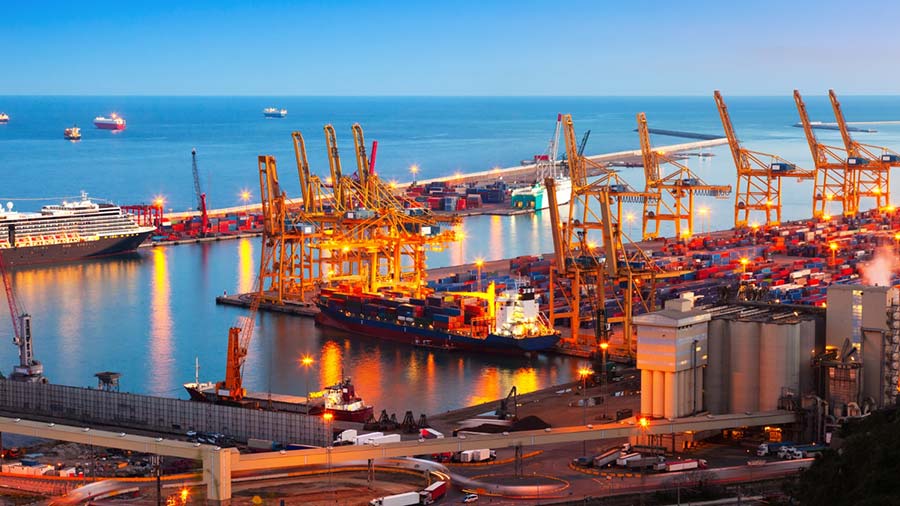
Hai Phong is home to one of Vietnam’s most advanced deep-water port systems. Key highlights include:
- Lach Huyen International Port: With six deep-water berths now in operation, including berths 3 through 6 brought into service in 2025, the port can handle some of the largest container vessels in the global fleet. This has contributed to Hai Phong Port’s ranking among the world’s top 30 busiest container ports.
- Nam Dinh Vu Port: Supports additional capacity in container handling (over 600,000 TEU annually) and bulk cargo, strengthening the seaport complex.
- Nam Do Son Port: Planned as a future international transshipment hub to further enhance the city’s maritime throughput and logistics reach.
Land connectivity
Hai Phong’s land transport connectivity continues to improve through significant infrastructure investments aimed at easing movement within the city and strengthening links with regional markets:
- Hanoi – Hai Phong Expressway (CT.04): A controlled-access highway connecting Hai Phong with Hanoi and key economic corridors, supporting efficient cargo flows to the capital region.
- Road expansion and new interchanges: The city is actively investing in urban and regional road projects, including bypass roads, ring roads, arterial routes, and major bridge projects. These help unlock industrial zones, improve traffic flow, and reduce bottlenecks.
- Strategic future corridors: Hai Phong has outlined key transport projects for 2026-2030, such as a part of the Ninh Bình – Hai Phong Expressway (CT.08), connections with coastal routes, and extra city bypass links, all aimed at boosting regional connectivity and economic growth.
Air cargo and airport expansion
Cat Bi International Airport serves as Hai Phong’s principal aviation gateway, handling both domestic and international passenger flights, and laying the groundwork for increased air cargo capacity. Key ongoing developments include:
- Passenger Terminal T2 expansion;
- Enlarged aircraft aprons; and
- A dedicated cargo terminal facility under construction to support logistics and freight growth.
Industrial land and cluster development
Hai Phong continues to build out industrial and logistics clusters that leverage its location and transport advantages:
- The Dinh Vu – Cat Hai Economic Zone remains the city’s core industrial land bank (22,540 ha), focusing on export-oriented manufacturing and port-linked production.
- Expansion projects in the southern coastal zone, including multi-thousand-billion-dong industrial developments, are underway to modernize infrastructure, attract investors, and support sectoral diversification.
FDI profile and sectors likely to benefit
Export growth and trade orientation
The merged city continues to operate a robust, export-driven economy, underpinned by deep-water port infrastructure, expressway connectivity, and integrated industrial zones that enable efficient access to global markets. In 2025, Hai Phong recorded strong economic momentum, with export turnover reaching approximately US$50.14 billion, reaffirming its position as a leading export hub in northern Vietnam.
This performance is reinforced by the city’s logistics capacity, with cargo throughput at seaports totaling 238 million tons, strengthening Hai Phong’s competitiveness in international trade and port-linked manufacturing.
FDI in manufacturing and technology
Foreign direct investment in Hai Phong continues to be concentrated in manufacturing and technology-intensive sectors, with a strong presence of export-oriented projects located in industrial zones and the Dinh Vu – Cat Hai Economic Zone.
Investment attraction priorities emphasize:
- High-tech manufacturing, including electronics and supporting industries;
- Large-scale, capital-intensive projects with strong export orientation; and
- Technology-driven production, aligned with the city’s broader goals for industrial upgrading and value-chain integration.
Hai Phong’s manufacturing profile is anchored by major multinational investors, most notably LG, Pegatron, USI, and Bridgestone, which have committed multi-billion-dollar investment projects in the city’s industrial zones. These projects play a central role in shaping Hai Phong’s position within global electronics and manufacturing supply chains, while generating spillover demand for supporting industries and logistics services.
The city’s FDI structure reflects a continued focus on export manufacturing, high-tech production, and large anchor investors, positioning the city to benefit from supply chain realignment and sustained demand for port-connected industrial locations.
Key industrial parks of Hai Phong
DEEP C Industrial Zones (Hai Phong I, II, III)
DEEP C Industrial Zones in Haiphong serve as a leading industrial center built on an eco-industrial park model, aimed at promoting sustainable long-term industrial growth. This hub includes DEEP C Haiphong 1, 2, and 3, located within the Dinh Vu – Cat Hai Economic Zone, collectively covering over 1,700 hectares, with DEEP C Haiphong 2 and 3 situated inside the Haiphong FTZ.
The hub enjoys direct access to major transport infrastructure such as:
- Lach Huyen deep-water port;
- Cat Bi International Airport;
- Lao Cai – Hanoi – Haiphong railway;
- Hanoi–Haiphong Expressway; and
- Haiphong – Ha Long – Van Don – Mong Cai Expressway.
The hub is suitable for a wide range of industrial and logistics activities, including:
- Strategic industries (new materials, automotive, electronics, semiconductors, and renewable energy);
- Supporting industries (high-precision mechanics, automation, and spare parts for high-tech industries); and
- Logistics and port-related services (including bonded warehousing and smart logistics linked to Lach Huyen port).
VSIP Hai Phong Industrial Park
VSIP Hai Phong represents one of the city’s largest integrated industrial–urban developments, with a total planned investment of approximately US$1 billion across 1,600 hectares. Of this, 500 hectares are designated for clean industrial production, while 1,100 hectares are allocated to urban development.
- Location: Dinh Vu–Cat Hai EZ, Tan Duong Commune, Thuy Nguyen District
- Operation term: 2008–2058
Nam Dinh Vu Industrial Park
Nam Dinh Vu is a strategically positioned coastal industrial park covering 1,329 hectares within the Dinh Vu–Cat Hai Economic Zone. Notably, it is the only industrial park in Vietnam with an internal seaport (Nam Dinh Vu Port) capable of accommodating vessels up to 40,000 DWT, supported by a 300-meter turning basin.
Its gateway location provides direct access to Hai Phong’s maritime transport network.
- Location: Dong Hai 2 Ward, Hai An District
- Operation term: 2009–2059
Trang Due Industrial Park
Developed in three phases (187 ha, 214 ha, and 652 ha), Trang Due Industrial Park spans 1,088 hectares. The park has attracted major multinational investors, notably LG Group, and has emerged as a high-tech manufacturing hub.
- Location: Le Loi Commune, An Duong District
- Operation term: 2011–2061
- Operation term: 2008–2058
Industrial park | Land area | Infrastructure | Targeted sectors |
DEEP C Haiphong 1 | 541 ha | Fully occupied eco-industrial park within Dinh Vu – Cat Hai EZ; integrated utilities; direct access to Lach Huyen deep-water port, Cat Bi International Airport, Hanoi–Haiphong Expressway, and railway network | General manufacturing, chemicals, petrochemicals, high-tech industries |
DEEP C Haiphong 2 | ~645 ha | Operational eco-industrial park located within Haiphong Free Trade Zone; established infrastructure; dense tenant ecosystem; strong connectivity to port, airport, expressways, and rail | Semiconductors, electronics, automotive, new materials, high-tech components, renewable energy equipment |
DEEP C Haiphong 3 | ~520 ha | Operational with phased land availability; completed roads, power, water supply, and wastewater treatment plant; located within Free Trade Zone | Automotive assembly, bonded warehousing, smart logistics, international distribution centers, supporting industries |
VSIP Hai Phong Industrial Park | 1,600 ha | Master-planned industrial–urban complex (500 ha industrial, 1,100 ha urban); completed core infrastructure; stable utilities; located in Dinh Vu–Cat Hai EZ | Clean manufacturing, electronics, supporting industries |
Nam Dinh Vu Industrial Park | 1,329 ha | Coastal industrial park with internal Nam Dinh Vu Port (up to 40,000 DWT); full utilities; strong maritime logistics integration | Logistics, petrochemicals, port-based industries, heavy industry |
Trang Due Industrial Park | 1,088 ha | Phased modern infrastructure; established high-tech production cluster anchored by multinational investors (e.g., LG); stable technical utilities | Electronics, high-tech manufacturing, supporting industries |
Ready-built factory and warehouse options
Northern Vietnam’s seaport-adjacent industrial corridor, anchored by Hai Phong, continues to draw manufacturers and logistics operators looking for ready-built factory (RBF) and ready-built warehouse (RBW) solutions. These developments provide quick deployment timelines, high technical standards, and strong connections to deep-sea ports, expressways, and international airports.
Core5 Hai Phong Phase 2
Located within the DEEP C Industrial Zones, Core5 Hai Phong Phase 2 provides approximately 80,676 square meters of ready-built factory and warehouse space across 17 factory blocks.
Key features:
- Flexible unit sizes supporting diversified manufacturing operations
- Modern industrial standards with reliable power and water supply
- Internal road systems designed for heavy vehicle access
- Strategic proximity: 5 km to Dinh Vu and Lach Huyen ports; 12 km to Cat Bi International Airport; 125 km to Hanoi
- Expected handover: Q4 2026
Tenants benefit from DEEP C’s established eco-industrial ecosystem and integrated logistics infrastructure.
Core5 Hai Phong Phase 3
Core5 Phase 3 will deliver approximately 84,037 square meters of ready-built factory space, offering both single-storey and mezzanine configurations.
Key features:
- LEED-aligned green building design
- Integrated technical services and 24/7 security
- Close access to Dinh Vu and Lach Huyen seaports
- Approximately 60 km from Hanoi CBD and 25 km from regional airport infrastructure
- Expected handover: Q1 2027
BW Industrial RBFs and RBWs
BW Industrial is recognized as one of Vietnam’s premier developers specializing in logistics industrial spaces available for lease. The company provides flexible premises and tailored solutions to enterprises at various stages of their development. Its land portfolio encompasses 1,020 hectares distributed across 60 projects situated in ten principal provinces throughout Vietnam.
In the Hai Phong region specifically, BW Industrial has five RBFs/RBWs accessible for rental, with an additional two currently under development.
Project Name | Location | Key Advantages | Land Area | Status |
BW Deep C 1 | Deep C2B, Dinh Vu – Cat Hai EZ, Hai An, Hai Phong | Adjacent to Lach Huyen Deep Sea Port; Easy access to Hanoi – Hai Phong Hwy & Cat Bi Airport. | 6.7 ha | Available |
BW Nam Dinh Vu ESR | Nam Dinh Vu IP (Zone 1), Dinh Vu – Cat Hai EZ, Hai Phong | Tax incentives (EZ); EPE (Export Processing Enterprise) friendly; Near Lach Huyen Port. | 12.1 ha | Available |
BW Nam Dinh Vu | Nam Dinh Vu IP (Phases 1 & 2), Hai An, Hai Phong | Strategic port proximity; Connectivity to Hanoi – Hai Phong Hwy; Tax incentives. | 49.8 ha | Available |
BW VSIP Hai Phong | VSIP Hai Phong, Thuy Nguyen, Hai Phong | Low labor costs; Access to Hai Phong Port & Cat Bi Airport; BW Commercial Center nearby. | 5.9 ha | Available |
BW VSIP Hai Duong | Cam Dien – Luong Dien IP, Cam Giang, Hai Duong | Regional minimum wage (Zone 3); Strategic midpoint between Hanoi and Hai Phong. | 42.6 ha | Available |
BW Nam Dinh Vu Phase 4 | Nam Dinh Vu IP, Hai Phong | Strategic expansion in a major industrial hub. | 12.2 ha | Q2, 2025 |
BW Nam Dinh Vu Phase 3 | CN10-02, Nam Dinh Vu IP, Hai Phong | Quick access to deep-sea logistics. | 5.8 ha | Q1, 2025 |
Expert’s take: Bright industrial outlook for post-merger Hai Phong
Following the July 2025 administrative merger with Hai Duong province, Hai Phong has emerged as a massive economic subdivision encompassing over 3,100 square kilometers and a population of 4.6 million. This expansion provides the critical mass needed to support a proposed free trade zone and the new South Economic Zone, both central to the city’s manufacturing and export growth.
The strategic shift is supported by Resolution No. 59-NQ/TW, a Politburo directive issued in early 2025, which prioritizes proactive international integration to move Vietnam toward a US$1 trillion economy. By integrating Hai Duong’s industrial land bank with Hai Phong’s deep-sea port infrastructure, the city has created a unified ecosystem that reduces logistics bottlenecks for northern manufacturing clusters.
Current indicators suggest that the city is no longer just a transit point but a primary driver of national resilience. Paul Tonkes, Industrial Deputy Director of Indochina Kajima Development, said the city’s trajectory toward becoming the nation’s dominant maritime gateway is now a reality.
“Hai Phong becoming Vietnam’s largest port in five years is starting to be very tangible right now,” Tonkes said. “Between the Hai Phong FTZ and the new South Economic Zone, the city’s status as a critical gateway is a lock – merger or not.”
Tonkes noted that the city serves as a “frontline instrument” for Vietnam’s global standing.
Hai Phong is not just a port, but a frontline instrument for Vietnam’s international standing and closing in on the 1 trillion USD economy. I expect that Resolution 59 helps to move the needle toward an independent, resilient economy and proactive international integration; even if these are currently on-paper promises, there are players in Hai Phong capable of turning them into operational reality” – Paul Tonkes, Industrial Deputy Director of Indochina Kajima Development