The US Supreme Court has ruled that reciprocal tariffs imposed under the International Emergency Economic Powers Act (IEEPA) are unlawful. For Vietnam-invested businesses, this creates short-term uncertainty and longer-term trade management considerations, as a new 10 percent tariff has been introduced under Section 122 of the Trade Act of 1974, with President Trump seeking to raise it to 15 percent.
On February 20, 2026, the US Supreme Court ruled that the Trump administration lacked statutory authority under IEEPA to impose broad reciprocal tariffs. The decision invalidated key tariff measures but did not automatically unwind all trade restrictions.
The ruling has generated immediate implications for global supply chains and cross-border commerce, particularly for export-oriented economies such as Vietnam.
As bilateral trade negotiations continue and high-level diplomatic engagement deepens, businesses in Vietnam must assess how evolving US trade enforcement mechanisms could affect pricing, compliance, investment planning, and long-term market access.
What happened?
The US Supreme Court ruled against two tariff measures that President Donald Trump’s administration pursued in a sweeping manner, with the IEEPA being the legal basis.
What are Trump’s IEEPA tariff measures?
The IEEPA, enacted on December 28, 1977, is a US federal law that grants the president the authority to respond to an unusual and extraordinary threat from abroad that targets U.S. national security, foreign policy, or the economy.
Citing the law, the Trump administration implemented five corresponding tariff measures, including:
- Reciprocal tariffs;
- Fentanyl tariffs;
- Russian oil tariffs;
- Brazil tariffs; and
- Trade deals negotiated with foreign countries pursuant to IEEPA.
Rulings of the US Supreme Court on February 20, 2026
Under the latest ruling, the court ruled that the following tariffs are illegal:
- The reciprocal tariffs imposed to match the value of trade barriers set by other countries; and
- The 25 percent tariff on some goods from Canada, China, and Mexico for the supposed failure to curb the flow of fentanyl into the US.
The reasoning behind the court’s ruling is:
- The IEEPA does not expressly authorize the president to impose tariffs.
- Although IEEPA permits emergency measures such as embargoes and asset freezes, tariffs are not listed among the authorized tools.
The Supreme Court ruling introduces legal clarity in one sense, but commercial uncertainty in another. While it narrows the president’s ability to sustain sweeping tariffs indefinitely, companies that reshaped supply chains over the past year are now reassessing whether those moves were durable adjustments or temporary reactions to policy shock. That ambiguity is already weighing on capital deployment, particularly for manufacturing projects with multi-year timelines. At the same time, firms need to remain clear eyed that uncertainty itself is becoming the baseline, and delaying projects indefinitely in hopes of policy clarity is not a viable long term strategy” – Dan Martin, Co-head of Business Intelligence, Dezan Shira & Associates
Corresponding actions by the US government
Although the ruling did not automatically invalidate the tariffs, it has triggered immediate executive actions:
- Issuance of an Executive Order terminating the IEEPA tariffs: In response to the Supreme Court’s decision, the aissued an executive order terminating the collection of additional ad valorem duties that had been imposed under IEEPA, directing federal agencies to end those tariff actions as soon as practicable.
- Continuation of suspension on US de minimis treatment: Alongside the new surcharge, a separate executive order maintained the suspension of duty-free de minimis treatment, meaning low-value imports still are subject to duties.
- US Customs stops collecting ‘illegal’ tariffs: The US Customs and Border Protection agency announced it will cease collecting tariffs imposed under the IEEPA starting at 12:01 a.m. EST on Tuesday, February 24, 2026. In a message to shippers via its Cargo Systems Messaging Service (CSMS), the agency stated it will deactivate all tariff codes linked to previous IEEPA-related orders from the given date onward. It also noted that the collection halt does not affect any other tariffs imposed by Trump, including:
- Tariffs under the Section 232 national security statute; and
- Tariffs under the Section 301 unfair trade practices statute.
The new global surcharge under Section 122
One day after the ruling, President Trump said he would raise the “10 percent worldwide tariff” to 15 percent, effective immediately. The administration is now invoking Section 122 of the Trade Act as the legal basis for the move, which permits the swift imposition of tariffs of 10 percent but limits their duration to 150 days.
The proclamation also outlines the exceptions for the surcharge, including:
- Section 232 primacy: Products already covered by Section 232 tariffs, such as steel, aluminium, copper, lumber, and automobiles, are not subject to the surcharge if the 232 tariff applies;
- USMCA preferences: Articles that enter duty-free under the USMCA remain exempt from the surcharge;
- CAFTA-DR textiles: Textile and apparel products imported duty-free under the Dominican Republic-Central America Free Trade Agreement are also exempt; and
- Annex II exceptions: Around 1,100 product codes are exempt from the surcharge under Annex II.
Implications of the latest US tariff developments
Increased uncertainty for global trade
The Supreme Court’s decision striking down broad tariffs imposed under the IEEPA, though celebrated by many, has introduced uncertainty in how US trade policy will be shaped going forward. Many companies are unsure whether tariffs may be reintroduced under different legal authorities or remain subject to change.
Possibility of refund claims but no clear process visible
Although the ruling invalidates tariffs collected under IEEPA, the court did not provide explicit guidance on how refunds should be processed, leaving businesses to pursue lengthy legal action to reclaim duties paid.
Firms that paid IEEPA-based tariffs may be able to seek refunds, but must navigate complex US legal proceedings to do so, thereby increasing administrative and compliance costs.
Continuation of trade frictions through alternative statutes
The US administration has indicated it will continue using other legal authorities, such as the Trade Act of 1974, to impose global tariffs, which may temporarily replace those invalidated, maintaining pressure on global trading partners.
Even after the court’s decision, exporters may still face 15 percent global tariff rates under new US measures, potentially affecting competitiveness in the American market.
Impact on existing and future trade agreements
The ruling impacts bilateral and multilateral trade deals negotiated under the previous tariff regime as partner countries reassess agreements amidst legal challenges and changing US policy.
In Vietnam’s context, Vietnam’s bilateral trade negotiations with the US or changes in tariff commitments could be influenced, prompting Vietnamese businesses and policymakers to monitor developments closely and possibly renegotiate terms.
Market and supply chain volatility
Businesses worldwide are facing volatility due to uneven tariff application, legal challenges, and shifting policies. This environment may slow investment, disrupt supply chains, and increase operational risk.
Vietnamese supply chains that integrate with US imports and exports may see delays or cost shifts as global companies adjust to ongoing tariff ambiguity and plan alternative routes or partners.
Many multinational firms now face a second round of supply chain evaluation. Initial diversification decisions were made under tariff pressure, while current reassessments are being driven by policy unpredictability. This creates demand for more granular scenario analysis across locations, costs, and compliance exposure rather than single country relocation strategies” – Dan Martin, Co-head of Business Intelligence, Dezan Shira & Associates
Reinforced the role of congressional authority over trade policy
By limiting executive use of emergency powers for broad tariff imposition, the ruling re-establishes Congress’s role in defining tariff authority, potentially leading to more deliberative, but slower, trade policy formation.
Legal clarity around trade policy authority could benefit Vietnamese stakeholders in the long run by providing a more structured negotiation process, though short-term adjustment costs may remain.
How Vietnam secures its positions amid recent developments
High-level diplomatic engagement strengthening bilateral relations
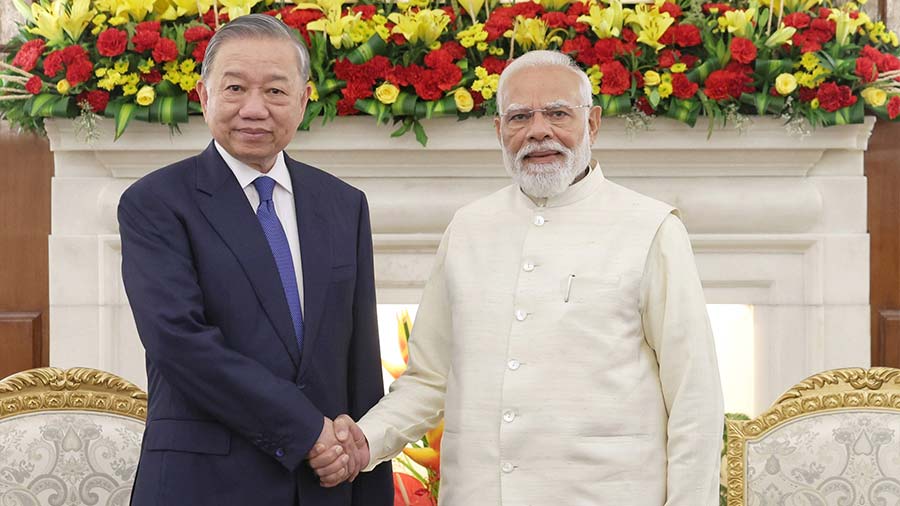
Vietnam’s Party General Secretary To Lam visited Washington, D.C., from February 18-20, 2026, to attend the inaugural meeting of the Board of Peace for Gaza, where he met with US leaders, including President Donald Trump. The trip reaffirms the US view of Vietnam as a key partner and promotes cooperation in digital transformation, telecommunications, aviation, and investment.
About US$37.2 billion in agreements were signed to enhance connectivity and economic ties.
Progress on export control list removal
The US government has agreed to remove Vietnam from its strategic export control lists (D1–D3), easing restrictions on high-tech and dual-use technologies and signaling growing strategic trust between Hanoi and Washington.
Ongoing negotiations toward a trade agreement
Vietnam and the US continue negotiations on a trade agreement aimed at fostering balanced market access and deeper economic integration, with both sides expressing commitment to finalizing the terms in the near future.
Expansion of science, technology, and digital cooperation
High-level Vietnamese officials engaged US partners on enhancing cooperation in science, technology, digital transformation, and the semiconductor industries. This is a key focus for advancing Vietnam’s industrial upgrading and integrating into global high-tech value chains.
Strategic considerations for businesses
As tariff regimes become less predictable, location decisions are increasingly comparative exercises across Southeast Asia and India rather than binary China plus one moves. Companies are looking at infrastructure readiness, supplier ecosystems, and regulatory predictability side by side, which elevates the importance of structured multi-country benchmarking in investment planning” – Dan Martin, Co-head of Business Intelligence, Dezan Shira & Associates
While the US Supreme Court’s ruling reshapes the legal basis of certain tariffs, it does not eliminate trade risk. For companies in Vietnam with US exposure, whether exporters, manufacturers, or foreign-invested enterprises, the priority should now shift from reacting to headlines toward strengthening strategic preparedness and operational resilience.
Recommended strategic actions:
- Reassess US market exposure: Conduct a tariff impact review across product lines, customers, and supply chains to quantify continued exposure under the 15 percent global surcharge and other US trade measures.
- Stress-test pricing and margin structures: Review transfer pricing models, export pricing, and long-term supply contracts to ensure margins remain sustainable under fluctuating tariff scenarios.
- Review contractual risk allocation: Examine Incoterms, tariff clauses, force majeure provisions, and change-in-law clauses to determine where tariff burdens legally fall.
- Evaluate refund feasibility: For businesses that paid IEEPA-based tariffs, assess whether pursuing refunds in the US is commercially viable given legal costs and administrative complexity.
- Continue to diversify export markets: Reduce overconcentration on the US market by accelerating access to alternative destinations under Vietnam’s FTAs (e.g., CPTPP, EVFTA, RCEP).
- Strengthen customs and trade compliance systems: Ensure HS classification accuracy, origin documentation integrity, and internal audit readiness amid heightened US trade scrutiny.
- Monitor bilateral negotiations and policy signals: Closely track Vietnam–US trade discussions, export control developments, and sector-specific measures that may affect high-tech, digital, or strategic industries.
- Integrate tariff risk into strategic planning: Treat trade policy volatility as a structural variable in board-level planning, investment decisions, and capital allocation.
For Vietnam-based businesses, resilience will depend less on predicting US policy shifts and more on building adaptive commercial, legal, and compliance frameworks that can absorb ongoing trade uncertainty.
This article was first published February 23, 2026. It was last updated February 27, 2026.