The US has implemented a new executive order, on July 31, 2025, that maintains existing rates for Vietnamese imports while imposing modified reciprocal tariffs on other countries. This framework, which came after extensive trade negotiations, offers a mixed bag of implications for Vietnam’s exporters as they navigate the competitive landscape against regional peers.
On July 31, 2025, US President Donald Trump signed a new executive order imposing additional tariffs, ranging from 10 to 41 percent, on imports from 68 countries and the EU. While there are many newly announced rates for US trade partners, the rates for Vietnam have stayed the same as previously stated.
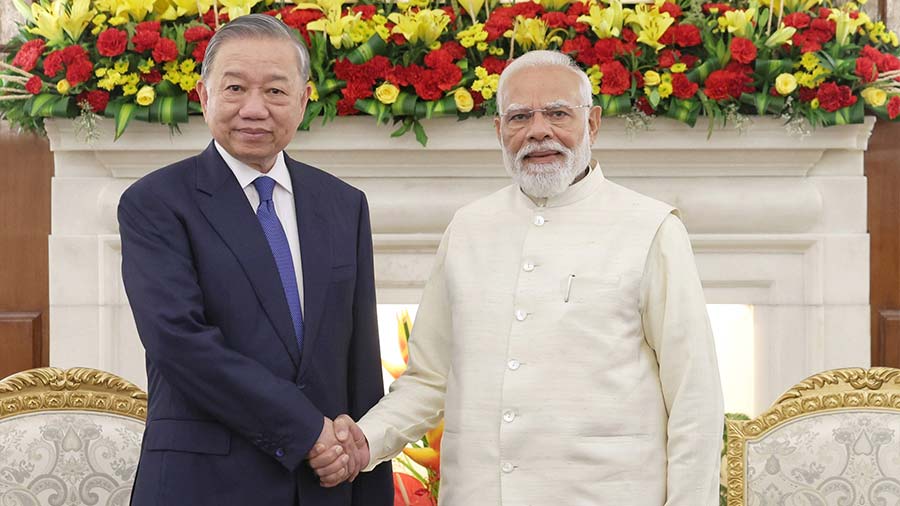
On July 2, 2025, President Trump announced a 20 percent tariff on several of Vietnam’s exports and a 40 percent duty on transshipments from third countries. Before these rates were announced, the US President and Vietnam’s General Secretary To Lam had spoken on the phone.
With the official rates significantly lower than the 46 percent initially threatened, both sides claimed that the trade negotiations, which lasted more than two months, had yielded a win-win result. Vietnam was the third country to announce a tariff agreement with the US, following that of the UK and China.
Key points from the executive order of July 31, 2025
Modified reciprocal tariff rates and the harmonized tariff schedule
There are two annexes attached to the executive order.
Annex I, which prescribes the modified reciprocal rates by country or territory
It will replace the older set of percentage-based import taxes on goods from certain countries with new rates.
Accordingly, around 40 countries will pay a 15 percent tariff rate, which is the tariff floor for those who export more to the US than they import from the country. Meanwhile, a 10 percent tariff rate will be applied to imports from countries with which the US has a trade surplus. This rate will be effective with respect to goods entered for consumption, or withdrawn from the warehouse for consumption, from August 7, 2025.
Annex II, which prescribes the modified US Harmonized Tariff Schedule
These are product-specific tariffs effective with respect to goods entered for consumption, or withdrawn from the warehouse for consumption, from August 7, 2025.
Effective dates of the new schedules
The tariffs from both annexes will take effect on August 7, 2025, to give US Customs and Border Protection (CBP) enough time to implement the necessary changes for collecting the new duties.
Reciprocal tariff exceptions
In alignment with Executive Order 14257, issued on April 2, 2025, a number of product categories are exempt from the application of reciprocal tariff rates outlined in the latest executive action. Key exclusions include:
- Section 232 Tariff Exemptions: The following categories already subject to Section 232 measures are excluded:
- Steel and aluminum articles and their derivatives;
- Automobiles and auto parts; and
- Semi-finished copper and copper-intensive derivatives.
- Transit Exemption for items in Annex II: Goods are exempt if they meet both of the following conditions:
- Loaded onto a vessel at the port of loading and in transit on the final mode of transit before 12:01 a.m. (ET) on August 7, 2025; and
- Entered for consumption, or withdrawn from warehouse for consumption, before 12:01 a.m. (ET) on October 5, 2025.
This exemption does not apply to goods subject to the 10 percent baseline reciprocal tariff.
- Annex II Product Exemptions: Additional exemptions apply to select goods listed in Annex II of the executive order. These include:
- Pharmaceuticals, semiconductors, and critical minerals;
- Energy and energy-related products; and
- Lumber and copper articles.
Transshipment
Under Section 3 of the executive order, any article found by the US CBP to have been transshipped in order to evade applicable duties will be subject to enhanced enforcement measures. Specifically:
- A 40 percent tariff rate will apply to the offending goods, replacing the reciprocal rate otherwise applicable based on the country of origin;
- The importer may face additional fines or penalties, including those authorized under 19 US Code § 1592, which governs civil penalties for customs fraud; and
- The goods will remain liable for all other US duties, taxes, and charges applicable to imports from the actual country of origin.
Furthermore, CBP will not grant mitigation or remission of penalties assessed in such cases, consistent with US law. This underscores a strict enforcement stance against transshipment as a means of tariff circumvention.
Implications of the 20 percent rates for businesses in Vietnam
Overall, experts believe the 20 percent rates for Vietnam can be perceived either as a good or a bad deal for producers and exporters from the country, depending on how they leverage other competitive edges that Vietnam provides.
According to Dragon Capital, the resolution strengthens Vietnam’s regional competitiveness, offering lower tariff exposure compared to Indonesia (19 percent) and the Philippines (20 percent), while maintaining a significant margin over China’s 55 percent rate. By eliminating a key macroeconomic uncertainty that previously threatened to shave 1.4 to 2 percent off GDP growth, the move reinforces investor confidence and mitigates the risk of capital flight. Although discussions on transshipment classifications are ongoing, the overall framework safeguards Vietnam’s export-oriented growth strategy and solidifies its position as a leading alternative in Asia’s supply chain restructuring.
In addition, Vietnam still offers distinct merits in comparison with many of its regional counterparts, such as:
- Strategically located near China, which facilitates the seamless flow of raw materials and components;
- Developing infrastructure supported by rigorous state policies;
- Numerous incentives which have been or will be put in place in order to promote the development of the private sector, as well as supporting and high-tech industries; and
- An astonishing number of 20 Free Trade Agreements (FTAs) to date. Of these, 16 are currently in force, one FTA with the United Arab Emirates (UAE) has been signed and is pending ratification, and negotiations or exploratory discussions are underway for potential FTAs with Qatar, Saudi Arabia, and other partners.
Country/Territory | April 2, 2025, announced rate | July 31, 2025, modified rate |
|---|---|---|
Bangladesh | 37% | 20% |
Brazil | 10% | 10% |
Brunei | 10% | 25% |
Cambodia | 49% | 19% |
European Union: Goods with Column 1 Duty Rate > 15% | 20% | 0% |
European Union: Goods with Column 1 Duty Rate < 15% | 20% | 15% minus Column 1 Duty Rate |
India | 26% | 25% |
Indonesia | 32% | 19% |
Japan | 24% | 15% |
Laos | 48% | 40% |
Malaysia | 24% | 19% |
Myanmar (Burma) | 44% | 40% |
Philippines | 17% | 19% |
South Korea | 25% | 15% |
Taiwan | 32% | 20% |
Thailand | 36% | 19% |
Vietnam | 26% | 20% |
Impacts of the 20 percent levy on US imports from Vietnam
Despite being significantly lower than the 46 percent rate, the newly announced 20 percent tariff is double the current 10 percent tariff rate that the US imposed on Vietnamese imports on April 21, 2025.
Many experts believe that the new tariff can be seen either as a relief from the earlier threat or as a greater burden to US importers and consumers. Increasing the tariff on Vietnamese goods to 20 percent will raise costs for US importers, potentially leading to pass-down costs for suppliers or higher prices for consumers.
According to CNBC, a 10 percent US tariff on Vietnamese goods would result in an approximate 8 percent increase in the cost of imported men’s sweaters. Meanwhile, under the 46 percent tariff initially imposed by President Trump on Vietnam, the price of such sweaters would rise by approximately 35 percent.
One notion is that, according to Bloomberg, some officials in the US government want tariffs for Vietnam and others in Southeast Asia to be sufficiently lower than those imposed on China, in order to encourage production to leave that country.
Vietnam’s Key Exports to the US, Q1 2025 | ||
Items | Value (US$ billion ) | Proportion |
Total | 31.39 | 100% |
Computers, electrical products, spare-parts and components thereof | 7.47 | 24% |
Machine, equipment, tools and instruments | 5.26 | 17% |
Textiles and garments | 3.78 | 12% |
Telephones, mobile phones and parts thereof | 2.74 | 9% |
Wood and wooden products | 2.13 | 7% |
Toys and sports requisites; parts and accessories thereof | 2.06 | 7% |
Foot-wears | 1.97 | 6% |
How to determine ‘transhipments’ subject to a 40 percent tariff
A 40 percent rate is set to be imposed on goods deemed to be “transshipping,” which has not been supported by guidelines. Experts suggest this targets Chinese-origin goods minimally processed in Vietnam before re-export to the US.
Currently, a key tool for determining transhipments is the Country of Origin Marking on US imports.
General provisions of the Country of Origin Marking
According to the US Customs and Border Protection (USCBP), every article of foreign origin entering the US must be legibly marked with the English name of the country of origin unless an exception from marking is provided for in the law. The marking’s purpose is to inform the final buyer in the US about where the product was manufactured.
The most effective marking integrates with the product itself, such as via branding, stenciling, stamping, printing, molding, or similar techniques. Other marking methods can also be acceptable, provided that they remain legible and visible until the product reaches the final US purchaser. The marking must withstand handling, meaning it should only be defaced, destroyed, removed, altered, obliterated, or obscured through intentional actions.
How country of origin is determined under the regime
USCBP clarifies that the country of origin is where the article is manufactured, produced, or grown. The country of origin of an article may change in a secondary country in one of the following situations:
- Additional work or material is added in the second country, resulting in a substantial transformation. A substantial transformation is when a new article with a different name, character, and use is created.
- For a good from a NAFTA country: if under the NAFTA Marking Rules (19 CFR Part 102), the second country is determined to be the country of origin; or
- For an article considered a textile or apparel product (regardless of whether it is from a NAFTA country),
ifthe country of origin is determined by the general rules in Part 102.21 of 19 Code of Federal Regulations (CFR) to be the second country. To determine if a textile or apparel product is from Israel, the general rules in Part 12.130 of 19 CFR apply.
While waiting for further guidelines from both countries, businesses shall refer to this regime to avoid possible product labels as “transshipment”.
What is next?
Response from China
China is likely to respond to the latest deal. The question is how. Beijing has indicated it would react to deals that harm Chinese interests, and the higher tariff on goods transshipped through Vietnam might be such a response. If China, Vietnam’s largest trading partner and a key source of inputs, retaliates, it could impact Vietnam’s economy. Bloomberg estimates Vietnam could lose 25 percent of its US exports in the long term, risking over 2 percent of its annual Gross Domestic Product (GDP).
Formal content threshold for transshipment avoidance
Neither party’s statements specify a formal threshold for determining transshipment status. Trade analysts anticipate that the US government will enforce a near-zero tolerance standard, potentially flagging goods with as little as one percent Chinese-origin content. Although trade agreements usually define origin through value-added or transformation criteria, no specific origin thresholds have been officially announced for this agreement.
Other clarifications are expected for the agreement’s rules of origin and safe harbors.
If you want to understand how supply chain engineering could help your organization, get in touch with our Business Intelligence team.
(This article was originally published on July 3, 2025. It was last updated on August 1, 2025.)